A hobby metal detector does not identify buried objects by magic or by depth alone. It sends an electromagnetic field from the search coil, measures the response from metal and the surrounding ground, then converts that response into audio, target ID, and other clues. The useful way to understand detector performance is in three layers: the technology processing the signal, the specifications shaping that processing, and the field conditions that decide how much of the signal survives. Once those layers are separated, it becomes easier to judge a machine, interpret a shaky target, and understand why the same setup behaves differently from one site to the next.
How Metal Detectors Work From Coil Signal to Target Response
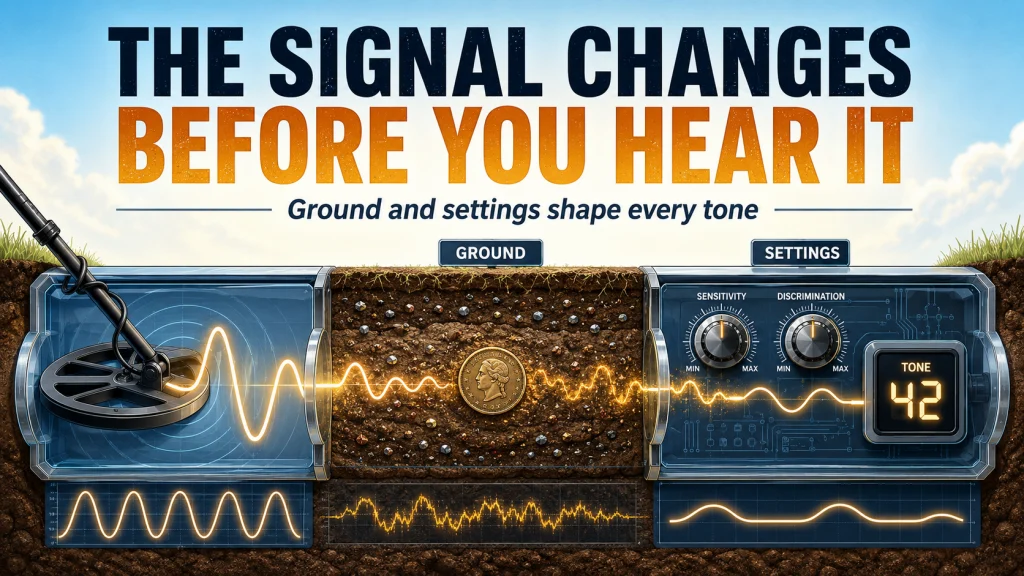
Most people asking how metal detectors work picture a coil passing over a coin and triggering a beep. That description is not wrong, but it skips the part that determines whether the beep is stable, weak, misleading, or absent. The search coil creates a changing electromagnetic field. When that field reaches a conductive or magnetically responsive object, the object changes the signal returning to the detector.
The detector then compares that returned response with what it expects from the ground, the selected mode, and the current settings. Depending on the design, it may examine phase, amplitude, timing, decay, or a combination of those measurements. The control box turns the result into an audible tone, a target ID estimate, a depth indicator, or several clues at once. The machine is not seeing a coin-shaped picture underground. It is measuring an electrical and magnetic response, then classifying that response as well as its processing allows.
After thirty years surveying land and a decade swinging a coil, I have found that this distinction changes how a person evaluates both equipment and field results. A clean target response is not created by the buried object alone. It is the target response after the detector has also dealt with soil, nearby metal, coil position, electrical interference, and the settings chosen by the operator. That is why two targets made from similar metal can sound different, and why two different objects can sometimes land in the same target ID range.
Key point: A detector reports a processed signal, not a guaranteed object identity. Treat the tone and screen as evidence to interpret, not a promise about what is in the hole.
This article stays with hobby metal detecting for US beginners and intermediate users. It does not cover airport screening equipment, industrial inspection systems, professional geophysical surveying instruments, or SCUBA salvage work. The physics may share a family resemblance, but the decisions a hobby detectorist makes are about search-coil technology, settings, terrain, and recoverable targets close enough to matter in a real hunt.

The Garrett Pro-Pointer AT is designed for precise target pinpointing after a detector locates a potential find. It provides three sensitivity levels with quick button adjustment for changing target conditions. Its bright orange body improves visibility while working around a recovery hole.
Check On AmazonIf you click this link and buy, we earn a commission at no additional cost to you.
The Three Layers That Explain Detector Performance
Understanding metal detector technology should give you a decision framework, not a pile of isolated terms. I separate performance into three layers because each answers a different question. Technology explains how the detector sends and processes energy. Specifications explain what controls and design choices shape that process. Field variables explain what happens when the machine leaves the test bench and meets actual soil.
The mistake is treating one layer as if it can answer all three questions. A person may hear that a machine uses multiple frequencies and assume that settles performance in every site. Another may compare two sensitivity scales as if the higher number must reach deeper. A third may blame the detector when a large coil, wet mineralized soil, nearby iron, and electrical noise are all changing the same target response.
| Layer | Question it answers | What it cannot answer alone |
|---|---|---|
| Technology type | How does the machine transmit, receive, and process target and ground signals? | Whether it will be the best choice in every soil, for every target, or for every operator. |
| Specifications and settings | How can frequency, ground balance, discrimination, target ID, and sensitivity change the response? | The final field result without knowing the coil, target, ground, and interference. |
| Depth variables | Why does detection range and signal quality change from one target or site to another? | A universal depth number that applies to all machines and conditions. |
Use the layers in that order when you are comparing equipment or diagnosing a weak result. First identify the signal-processing approach. Then read the relevant specifications in context. Only after that should you judge likely field performance against the target, coil, soil, moisture, mineralization, nearby metal, and electrical environment you expect to face.
Layer One: Technology Changes How the Signal Is Processed
The broad technology families used in hobby detecting do not all ask the ground and target the same question. Single-frequency VLF systems transmit and analyze a continuous signal at one operating frequency. Selectable-frequency systems still use one chosen frequency at a time, but let the operator change that frequency. Simultaneous multi-frequency systems transmit and process more than one frequency together, while pulse induction systems send timed pulses and examine the response after each pulse.
Those differences matter because targets and soils do not respond identically across frequency and time. A small low-conductive target, a larger high-conductive target, wet salt, iron-rich soil, and a patch of electrical noise can each affect part of the signal differently. A technology that handles one difficult condition well may give up something elsewhere, such as target classification detail, sensitivity to a certain target size, separation behavior, or ease of adjustment.
Single Frequency Is Not a Synonym for Basic
A well-designed single-frequency VLF detector can be stable, responsive, and entirely appropriate for many ordinary park, field, and permission hunts. Its strength is not that one frequency is universally superior. Its strength is that the complete system, including the coil, processing, ground handling, recovery behavior, and settings, may fit a defined job without unnecessary complexity.
The common mistake is comparing only the frequency number. A higher operating frequency does not automatically mean more depth, and a lower frequency does not automatically mean every large target will be found farther away. Frequency changes the way a system responds to target conductivity, target size, ground signal, and interference. The final result still depends on the rest of the machine and the site.
Selectable and Simultaneous Multi-Frequency Are Different
A selectable-frequency detector lets you choose one operating frequency for the current problem. That can help move away from interference or adjust the machine toward a different target and ground response. A simultaneous multi-frequency detector processes several frequencies together, using the manufacturer’s signal-processing method to combine or compare them.
Do not reduce that distinction to “more frequencies equals better.” The count of frequencies does not tell you how they are weighted, processed, filtered, or used in a specific mode. It also does not tell you how the coil behaves in dense iron or whether the operator can keep the machine stable in difficult ground. The useful comparison is the whole signal path, not the largest number printed in a feature list.
Pulse Induction Uses a Different Timing Window
Pulse induction designs send strong, brief pulses through the coil and measure how the response decays after each pulse. This approach can handle some mineralized ground conditions differently from conventional VLF systems because it is separating target and ground information through timing rather than relying on the same continuous-wave comparison. That can be a real advantage in the right terrain.
It is not a free advantage. Pulse induction systems may offer less detailed target identification or discrimination than many VLF and multi-frequency designs, and their behavior around small targets, iron, salt, and ground changes depends on the specific engineering. The correct conclusion is not that one technology wins a hunt category. It is that the technology must match the target, terrain, trash level, and amount of signal interpretation the operator is willing to do.
For a deeper comparison of these signal-processing approaches, use the guide to metal detector technology types. That page is the right next step when the technology label itself is the part you need to understand.

The Garrett Viper is a 6 x 11 inch DD search coil for Garrett AT series detectors. The Amazon listing identifies compatibility with the AT Pro, AT Gold and AT Max. It includes a search coil cover and is designed as a maneuverable accessory coil for metal detecting.
Check On AmazonIf you click this link and buy, we earn a commission at no additional cost to you.
Layer Two: Specifications Shape the Information You Receive
Once the technology type is clear, the next layer is the set of specifications and controls that shape the signal. Frequency, ground balance, discrimination, target ID, and sensitivity are often listed side by side, which encourages buyers to compare them as independent scores. They are not independent. Each setting changes what the detector emphasizes, suppresses, or reports.
On permission properties, I have watched the same machine sound settled in open ground and become far busier near an old foundation where soil disturbance, iron fragments, and changing mineral response were all present together. The detector had not suddenly become worse. The signal environment had changed, and several settings now mattered at the same time.
| Specification or control | What it changes | Common beginner mistake |
|---|---|---|
| Operating frequency | Changes how the system responds to target conductivity, target size, ground, and interference. | Assuming one frequency number predicts depth by itself. |
| Ground balance | Reduces the detector’s response to the ground so target responses stand out more clearly. | Treating ground balance as a universal depth booster. |
| Discrimination | Accepts or rejects selected response ranges before they reach the operator as normal target signals. | Rejecting so much that useful targets sharing those response ranges are also silenced. |
| Target ID | Estimates where a response falls on the detector’s conductivity and magnetic classification scale. | Reading the number as a guaranteed object label. |
| Sensitivity | Changes how strongly the detector responds to weak signals and background noise. | Running it at maximum even when instability hides more than the added gain reveals. |
Ground balance is a good example of why the interaction matters. Its job is to reduce the response produced by mineralized or conductive ground. When it is poorly matched to the soil, the detector may chatter, lose stability, or give a weak target less contrast against the background. A better balance can improve usable performance, but it does not create a fixed amount of extra depth.
Discrimination and target ID are also easy to confuse. Target ID is an estimate based on the measured response. Discrimination is a decision rule that accepts or rejects parts of that response range. If a gold ring and a piece of aluminum overlap electrically, the detector cannot know which one the operator values. Raising discrimination may reduce trash signals, but it can also silence desirable targets that occupy the same range.
Sensitivity causes a similar problem. More sensitivity can make weak responses more audible, but it can also magnify ground noise, electrical interference, coil movement, and unstable target responses. The practical goal is not the highest setting. It is the highest stable setting that preserves repeatable information in the current site.
The detailed guide to metal detector specifications and settings explains how to read these controls without treating any one number as a performance guarantee.

The Bounty Hunter HEAD-PL uses a 1/4-inch stereo plug for connection to compatible detectors. It is listed for Bounty Hunter metal detectors except Junior models. The headphones use padded construction for greater comfort while listening to detector signals.
Check On AmazonIf you click this link and buy, we earn a commission at no additional cost to you.
Layer Three: Field Depth Is a System Result
Questions about how metal detectors detect metals usually lead quickly to depth. That is understandable because depth feels like the simplest performance score. It is also where the most misleading claims appear. Detection range is not a property of the control box alone. It is the result of the detector, coil, mode, settings, target, ground, moisture, mineralization, nearby metal, coil height, sweep quality, and electrical interference working together.
A coin-sized target lying flat can present a different electromagnetic response than the same coin on edge. A larger object may be detectable farther away than a small one, but its apparent depth indicator may also be less accurate if the detector assumes a coin-sized target. A larger coil may cover more ground and respond well to larger or deeper targets in cleaner conditions, yet it can struggle to separate a desirable target from nearby iron. A smaller coil may lose coverage but provide a cleaner look between adjacent objects.
Ground Is Part of the Detection Problem
Soil is not empty space. Its electrical conductivity, magnetic minerals, salt content, moisture, and layering can all change the signal reaching the coil and the detector’s ability to separate a target response from the background. In mild ground, a signal may remain clean enough for the machine to classify. In difficult ground, the same target may become weaker, less repeatable, or less accurate on the screen.
Moisture is not universally helpful or harmful. It can improve electrical coupling in some soils and worsen conductive ground effects in others. The useful question is not whether wet ground is better. It is whether the current soil, mineral content, salt level, and detector technology produce a cleaner or noisier target-to-ground contrast after the rain.
Interference and Sweep Control Change Usable Depth
Power lines, radio transmitters, electric fences, buried cables, generators, and nearby detectors can introduce electromagnetic interference. Raising sensitivity in that environment may increase noise faster than it increases useful target information. Frequency shift, noise cancel, a lower sensitivity setting, or simply moving away from the source may produce a more repeatable response.
Coil control matters for the same reason. Lifting the coil at the end of a swing changes the distance to the ground and target. Striking stubble or moving the cable can create extra signals. Sweeping too quickly or too slowly for the selected mode can change how the processor separates adjacent responses. These are not advanced tricks. They are basic reasons a machine that air-tests well may disappoint in the field.
Field Note: When a target response changes, I first ask what changed around the signal before I blame the detector. Moving from open pasture toward disturbed ground, iron debris, or a utility line can alter the entire response even though the machine and target have not changed.
Use a Complete Test Description
A depth claim is useful only when the test conditions are attached to it. At minimum, a technical example should identify the detector, search coil, operating mode, target material, target size, target orientation, and ground condition. Sensitivity, ground balance method, mineralization, moisture, nearby metal, and interference should also be stated when they affect the conclusion.
- Name the detector technology and operating mode.
- Identify the coil size and coil type.
- Describe the target material, size, and orientation.
- State whether the test was in air, a test bed, or undisturbed ground.
- Describe soil mineralization, moisture, salt, trash, and interference when relevant.
- Report whether the response was repeatable audio, stable target ID, or only a faint threshold change.
That checklist prevents a faint one-way signal in mild test soil from becoming a universal claim. It also helps you compare two reports without pretending they measured the same thing. The guide to metal detector depth and field variables goes further into why target range changes and how to interpret depth claims responsibly.

This Garrett PROformance accessory is a 9 x 12 inch search coil for the AT Series. The listing identifies it as a concentric elliptical search coil from Garrett Metal Detectors. Its larger coil format makes it directly relevant when comparing how search coil size changes a detector setup.
Check On AmazonIf you click this link and buy, we earn a commission at no additional cost to you.
A Practical Decision Path for Reading Detector Claims
When a specification or performance claim catches your attention, do not ask only whether it is true. Ask what layer it belongs to and what information is missing. A technology claim should explain the transmit and processing method. A specification claim should explain what the setting changes. A depth claim should describe the complete test conditions.
This decision path works before a purchase and after a difficult hunt:
- Identify the claim. Is it about technology, a setting, target identification, or depth?
- Find the operating condition. What target, soil, coil, mode, and interference level does the claim assume?
- Look for the trade-off. What becomes less convenient, less stable, less selective, or harder to interpret?
- Match it to your hunt. Decide whether the claimed advantage solves the terrain and target problem you actually have.
- Reject unsupported certainty. If the claim gives a universal result without conditions, treat it as incomplete.
For example, “high frequency finds small targets” is a starting point, not a buying conclusion. You still need to know the target conductivity, ground mineralization, coil, processing, and whether the site is clean or full of adjacent iron. Likewise, “pulse induction handles mineralized ground” does not tell you how much target classification you will have or whether that trade-off suits a trashy permission property.
The same logic applies after you already own a detector. If a target ID is jumpy, do not immediately change five settings. Check repeatability from multiple directions, coil height, nearby metal, ground response, and interference first. One test should answer one question. Otherwise, you can make the machine quieter without learning which condition caused the problem.
Final Thoughts: Read the Whole Signal Path
A metal detector is best understood as a signal-processing system working in imperfect ground. The coil energizes the search area, the target and soil respond, and the detector tries to separate and classify those responses. Technology determines how that information is collected, specifications determine how it is shaped, and field conditions determine how much useful information reaches you.
The next time a feature list promises more depth, better identification, or superior ground handling, place the claim in the correct layer. Then ask what target, coil, mode, soil, and trade-off sit behind it. That habit will do more for your decisions than memorizing a frequency number or treating a target ID as a label on the buried object.
Explore the Three Parts of Detector Performance
Use these guides in sequence when you need more detail. Start with the signal-processing approach, move to the controls and specifications, then study the field variables that change detection range.
| Guide | What it helps with |
|---|---|
| Metal Detector Technology Types | Separates single-frequency VLF, selectable frequency, simultaneous multi-frequency, and pulse induction by how they process target and ground signals. |
| Metal Detector Specifications Explained | Shows how frequency, ground balance, discrimination, target ID, sensitivity, and related controls affect practical use. |
| Metal Detector Depth Explained | Connects coil, target, soil, moisture, mineralization, settings, and interference to changing field depth. |
Together, the three guides give you a complete way to judge performance without relying on one technology label, one specification, or one unsupported depth number.
FAQs
🧲 How does a metal detector work when metal is under the coil?
The coil creates a changing electromagnetic field. A metal object changes that field by producing its own conductive and magnetic response, which the detector receives and processes into audio or visual information.
🔢 Can a metal detector tell exactly what the object is?
No. Target ID estimates a response range based on electrical and magnetic behavior. Different objects can overlap in the same range, especially when depth, orientation, corrosion, soil, or nearby metal changes the signal.
📡 Is multi-frequency always better than single frequency?
No technology is automatically best in every site. Multi-frequency can provide useful ground and target information across several frequencies, while a well-matched single-frequency system may still perform very well for a defined target and terrain.
⏱️ How is pulse induction different from VLF?
VLF systems normally analyze a continuous transmitted signal, while pulse induction systems send timed pulses and measure the response as it decays. The designs handle ground and target classification differently, so each comes with practical trade-offs.
🌱 How do metal detectors work in mineralized soil?
Ground balance reduces the detector’s response to mineralized or conductive soil. A better match can make target signals easier to hear, but it does not create a universal amount of extra depth.
🎚️ Should I always run sensitivity at maximum?
No. Maximum sensitivity can amplify interference and ground noise until weak targets become harder to recognize. Use the highest setting that remains stable and repeatable in the current site.
📏 How deep can a hobby metal detector detect?
There is no single depth that applies to every detector or target. Coil size, target size and orientation, soil, moisture, mineralization, settings, interference, and the standard used for a “detectable” signal all change the answer.
Sources and References
These technical references support the explanations of electromagnetic response, detector controls, coil behavior, interference, and ground-dependent depth.
- Minelab, How Detectors Work: technical overview of electromagnetic target response, target identification, ground balance, and major hobby detector technologies.
- Minelab USA, Frequently Asked Questions: manufacturer explanations of selectable and simultaneous frequencies, coil-size effects, ground response, and electromagnetic interference.
- Minelab, Target Separation vs Target Discrimination: explanation of why separating adjacent targets is different from rejecting a response range.
- U.S. Geological Survey, Vertical Spatial Sensitivity and Exploration Depth of Electromagnetic-Induction Instruments: technical evidence that soil electrical conductivity and coil configuration affect electromagnetic response and effective exploration depth.
Manufacturer material is used for the behavior of hobby detector systems, while the USGS research supports the broader point that electromagnetic exploration depth changes with soil conductivity and coil configuration.