The best metal detectors for gold are not one permanent list because lost jewelry and natural nuggets are different targets found in different ground. A jewelry hunter needs useful target information, trash handling, wet-salt stability when relevant, and the right waterproof coverage, while a prospector needs small-target response, ground handling, informative audio, suitable coils, and a machine that can be carried through rough terrain. I choose the detector class only after defining the exact gold target, likely target size, soil, mineralization, salt, trash, terrain, and water exposure. That process prevents a versatile jewelry machine from being mistaken for a dedicated prospecting tool, or an expensive prospecting detector from being bought for a job a simpler setup could handle.
Gold Jewelry and Natural Nuggets Are Different Buying Problems
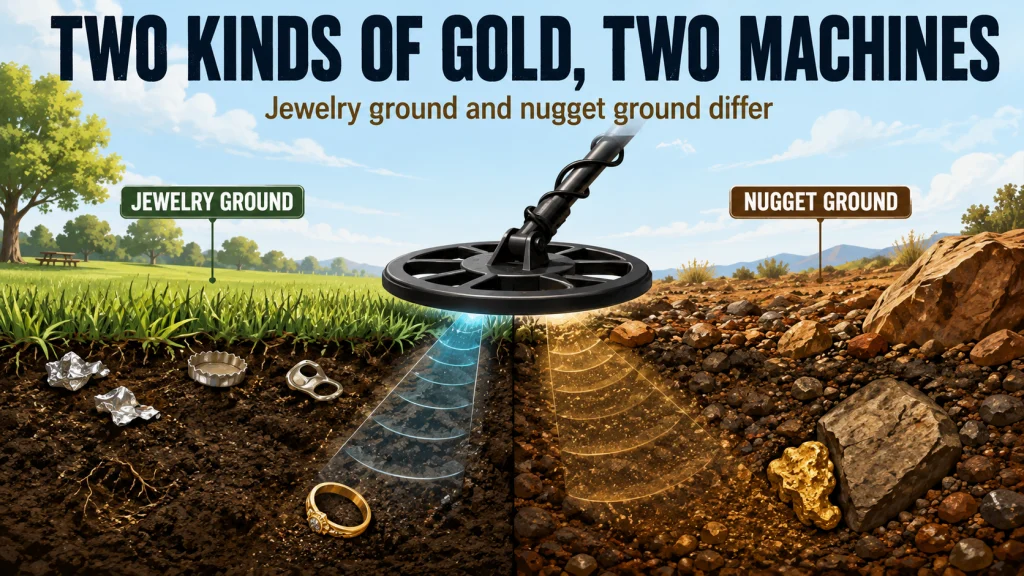
A machine can detect gold and still be the wrong machine for the gold you intend to find. A ring lost beside a volleyball court is a manufactured object with enough metal mass to produce a useful response, but it may sit among foil, pull tabs, bottle caps, and other modern trash. A small natural nugget in mineralized soil presents a different problem because target size, irregular shape, ground response, and hot rocks can matter more than a clean visual identification number.
This is why I do not name one overall winner. The best metal detector for gold begins with a narrower question: are you recovering jewelry from parks, beaches, swimming areas, and private property, or prospecting for naturally occurring gold in known gold country? Anyone still comparing the broader machine classes should first look at choosing a detector by hunt type, then return to the gold path that matches the real target.
Key point: “Detects gold” is not a complete buying standard. The machine must detect the likely size of your gold target while remaining usable in the ground, trash, salt, terrain, and water conditions where that target is found.
That distinction also sets the boundary for this page. I am not ranking individual models, promising detection depth, or treating one frequency or technology as universally superior. The purpose is to route the buyer toward the correct detector class before price, advertising, or a long feature list takes over the decision.
Define the Exact Gold Target Before Comparing Features
The word “gold” hides several target sizes and hunt conditions. A heavy ring, a thin chain, an earring back, a coarse nugget, and a tiny picker do not present the same signal to a detector. The likely target size changes how much weight to place on frequency, coil size, audio detail, target identification, ground balance, and the detector’s ability to remain stable.
I use a simple target statement before comparing machines: “I want to find this type of gold, in this type of ground, with this amount of trash and water exposure.” That sentence is more useful than starting with a budget or asking which gold metal detector has the longest feature list. It forces the purchase back toward the conditions that will decide whether the machine is practical.
| Primary target | Conditions that usually control the decision | What deserves less weight |
|---|---|---|
| Lost rings and larger jewelry | Trash separation, useful audio and Target ID, site type, waterproof coverage | Extreme sensitivity to microscopic natural gold |
| Thin jewelry and small pieces | Low-conductive target response, coil control, trash overlap, recovery behavior | A single impressive depth claim without test conditions |
| Natural nuggets in mild ground | Likely nugget size, ground balance, audio detail, suitable searchcoil choices | Coin-focused display features that do not improve prospecting decisions |
| Natural gold in difficult ground | Mineralization, hot rocks, variable ground, salt, stability, physical burden | A universal technology label used without site context |
The table is not a ranking. It is a filter that removes features that sound impressive but do not solve the buyer’s actual problem. Once the target statement is clear, jewelry recovery and natural-gold prospecting separate into much cleaner paths.
Choose for Gold Jewelry by Reading the Site, Not the Metal Name
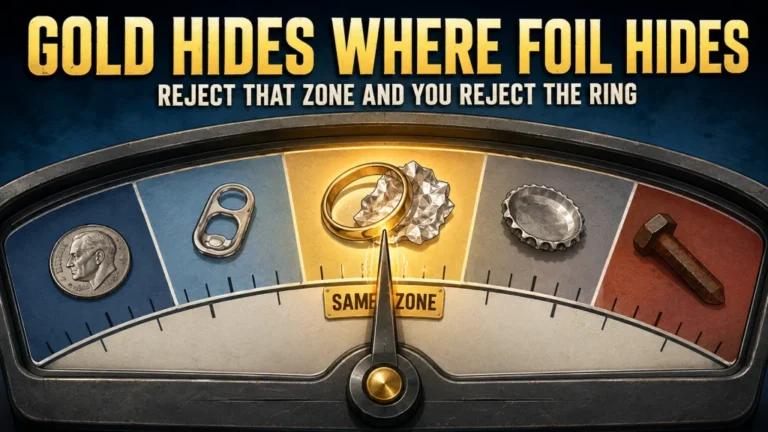
A detector for gold jewelry must work where jewelry is lost, which often means modern trash, changing moisture, crowded target fields, and sometimes wet salt. Gold jewelry can overlap with common trash responses, so aggressive rejection can silence the item you came to recover. The useful machine is the one that gives enough audio and visual information to make consistent dig decisions without becoming unstable in the site conditions.
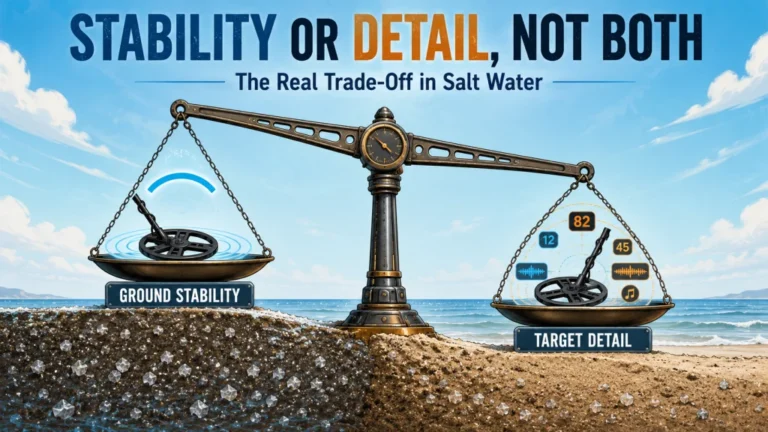
At a dry inland park, wet-salt performance may add cost without solving a real problem. At a saltwater beach, a machine that is calm on dry sand but unstable in the wet transition zone may leave the most promising ground difficult to search. Waterproofing also needs to be read component by component because a waterproof coil does not automatically make the control unit safe for submersion.
- Trash density: Determine whether the site requires fast recovery and clear adjacent-target responses.
- Gold size: Thin chains and small earrings are harder targets than solid rings, so do not treat all jewelry as equivalent.
- Salt exposure: Separate dry sand, wet salt sand, surf, and actual submersion because each creates a different minimum requirement.
- Dig strategy: Expect some overlap between gold and trash, and choose a machine that supports informed digging rather than promising perfect identification.
- Coverage and comfort: A balanced setup that can be swept for the full hunt may recover more ground than a heavier machine with unused capability.
The practical mistake is buying a dedicated prospecting machine because the word “gold” appears in the goal. That may reduce the target information and trash-handling convenience a jewelry hunter needs. The complete breakdown of matching a detector to gold jewelry follows the jewelry path without mixing it with natural nuggets.

Minelab X-Terra PRO provides Park, Field and Beach detection modes for different hunting environments. Its Pro-Switch system allows selectable operating frequencies. The detector is fully waterproof and the listed package includes a PRO-FIND 15 pinpointer, carry bag, finds pouch and gloves.
Check On AmazonIf you click this link and buy, we earn a commission at no additional cost to you.
Natural Nuggets Shift the Decision Toward Ground and Audio
A metal detector for gold prospecting is judged less by how neatly it classifies a target and more by whether a repeatable target response remains audible over the ground. Natural gold varies in size, shape, purity, and attachment to rock. The smaller and less regular the target, the more important stable ground handling, precise coil control, and informative audio become.
Threshold-based audio can help a prospector hear small changes that never become a confident screen number, but it also demands attention and practice. Automatic operation can lower the learning burden, while manual control can help an experienced user adapt to changing conditions. Neither approach is automatically better because the useful choice depends on the operator’s patience, the ground, and how much adjustment the site requires.
Coil choice belongs in the same decision. A smaller coil can be easier to control around rocks, brush, shallow crevices, and dense target patches, while a larger coil may cover more open ground but adds weight and can become awkward in confined terrain. The right package is not the one with the largest coil count, it is the one that includes or supports the coil size the actual ground allows you to use.
My surveying background taught me to define the ground before trusting the equipment comparison. A machine built for a different target size or soil condition does not become suitable because its price is higher. The dedicated natural gold detector selection process goes deeper into target size, audio, coils, and field ergonomics.

Minelab Gold Monster 1000 uses a 45 kHz VLF system with a 24-bit signal processor for gold detection across a range of nugget sizes. It provides fully automatic operation for easier setup. Automatic noise canceling, ground balance and sensitivity adjustment are built into the detector.
Check On AmazonIf you click this link and buy, we earn a commission at no additional cost to you.
Identify the Ground Problem Before Choosing Technology
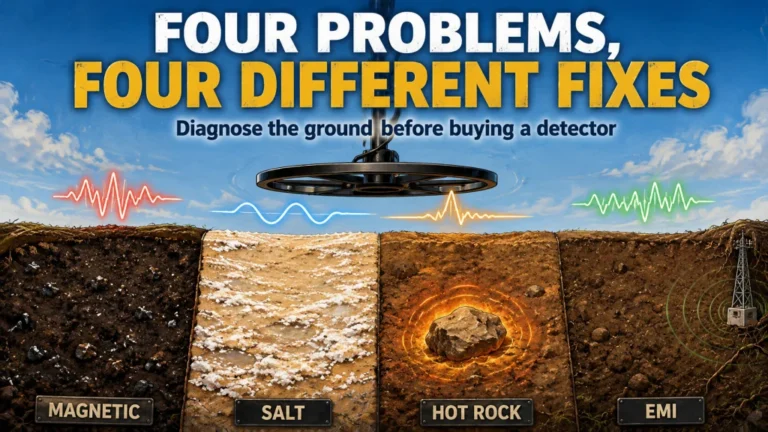
“Mineralized soil” is often used as if it describes one condition, but several different problems can produce noise, unstable identification, or lost sensitivity. Magnetic minerals, conductive salt, hot rocks, rapidly changing ground, and electromagnetic interference can sound similar to a beginner. Buying by a technology label before identifying the source of instability can solve the wrong problem.
Field Note: On permission properties, I have seen a detector run smoothly in open pasture and become noisy near an old foundation only a short distance away. The machine did not suddenly fail. The ground, buried iron, and surrounding interference changed, which is why I test conditions across the site instead of assigning one setting or one diagnosis to the entire property.
Magnetic black sand can indicate heavy minerals, but its presence does not prove that every dark patch contains detectable gold. Hot rocks may create isolated responses that behave differently from a normal metal target. Conductive salt can affect a detector even where magnetic mineralization is modest, and nearby power systems or other detectors may create EMI that is incorrectly blamed on the soil.
| Observed problem | What to test before buying | What it changes |
|---|---|---|
| Broad ground noise with each sweep | Ground balance response, sensitivity reduction, another patch of ground | Required stability and ground-handling capability |
| Isolated rock-like signals | Repeat from multiple directions, move the rock, compare surrounding soil | Need for hot-rock handling and informative audio |
| Instability near wet salt | Compare dry sand, damp sand, wet transition, and surf conditions | Minimum salt capability and waterproof coverage |
| Noise that changes near electrical sources | Noise cancel, frequency shift, distance from the source, other detectors | EMI controls, not necessarily a different gold technology |
| Ground response changes over short distances | Rebalance in several zones and note where stability changes | Need for tracking, manual control, or easier rebalancing |
VLF, pulse induction, and simultaneous multi-frequency systems each involve trade-offs. Higher operating frequency can improve response to smaller low-conductive targets, but frequency alone does not override ground conditions, coil design, signal processing, or operator control. Start with comparing metal detector technology types and understanding how detector frequency changes response, then apply those concepts to the actual site rather than turning them into universal rules.
The more focused explanation of choosing for mineralized gold ground is the correct next step when difficult soil, hot rocks, salt, or variable ground controls the purchase.
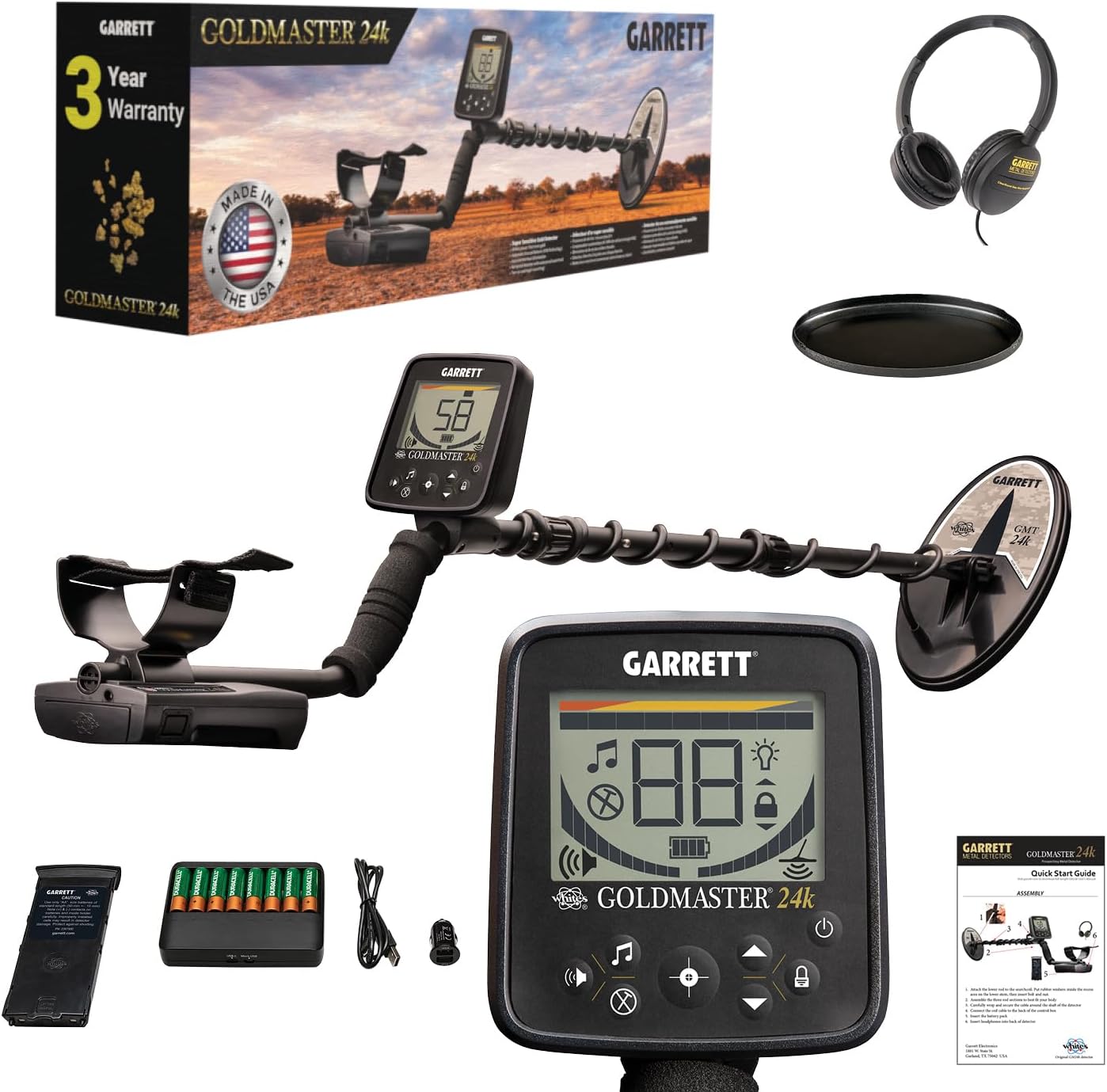
Garrett Goldmaster 24K operates at 48 kHz for detecting small gold nuggets. Its XGB ground balance system automatically tracks changing ground conditions to reduce noise. The detector also provides adjustable sensitivity, threshold and iron cancel controls.
Check On AmazonIf you click this link and buy, we earn a commission at no additional cost to you.
A Budget Under 500 Dollars Creates Two Different Gold Paths
A strict budget can still support useful gold hunting, but the answer depends on whether the buyer means jewelry or natural nuggets. A general-purpose detector within this range may be capable of finding rings and other gold jewelry in suitable conditions. That does not automatically make it a dedicated prospecting machine for small natural gold in difficult ground.
For nugget prospecting, the current new-machine market may leave fewer dedicated choices at this price than the phrase “gold detector under 500 dollars” suggests. A buyer may need to choose among a simpler new prospecting unit, a carefully inspected used detector, a general machine with limited nugget capability, or waiting until the budget covers the ground-handling and coil requirements of the intended site. Each path has a different risk.
A used detector can stretch the budget, but the purchase needs a condition check: coil compatibility, cable condition, battery system, available service, included parts, and whether the machine can be tested before money changes hands. The focused gold detector options under 500 dollars separates current jewelry-capable choices from machines intended for prospecting rather than blending both into one misleading list.
Use the Gold-Detector Decision Framework
After 30 years of reading plats, land records, and topographic surveys, I am wary of equipment decisions that begin without a defined location. The same discipline applies here: describe the target and ground first, then judge the machine. This keeps the purchase tied to the hunt instead of letting one attractive feature control the entire decision.
Write the answers down before opening comparison pages. A short record exposes contradictions quickly, such as wanting tiny-nugget sensitivity, strong trash identification, wet-salt stability, full submersion, low weight, multiple coils, and a very low total cost from one machine. Some combinations exist, but every added requirement narrows the field or raises the price.
- Exact target: Ring, thin chain, earring, coarse nugget, small picker, or mixed gold goals.
- Likely target size: Base this on the hunt type and local prospecting evidence, not the largest nugget shown in advertising.
- Soil: Mild soil, magnetic ground, decomposed rock, clay, black sand, stream gravel, or mixed conditions.
- Mineralization and hot rocks: Note whether the ground is broadly noisy, changes by zone, or contains isolated problem rocks.
- Salt: Separate inland soil, dry beach, wet salt sand, surf, and salt-bearing prospecting ground.
- Trash: Record the amount of foil, iron, pull tabs, wire, and other modern debris that will affect digging decisions.
- Terrain: Open flats, steep slopes, brush, boulders, creek beds, or tight bedrock crevices.
- Water exposure: Rain resistance, waterproof coil use, wading, or full submersion.
- Physical burden: Detector weight, balance, coil weight, pack length, and the hours you can realistically swing.
- Service: Warranty terms, repair path, coil availability, battery replacement, and parts support.
- Full package cost: Detector, usable coil, charging system, headphones, protective items, shipping, tax, and any required adapter.
The framework does not produce the same answer for every buyer. It produces a defensible reason for including or excluding a detector class. That is more valuable than a ranking because the reason remains useful even when current models, bundles, and prices change.
Separate Evidence From Marketing and Record Exclusion Reasons
A useful comparison should show why a capability is believed, not just repeat the manufacturer’s strongest sentence. I label evidence by type because a specification, an official operating instruction, a controlled comparison, and a field observation answer different questions. None should be stretched beyond what it supports.
For example, a listed frequency confirms how the machine transmits, but it does not prove universal superiority on every gold target. A waterproof rating defines a protection boundary, but only for the components and depth stated. A field report can expose a recurring problem, yet one person’s ground and settings do not become a guaranteed result for everyone else.
| Evidence label | What it can support | What it cannot prove alone |
|---|---|---|
| Official specification | Frequency, weight, coil compatibility, waterproof limits, included equipment | Performance in every soil or the buyer’s exact site |
| Official manual instruction | Controls, setup sequence, ground balance method, warnings, maintenance | That the machine is the best choice for a different target or terrain |
| Controlled comparison | Relative behavior under stated targets, settings, coils, and ground | A universal depth or sensitivity result |
| Direct field observation | How a machine behaved in a documented site and condition | A guaranteed outcome for every operator |
| Research-based explanation | Why target size, soil minerals, salt, and technology can change response | The current contents or price of a retail package |
I also record exclusion reasons. A machine may be excluded because it lacks the required water protection, becomes too heavy with the needed coil, has no practical service route, cannot handle the site’s salt or mineralization, or pushes the complete package beyond budget. Exclusion does not mean the detector is poor. It means the detector does not fit this buyer’s stated hunt.
Verify the Current Model and Package Before Paying
Gold detector lines change. A model can be replaced, a coil bundle can disappear, headphones may move from included to optional, and the same detector name may be sold in more than one package. A page that was accurate when written can become wrong at the checkout screen without the detector technology changing at all.
For that reason, I treat current availability as a final verification step, not the foundation of a permanent ranking. Check the manufacturer’s current product page, then compare the exact retailer package against it. The detector body alone is not the full purchase when the planned hunt requires a different coil, charging equipment, audio connection, carrying solution, or water-safe accessory.
- Confirm the exact detector version and regional package.
- List every included coil by size and type.
- Check whether coil covers, headphones, chargers, adapters, and battery holders are included.
- Verify waterproof limits for the control unit, coil, audio connection, and headphones separately.
- Confirm current warranty coverage and the repair path available in the United States.
- Calculate the full usable cost before comparing it with another package.
This step prevents a lower advertised price from winning a comparison when the machine still needs several required parts. It also prevents a large bundle from looking like better value when half of the included equipment does not match the intended ground or target.
Final Thoughts: Build a Purchase Brief Before Comparing Machines
Before comparing current options, reduce the entire hunt to a one-page purchase brief. Write down the smallest gold target you realistically expect, the hardest ground condition you expect to face, the deepest water exposure allowed, the terrain you must carry the machine through, and the complete budget for a usable setup. Those five limits remove more unsuitable choices than a long feature comparison.
I also keep the exclusion reason beside every machine removed from consideration. “Wrong water protection,” “too much physical burden,” “poor fit for wet salt,” or “package exceeds the full budget” is more useful than calling a detector good or bad. The final choice should be the machine that clears the real constraints with the least unnecessary complexity, not the one that wins the most categories on paper.

Minelab X-Terra Elite Bundle combines the X-Terra Elite detector with a PRO-FIND 40 pinpointer. The detector uses Multi-IQ simultaneous multi-frequency technology and provides 119 Target IDs for separating target responses. Amazon lists the detector at 2.9 pounds with a 12-inch search coil.
Check On AmazonIf you click this link and buy, we earn a commission at no additional cost to you.
Continue With the Comparison That Matches Your Constraint
Your purchase brief should now reveal the condition that controls the decision. Use that controlling constraint to choose the next comparison instead of reopening every possible gold-detecting scenario.
| Resource | What it helps you decide |
|---|---|
| Gold Jewelry Detector Selection | How trash, target information, wet salt, waterproofing, and jewelry size shape the choice. |
| Natural Gold Detector Selection | How nugget size, audio, ground handling, coils, and ergonomics change prospecting needs. |
| Gold Detectors for Difficult Ground | How to separate magnetic minerals, salt, hot rocks, variable ground, and EMI before choosing technology. |
| Gold Detectors Under 500 Dollars | How to separate jewelry-capable general machines from dedicated prospecting choices within a strict budget. |
Open only the resource tied to the controlling constraint, then compare current packages against the purchase brief you already wrote. This keeps the next page focused on a real buying decision instead of restarting the same broad research.
FAQs
💍 Can the same detector find gold rings and nuggets?
Some versatile detectors can find both, especially larger jewelry and larger natural gold in manageable ground. The overlap does not mean equal performance on thin jewelry, tiny nuggets, wet salt, trash, and severe mineralization. Choose based on the harder target and ground condition you expect to face most often.
⛏️ Do I need a dedicated detector for gold prospecting?
A dedicated prospecting detector becomes more useful when small natural gold, hot rocks, variable ground, or mineralization controls the hunt. A general detector may be enough for occasional prospecting in mild conditions, but its limits should be understood before the trip.
📶 Is a higher frequency always better for gold?
No. Higher frequency can improve response to small low-conductive targets, but ground conditions, signal processing, coil design, stability, and target size also matter. Treat frequency as one part of the system, not a universal winner.
🏖️ What matters most for gold jewelry at the beach?
Separate dry sand from wet salt sand, surf, and submersion. Then check wet-salt stability, useful low-conductive target response, trash handling, and the waterproof limit of every component that may enter the water.
🪨 How do I know if mineralized soil is the problem?
Test the detector in several nearby ground zones, rebalance it, reduce sensitivity, and move away from electrical sources or other detectors. Broad ground noise, changing behavior across short distances, and repeatable responses from certain rocks point to different causes that should not be treated as one problem.
💵 Can a detector under 500 dollars find gold?
Yes, especially gold jewelry and some natural gold in suitable conditions. The budget does not guarantee small-nugget sensitivity or difficult-ground performance, so separate general jewelry capability from dedicated prospecting capability before buying.
🎧 Should I prioritize the screen or the audio for nuggets?
For small natural gold, audio often carries more useful information than a confident visual identification number. The machine still needs to remain stable enough for weak target changes to stand out from ground noise, hot rocks, and interference.
📦 What should I verify in a gold detector package?
Confirm the exact version, included coil, charging equipment, headphones, adapters, waterproof limits, warranty, and service path. Compare the total cost of a usable field setup, not only the detector’s advertised base price.
Sources and References
- USGS Gold Prospecting Reference: Used for the forms and locations of placer gold, including fine particles, nuggets, bedrock traps, and the association of black sands with heavy minerals.
- Garrett Gold Detection Explanation: Used for the general VLF and pulse-induction distinctions, ground-condition factors, and the relationship between target size, settings, and mineralization.
- Minelab Frequency Selection Explanation: Used for the practical trade-offs between frequency, small low-conductive targets, mineralized soil, and detection conditions.
- Minelab Current Prospecting Detector Range: Used to verify that current gold-prospecting models and packages span multiple technologies, price levels, and included configurations.
- Nokta Current Gold Detector Range: Used to confirm current dedicated gold-detector categories and the need to refresh model and package availability before publishing or buying.