A metal detector product page can list frequency, sensitivity levels, target ID numbers, ground balance options, waterproof ratings, and several search modes without telling you how the machine will behave in your soil. The useful question is not which detector has the longest specification list, but what each control changes and what conditions are missing from the claim. I read specifications as clues that must be connected to target type, ground response, coil choice, and the operator’s tolerance for noise and adjustment. This guide shows you how to separate meaningful field information from numbers that need more context.
Metal Detector Specs Explained Without Treating Numbers as Results
The first mistake I see buyers make is reading a specification as though it were a field result. A higher frequency is not automatically better. More sensitivity levels do not prove greater usable depth. A wider target ID scale does not identify buried metal more accurately by itself, and a long list of ground balance options does not tell you how calmly the detector will run in red clay, wet salt, or changing pasture soil.
A specification describes part of the machine. Performance comes from the whole signal path, including the search coil, operating mode, filtering, recovery behavior, audio design, ground conditions, and the way the operator sets the machine. Understanding how a detector creates and interprets a target signal gives those numbers a useful frame. Without that frame, the product page can look precise while leaving the buying decision almost untouched.
This article explains frequency, ground balance, discrimination, target ID, and sensitivity at the decision level. It does not teach pumping procedures, calibration sequences, advanced audio tuning, or troubleshooting steps. Those jobs belong in field-use guides, while this one stays focused on what a buyer should understand before comparing product pages.
Frequency Tells You About Signal Priorities, Not Overall Quality
A frequency figure is easy to compare because it arrives as a clean number in kilohertz (kHz). The field response is not nearly that tidy. Frequency changes how the machine responds to small low-conductive targets, larger high-conductive targets, mineralized ground, and electrical interference, so the number describes a set of priorities rather than a quality ranking.
A higher-frequency setup may be useful when the target is very small or weakly conductive, yet it may also react more strongly to mineralized ground or tiny pieces of unwanted metal. A lower-frequency setup may provide a strong response on larger, higher-conductive targets, but that does not mean it will be the best choice for every coin, every depth, or every soil type. Coil size, mode design, filtering, and ground handling still shape what reaches the headphones.
| What the page shows | What it can help you infer | What it cannot prove |
|---|---|---|
| One fixed frequency | The machine is designed around a defined signal priority. | That the detector is outdated, shallow, or unsuitable for your site. |
| Several selectable frequencies | You can choose one operating frequency to suit a target or interference problem. | That the machine processes all listed frequencies at the same time. |
| Simultaneous frequency operation | The active mode processes more than one frequency as part of its search operation. | Universal depth gains, perfect target ID, or identical performance across brands and modes. |
When I read a frequency claim, I look for the operating arrangement, the modes that use it, and the conditions in which the manufacturer says it applies. The deeper explanation of how metal detector frequency affects target response is where the trade-offs become clearer. On a product page, the goal is simply to identify what the frequency option lets the operator change and what remains unknown.

The Garrett Viper is a 6 x 11 inch DD search coil for metal detecting. Amazon lists the coil as weighing just over one pound. The listing also identifies it as fully submersible to 16 feet for detecting in wet environments.
Check On AmazonIf you click this link and buy, we earn a commission at no additional cost to you.
Ground Balance Options Only Matter When the Ground Creates a Problem
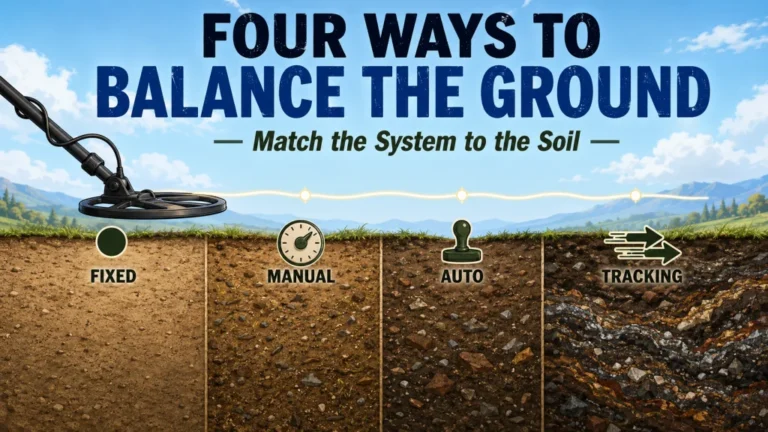
Ground balance becomes meaningful when the soil starts behaving like a target. Mineral content or conductive ground can create a response the detector must separate from buried metal, and product pages answer that problem with labels such as fixed, automatic, manual, tracking, or dedicated ground modes. Those labels describe available approaches, but their value still depends on the soil, how quickly it changes, and how the manufacturer implemented each option.
A fixed arrangement can be perfectly adequate in mild, consistent soil. Automatic balance can make setup easier when the system finds a useful value, while manual adjustment gives the operator more control when the automatic result needs correction. Tracking can follow changing ground, but aggressive tracking may also react differently around weak targets depending on the machine and conditions. A dedicated beach or difficult-ground mode may change more than the balance value because filtering and signal processing can change with it.
Field Note: The ground balance question comes up on almost every permission hunt I run in this region. New detectorists assume one setting works everywhere, but mineralized soil near an old foundation can read completely differently from open pasture fifty yards away.
That observation is why I do not award points merely for having more ground balance choices. I want to know whether the detector can be matched to the ground without becoming difficult to control, and whether the manual explains what each option actually does. The guide to understanding metal detector ground balance covers the differences in more detail without turning one method into a universal winner.
Discrimination and Target ID Are Estimates, Not Metal Labels
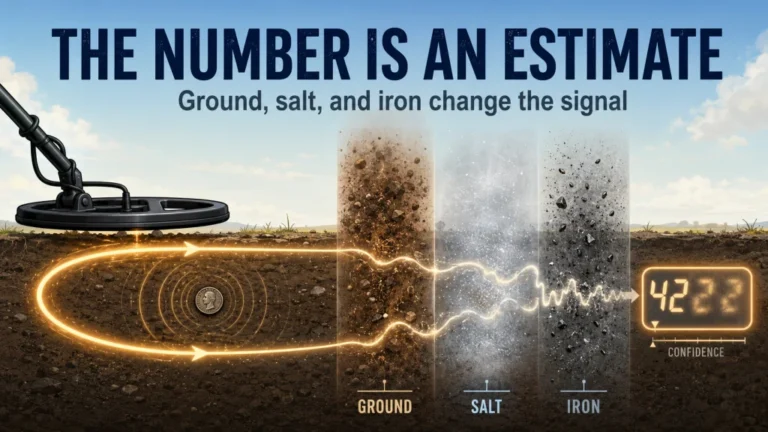
A neat target number can look more certain than the signal behind it. Target ID places the processed response on a numeric or segmented scale, while discrimination controls which parts of that response are accepted, rejected, muted, or presented differently. The features work together, but one estimates where the response falls and the other changes what the machine reports.
The scale is model-specific. A value on one detector does not carry the same meaning on every other detector, and even the same target can move because of depth, orientation, corrosion, soil, nearby iron, coil position, or sweep direction. A gold ring can share an identification region with foil or pull tabs, which means rejecting that region to reduce trash can also silence the target the operator hoped to find.
A wider scale can give the manufacturer more display positions, but it does not automatically create cleaner separation between real targets. Likewise, more notch segments can provide finer control while increasing the risk that a beginner rejects too much. The practical limits of metal detector discrimination and target ID matter more than the number of boxes printed across the screen.
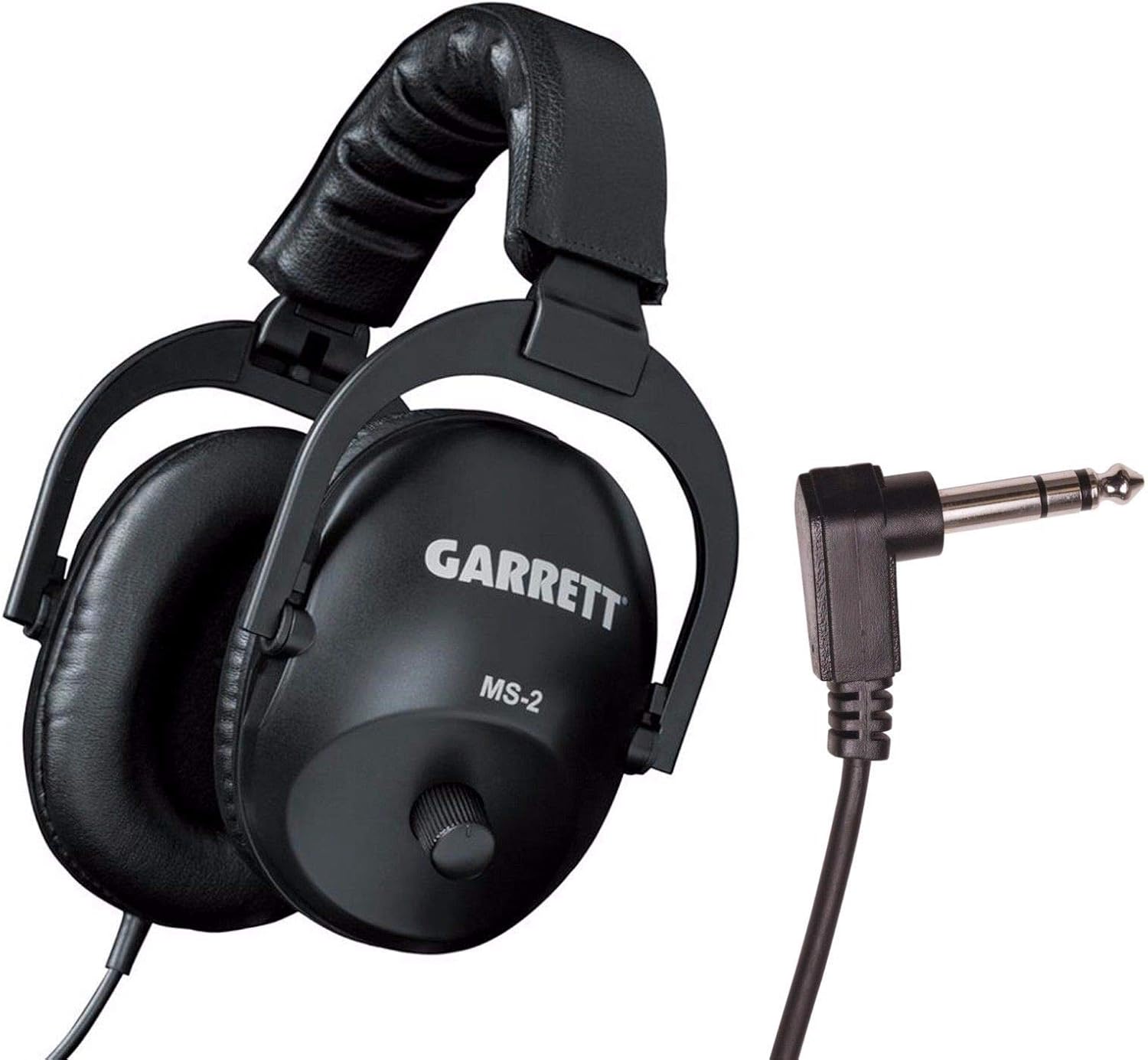
The Garrett MS-2 Headphones use a 1/4 inch right-angle stereo plug and are made for metal detecting use. They include volume control for adjusting signal levels and improving weak-signal listening. The design also uses padded ear cups, an adjustable headband, and a reinforced coiled cable.
Check On AmazonIf you click this link and buy, we earn a commission at no additional cost to you.
Sensitivity Controls Signal Response and Noise Together
The maximum sensitivity number is often the first setting a new owner wants to try. Sensitivity, sometimes described as gain, strengthens the detector’s response to received signals, so raising it can make a weak target easier to hear. The same change can also strengthen ground noise, electromagnetic interference (EMI), coil movement, and unstable responses, which is why the highest setting is not automatically the deepest usable one.
The number of adjustment steps tells you how finely the control can be changed, not how powerful the detector is. One machine may offer ten steps and another may offer thirty, yet the ranges and spacing are not standardized. A detector running calmly at a moderate setting can provide more usable information than one producing constant chatter at maximum sensitivity.
- Look for whether sensitivity is global or changes by search mode.
- Check whether the manual separates sensitivity, threshold, volume, and audio gain.
- Do not compare the top number across different scales as though the scales were equal.
- Ask whether the detector remains stable in the ground and EMI conditions you expect to hunt.
- Treat “maximum depth” claims cautiously unless target, soil, coil, mode, and settings are stated.
I usually judge sensitivity by the point where the machine remains interpretable, not by the highest number the control will display. That distinction is explored further in how metal detector sensitivity affects stability. For a buyer, the important specification is not the maximum level but the amount of useful control available before noise starts hiding real targets.
The Missing Specifications Often Decide the Hunt
The four headline controls rarely tell the whole story. A detector can look strong on frequency, ground balance, target ID, and sensitivity while still being a poor fit because the coil is too large for dense trash, the shaft is tiring after an hour, the audio hides weak targets, or the waterproof claim stops at the coil. These details are not secondary once the machine leaves the product page.
I read the remaining specifications as a system. Weight means little without balance. A waterproof coil does not make the control housing submersible. A replaceable battery and an internal rechargeable battery create different travel and field routines, while neither is automatically superior. Search modes matter only when the manual explains what changes beneath the mode name.
| Missing context | Why it changes field use | Question to ask |
|---|---|---|
| Search coil | Size and shape affect coverage, separation, balance, access, and response to small targets. | Does the included coil fit the site I will hunt most? |
| Weight and balance | A front-heavy machine can feel harder to swing than a slightly heavier balanced setup. | Where is the weight carried during a normal sweep? |
| Waterproofing | Coil-only, weather-resistant, and fully submersible claims permit different uses. | Which components are protected, to what depth, and under what limits? |
| Operating modes | Modes may change frequency, filtering, recovery, tones, ground response, or several controls together. | What actually changes when the mode changes? |
| Recovery behavior | It affects how clearly nearby targets are reported in iron or modern trash. | Can the machine separate the target spacing common at my site? |
| Audio system | Tone count, threshold, pitch, volume, and proportional response affect how much information reaches the operator. | Can I hear target differences without depending only on the screen? |
| Software and updates | Updates may change features or behavior, while app or computer requirements affect ownership. | Can settings be restored, and what equipment is required to update? |
| Battery system | Runtime, charging, replacement, and field backup affect long hunts and travel. | What happens when the battery is depleted away from power? |
| Ground conditions | The same detector can behave differently in mild soil, magnetic ground, conductive salt, hot rocks, and EMI. | Was the claim demonstrated in ground comparable to mine? |
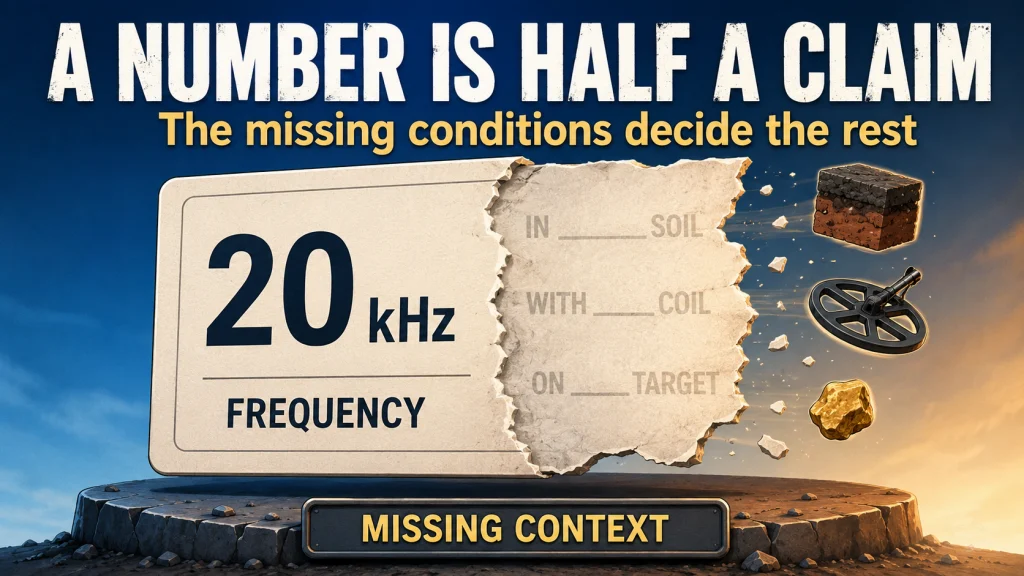
The biggest product-page omission is often the condition attached to the claim. “Deep,” “stable,” “high resolution,” and “advanced” need a target, coil, mode, soil type, and comparison point before they become useful. If the page does not provide those conditions, I treat the language as a question to investigate rather than an answer.

The KwikSafety SUPERCELL is a full body fall protection harness with three heavy-duty D-rings, including two hip D-rings and one dorsal D-ring. It uses cushioned shoulder pads, adjustable buckles, and polyester load-bearing straps. The listing states that it meets or exceeds ANSI/ASSE Z359.11-2021 standards and supports users from 130 to 310 pounds.
Check On AmazonIf you click this link and buy, we earn a commission at no additional cost to you.
How to Read a Product Page in the Right Order
Reading from the feature list downward encourages the page to define the problem for you. I reverse the order. Start with hunt type, target size, ground, trash density, water exposure, and the amount of control you are willing to learn. Then look for specifications that address those conditions.
This short sequence keeps the comparison practical and prevents one impressive number from dominating the decision:
- Define the regular site: mild park soil, old permission ground, wet salt, creek bed, mineralized prospecting ground, or another specific condition.
- Define the target problem: very small targets, deep coin-sized targets, mixed conductors, dense iron, or broad coverage.
- Identify the technology arrangement: learn whether the machine is fixed-frequency, selectable, simultaneous, or pulse induction before comparing smaller features.
- Read the manual by mode: determine which controls are available and what changes automatically.
- Match the coil and physical design: confirm that the included setup fits the site and your swing time.
- Check the omitted condition: look for soil, target, coil, and settings behind any performance statement.
- Compare ownership burden: include learning time, battery routine, updates, accessories, service, and weather limits.
The first technology decision belongs in the guide to choosing among detector technology types. Once the technology and specifications fit the site, the separate explanation of what controls real detection depth can keep depth claims from taking over the comparison. Specifications narrow the field, but they do not replace evidence from comparable ground.

The Minelab carry bag uses reinforced canvas with padding to protect metal detecting equipment during storage and transport. It is designed to accommodate a wide range of metal detectors. An exterior zippered pocket provides additional space for accessories such as diggers and headphones.
Check On AmazonIf you click this link and buy, we earn a commission at no additional cost to you.
Final Thoughts: Read Every Specification as a Conditional Claim
A product page becomes useful when each number is connected to a real decision. Frequency helps describe signal priorities. Ground balance describes how the detector can respond to the soil. Discrimination and target ID organize estimates, while sensitivity controls the balance between weak signals and noise. None of them predicts field performance alone.
I would choose the detector whose specifications solve the known site problem with the least unnecessary burden. That may be a simple machine with fewer controls, or it may be a more adjustable setup for changing ground and mixed hunt types. The right next step is to read the exact manual, compare the included coil and operating modes, and look for field evidence collected under conditions close to your own.
Explore Each Specification in More Detail
Explore more in this section when one line on a product page is carrying too much weight in your decision. Each guide below isolates one control, explains what it changes, and shows where the headline number needs more context.
| Guide | What it helps with |
|---|---|
| Metal Detector Frequency | Connects operating frequency with target size, conductivity, mineralization, and selectable or simultaneous operation. |
| Metal Detector Ground Balance | Explains fixed, automatic, manual, tracking, and mode-based approaches without declaring one method best everywhere. |
| Discrimination and Target ID | Shows why ID scales are estimates and how rejection choices can hide desirable targets along with trash. |
| Metal Detector Sensitivity | Separates usable signal response from unstable maximum settings and explains why more gain can create more noise. |
Use the guide that matches the specification causing the uncertainty, then return to the full product page with the missing condition in mind. That is faster than trying to rank every number at once.
FAQs
📋 Which metal detector specifications matter most?
Start with technology type, operating modes, frequency arrangement, ground handling, included coil, weight, waterproof limits, and sensitivity control. Their importance changes with target type, soil, trash density, and water exposure.
📡 Does a higher frequency mean a better metal detector?
No. Frequency changes target and ground response priorities, but it does not provide an overall quality score. The right range depends on target size, conductivity, soil, coil, and mode design.
🎚️ Should I always use maximum sensitivity?
No. Maximum sensitivity can amplify ground noise, EMI, and false responses along with weak targets. Use the highest setting that remains stable enough to interpret in the current conditions.
🔢 Is a wider target ID scale more accurate?
Not automatically. More display positions can provide finer visual resolution, but actual stability depends on processing, ground, target shape, depth, nearby metal, and coil control.
🌍 Do I need manual ground balance?
Manual control is useful when the automatic result needs correction or when the operator wants precise adjustment. In mild soil, a fixed or automatic system may be entirely adequate.
💧 Does a waterproof coil make the whole detector waterproof?
No. The coil, cable connection, control housing, and headphones can have different limits. Read the exact immersion depth and component coverage before taking the machine into water.
📏 Can specifications tell me how deep a detector will reach?
They can help identify factors that influence depth, but they cannot give a universal result. Soil, target size and material, orientation, coil, mode, sensitivity, and interference all change usable depth.
Sources and References
- Minelab instruction manual and detecting concepts: official explanations of frequency, ground balance, sensitivity, target ID, and the conditions affecting detection depth.
- Nokta detector operating manual: official descriptions of sensitivity, discrimination, target ID, automatic ground balance, and manual ground balance behavior.
- Garrett operating instructions: official documentation showing how sensitivity, threshold, frequency, ground balance, discrimination, and search modes are presented as separate controls.
- Minelab detector technology overview: official explanation of the transmitted field, received target response, signal processing, target ID, and common detector technology families.