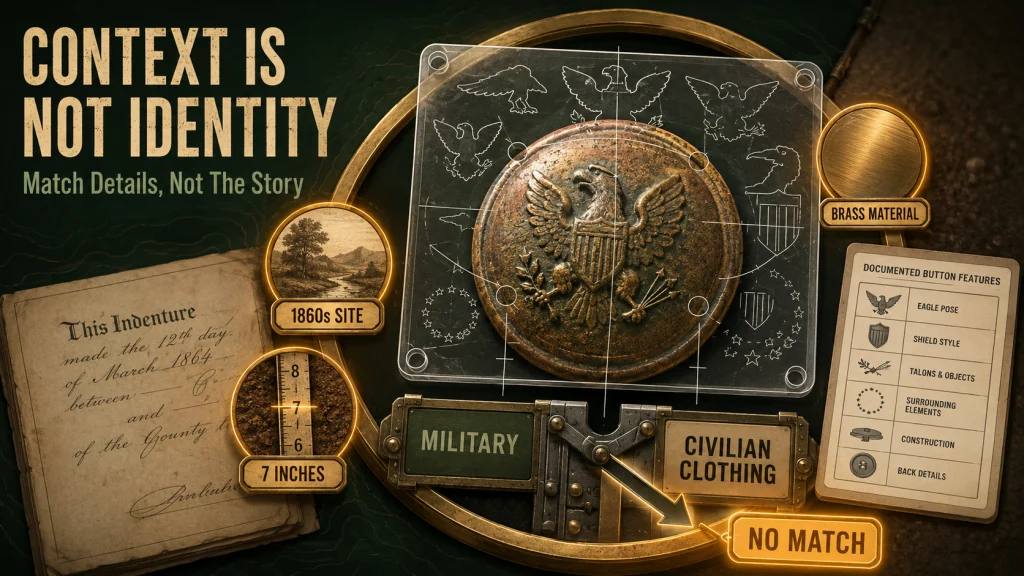
I once dug a flat brass button from a field tied by deed research to an 1860s farmstead and decided, almost immediately, that I had found a Civil War military button. The depth, the faint eagle, and the date of the site seemed to support the story, but a careful comparison with button references did not. The button was an ordinary 19th-century civilian clothing fastener with a decorative eagle motif, valuable as evidence of the occupation period but not as a military relic. It taught me that context can guide an identification, but it cannot replace one.
Four Good Clues Still Added Up to a Bad Identification
Nothing about my first impression felt reckless at the time. The property had documented occupation during the Civil War era. The object was brass. The eagle was visible. Seven inches of soil sat above it. Each clue was relevant, but I treated relevance as proof.
| Clue | What I assumed | What it actually established |
|---|---|---|
| An eagle design | The button was military | The maker or buyer chose a familiar national or decorative motif |
| Brass construction | It matched a uniform button | It was made from a material used for many kinds of buttons |
| A site occupied in the 1860s | The object came from a Civil War event | The button could be consistent with the broader occupation period |
| A depth of about 7 inches | It had remained there since the 1860s | It was beneath the current surface, with no automatic date attached |
The table makes the mistake look obvious. In the field, those clues arrived together, and together they felt persuasive. That is exactly why attractive misidentifications survive. One weak clue is easy to question. Four compatible clues can create confidence even when none of them identifies the object.
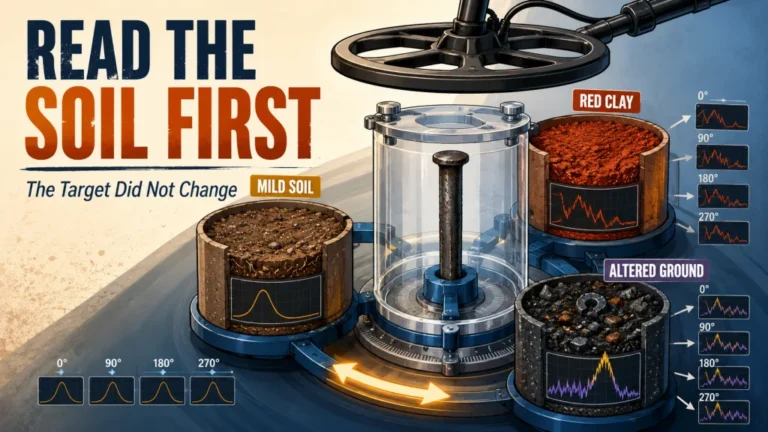
Depth was especially tempting. A deeper target often feels older, but soil does not maintain a clean calendar. Plowing, erosion, animal activity, roots, fill, freeze and thaw, and repeated traffic can move small metal objects. Seven inches told me where I recovered the button, not when it was dropped.
The Reference Search That Changed the Story
I began with published references for United States uniform buttons and then compared the face of the find against military button databases and museum records. I was looking for the details that turn a general symbol into a specific identification: the eagle’s pose, the objects held in its talons, the shield, surrounding stars or lettering, branch symbols, construction, and any maker information that can be documented.
Standard military buttons are not identified merely because they show an eagle. Their details belong to recognized patterns associated with a service, branch, state organization, period, or manufacturer. The more examples I compared, the less my button behaved like a standard Civil War issue piece. The decorative image was suggestive, but it was not specific.
That comparison also exposed a trap in online identification. A marketplace listing can attach a confident label to an object without showing the reference used to reach it. Repeating the same label across several listings does not turn it into evidence. I gave more weight to museum catalog records, formal classification resources, and references that showed why a design belonged in a particular group.
Field Note: I did not need a perfect twin before correcting myself. Once the button failed to match the defining features of the military patterns I had assumed, the honest label was no longer “Civil War button.” It was “unverified brass eagle button” until the civilian match became stronger.
The final fit was a common general-use civilian button with an eagle motif, manufactured and sold as ordinary clothing hardware during the 19th century. Buttons of that kind could appear on shirts, coats, and everyday garments far from any battlefield. The eagle was decoration, not a branch-specific military insignia.
Context Matters, but Context Is Not Identification
Archaeologists use context to understand an object in relation to its location, depth, surrounding material, chronology, and documented history. Detectorists should take that idea seriously. I record where a potentially important item came from because the location can help explain it later.
The mistake is allowing context to dictate the identity. A farm occupied in the 1860s may contain objects from before that decade, during it, and long after it. A military-looking symbol may also appear on political, patriotic, occupational, institutional, or ordinary commercial clothing buttons. The site narrows the question, but the object still has to match a recognized type.
- Location gives association: where the item was recovered and what activity occurred nearby.
- Depth gives recovery context: how far beneath the present surface the item was found.
- Construction gives physical evidence: material, shape, shank, face, and manufacturing details.
- Reference comparison gives identification: whether the defining features match a documented type.
- Uncertainty gives an honest limit: what remains unknown after the available evidence is exhausted.
I now separate those parts in my notes. That keeps a plausible site date from turning into an automatic object date, and it keeps a familiar image from becoming a specific military attribution. When the match is incomplete, “unknown” is a result, not a failure.
Three Times Research Changes the Outcome
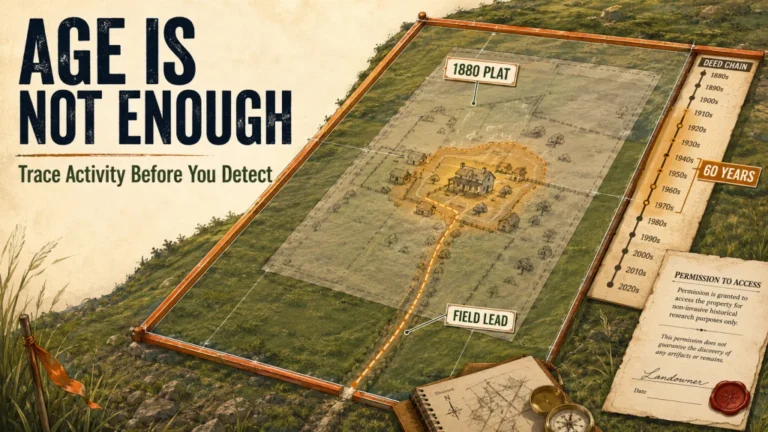
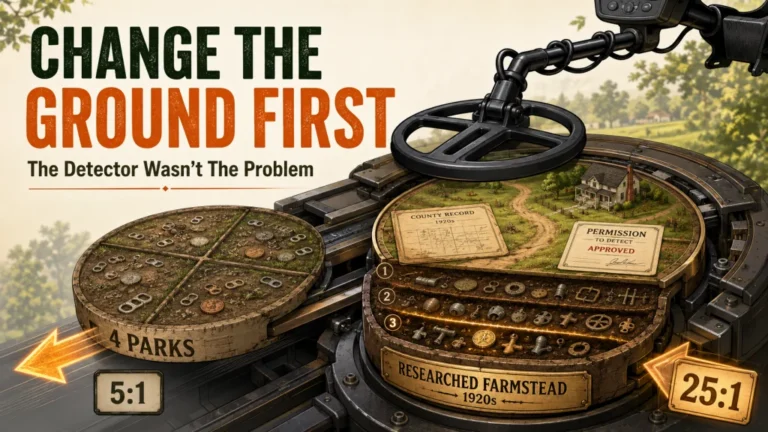
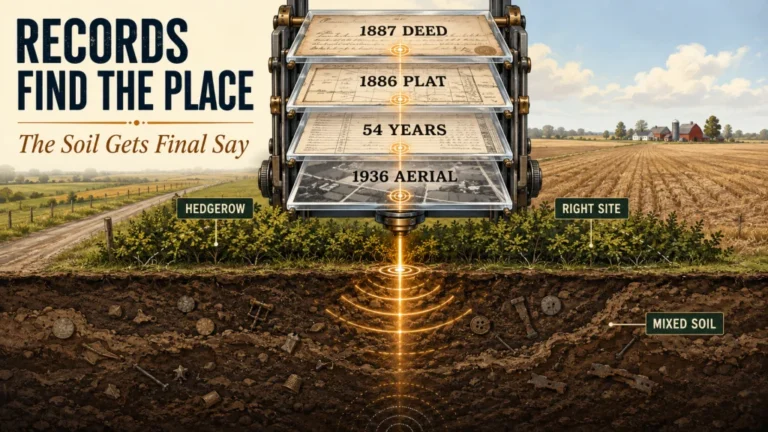
The button showed me that research does not end when the coil passes over a target. I had already used deed records to choose the field. After recovery, I needed a different kind of research to identify the object. Before describing it to anyone else, I needed a third pause to decide what the evidence actually allowed me to claim.
Before Asking Permission
Good location research helps me approach a landowner with a specific reason for my interest. I can explain the former use I found in public records and the limited area I hope to examine. That preparation does not guarantee permission, but it avoids treating someone’s property as an anonymous old place that I happened to notice.
The complete process for researching legal metal detecting locations includes ownership, records, map comparison, access, and field verification. This button story is not a substitute for that process. It is what happened after one researched location produced an object that seemed easier to explain than it really was.
After Recovering a Significant-Looking Find
A clear photograph of the front and back, measurements, recovery location, depth, and any visible construction details give me something useful to compare. Careful handling matters because aggressive cleaning can remove plating, markings, or surface details that might be needed later. The correct treatment depends on the material and condition, so I do not assume every brass-colored object should be polished.
The goal is not to find the first matching picture. It is to eliminate mismatches, compare defining details, and preserve the option to revise the label. My button became easier to understand when I stopped searching only for confirmation of the military story.
Before Making a Historical Claim
A claim follows the object. It may be repeated by the landowner, shared with a club, posted online, or used to describe the history of a property. A wrong label costs more than a few minutes because later details begin attaching themselves to it. Soon a civilian button becomes evidence of troop movement that the records never showed.
Research protects credibility by keeping the claim proportional to the evidence. It also prevents an assumed identification from influencing decisions about possession or removal. The legal question depends first on land ownership, the managing agency, the type and age of the resource, and the rules that apply there, not on what I call the object after digging it.
A Wrong Label Can Become More Than an Embarrassment
I found this button in a researched field, but the lesson applies before any detectorist removes an object from any property. Permission on private land and permission under federal, tribal, state, or local rules are different questions. An exciting identification does not create a right to dig, collect, or keep something.
Federal laws protect archaeological resources on federal and tribal lands, and individual agencies impose their own rules. National Park Service units prohibit metal detecting and artifact collection. Bureau of Land Management rules require more careful attention because allowed activity can depend on the land, the resource, and the managing office. State and local rules vary as well.
Warning: Confirm current rules with the agency or land manager before the hunt. Do not assume that all federal land follows one detecting rule, and do not assume that calling an object modern, common, or insignificant changes the law that applies to its removal.
The button did not create a legal problem for me, and I do not present every identification error as one. The broader point is that research should come before the claim and before any decision that depends on the claim. Excitement is not a classification system, and it is not a permit.
Final Thoughts: Let the Object Earn Its Story
The button taught me that a convincing story can form faster than a reliable identification. Its eagle, material, depth, and location all mattered, but none of them could carry the conclusion alone. Once the reference comparison failed, I had to let the military label go.
I value the button more accurately now. It is a modest object connected to the period of the farmstead, not proof of a Civil War presence. That narrower conclusion is enough. The best finds are not always the ones with the most dramatic labels, but the ones whose stories remain standing after the assumptions have been removed.
FAQs
🦅 Does an eagle on an old button mean it is military?
No. Eagle imagery appeared on military, political, patriotic, occupational, and civilian buttons. Identification depends on the complete design, construction, markings, and comparison with documented examples.
📏 Can the depth of a button tell me its age?
Depth is useful recovery information, but it is not a date. Soil movement, plowing, erosion, roots, fill, and other disturbance can place younger objects deeper or older objects closer to the surface.
📷 What should I record before identifying a metal detecting find?
Record the recovery location, approximate depth, and surrounding context, then photograph the front and back and note measurements and construction details. Preserve uncertainty until a reliable reference supports the identification.
🧽 Should I clean an old button before researching it?
Use caution. Cleaning methods depend on the material and construction, and aggressive treatment can remove plating, backmarks, or other useful details. Start with documentation and avoid assuming every button should be polished.
🏛️ Is a museum photo enough to identify my button?
A museum record can provide a strong comparison, but one similar image may not settle the identification. Compare the defining face details, back, construction, dimensions, and date range across more than one reliable reference when possible.
⚖️ Can I keep an old artifact if I find it with a metal detector?
That depends on where it was found, who owns the land, what the object is, and which federal, tribal, state, or local rules apply. Confirm permission and current rules before detecting or removing anything; National Park Service units prohibit metal detecting and artifact collection.
Sources and References
- Smithsonian National Museum of African American History and Culture, stamped brass U.S. Army eagle button: documented details of a standard Civil War general service button, including its eagle, shield, olive branch, arrows, material, and 1861 to 1865 date.
- Smithsonian National Museum of American History, George Washington commemorative clothing button: an example showing that American eagle imagery also appeared on non-military clothing buttons.
- Wisconsin State Button Society, Button Basics: button classification, material identification, reference use, and cautions about cleaning buttons before understanding their construction.
- National Button Society, introductory button collecting booklet: background on standardized button classification and the use of formal reference systems.
- National Park Service, What Is Archeological Context?: explanation of geographic, chronological, historical, cultural, and archaeological context in understanding an object.
- National Park Service, What If I Find an Artifact?: federal park guidance on documenting artifacts in place and the prohibition on metal detecting and artifact collection in National Park Service units.
- Bureau of Land Management, Cultural Resource Management: overview of ARPA protection for archaeological resources on federal and tribal lands and the need to follow the responsible agency’s rules.