I spent my first eighteen months returning to the same four nearby parks, where I learned my detector but slowly ran out of reasons to turn it on. My results changed when I stopped treating equipment as the answer and started treating site history and access as the real advantage. A researched 1920s farmstead produced older, deeper, and denser targets than those parks had given me, including a 1917 Barber quarter in my third hole. This is the story of that transition, not a step-by-step permission manual, and the lesson is that a site can wear out long before the hobby does.
The Four Parks That Taught Me to Detect
Why I stopped hunting the same parks as everyone else came down to one uncomfortable realization: I was asking my detector to replace ground that had already given up most of its easy targets. For the first eighteen months I detected, I rotated among four parks within ten minutes of my house. I found modern coins, a handful of older Memorial cents, and more pull tabs than I could count. I also found the same general mix that every other detectorist working those parks was finding, because all of us were searching the same convenient ground.
Those parks were not worthless. They taught me how to keep the coil level, recognize a repeatable tone, recover a target cleanly, and distinguish an aluminum signal that deserved a dig from random iron chatter. A beginner needs somewhere forgiving enough to make mistakes without turning every outing into a major project. The problem began when I kept using practice ground as though it should also produce a steady supply of older material.
Hunted-out does not mean empty. It means the obvious targets have been removed over years of repeated searching, leaving recent drops, difficult masked signals, deep targets, and plenty of trash. A skilled detectorist can still pull good finds from that kind of park, especially after changing conditions, construction, erosion, or a large public event. What wore me down was not the absence of all targets, but the shrinking return on every hour I spent covering familiar ground.
Kellyco’s discussion of a detecting slump describes the same pattern from a broader hobby perspective: discouragement builds when repeated outings feel the same, and a new site can restore the curiosity that first made the hobby enjoyable. That matched my experience. I did not need another control panel, another coil, or another round of adjusting settings. I needed ground with a different history.
My First Permission Changed More Than the Finds
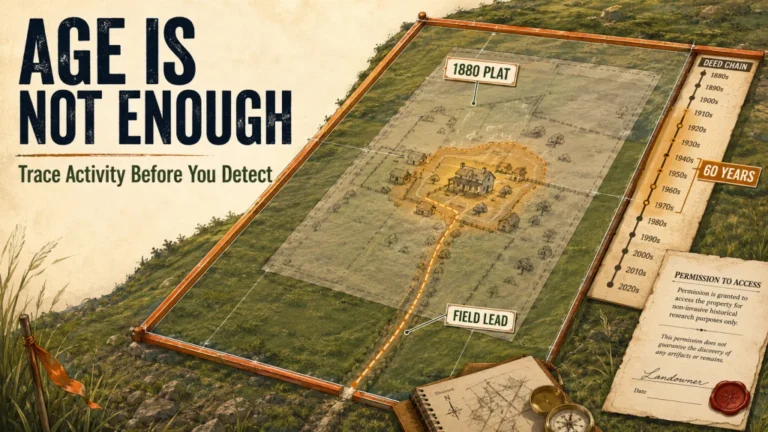
The first property that changed my thinking was a 1920s farmstead I located through county records. The parcel had the kind of documented occupation history I had been overlooking while driving straight to public parks. After receiving permission from the landowner, I arrived knowing why people had used that ground and where the older activity had likely concentrated. That confidence felt different from wandering toward another picnic table because it looked convenient.
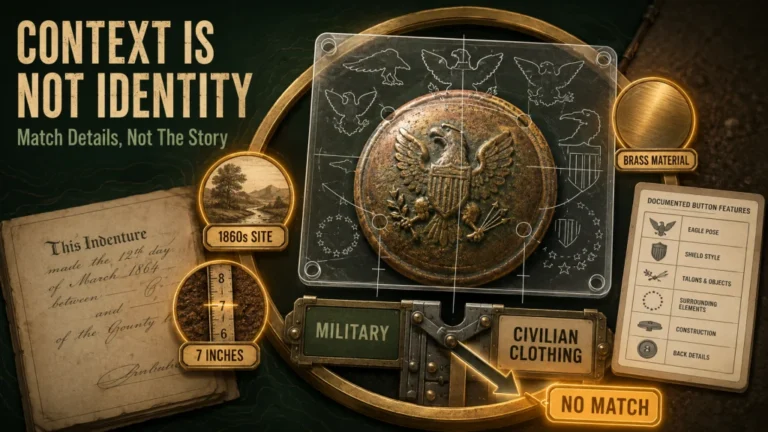
On my first visit, the third hole produced a 1917 Barber quarter. One coin did not prove that every private property would be productive, and it did not turn the permission into a guaranteed silver field. What mattered was the pattern around that find: target density was higher, recoverable targets tended to be deeper, and the material was older than anything I had found during eighteen months of park hunting.
The difference was not that private land is automatically better than public land. A modern private yard with little historical activity can be far less productive than an old public park, and a researched parcel can still disappoint once the coil reaches the ground. The useful distinction is not public versus private by itself. It is repeatedly searched ground versus ground selected because its ownership, occupation, and activity history give you a reason to search there.
That first farmstead also changed how the hobby felt. In the parks, I had started measuring a hunt by whether I could beat the last trip. On researched ground, every signal helped test a picture I had formed from the records. Even the junk had context, because square nails, hardware, and fragments of household metal helped confirm where activity had taken place.
The Transition Required Skills I Could Not Buy
Changing locations took less equipment than I expected and more nerve than I wanted. The practical cost was one afternoon in county records, one uncomfortable door knock, and a specific request made to a stranger who had every right to say no. None of those steps improved my detector’s depth or target separation. They improved the quality of the ground I was asking it to search.
Three parts of that first transition mattered more than any accessory:
- I researched the parcel before approaching the owner, so I could explain why the property interested me.
- I asked directly and honestly, without pretending the owner owed me access or that valuable finds were guaranteed.
- I accepted that permission was a separate skill, and that the first conversation would feel harder than later ones.
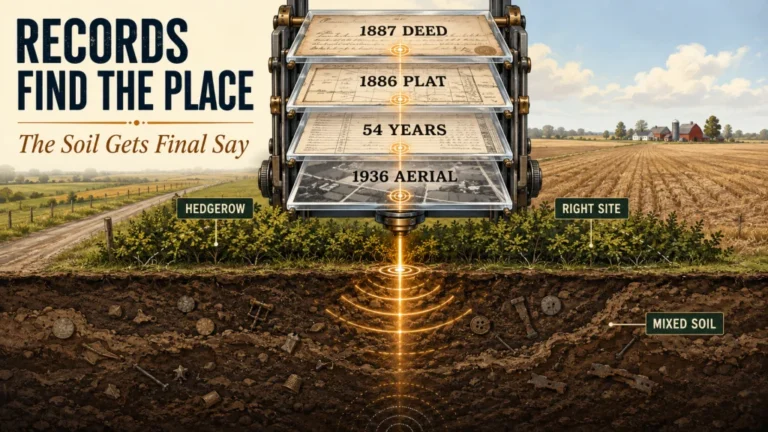
Metal Detecting Life’s location-research article describes the same broad toolbox I began using: local records, historic photographs, libraries, plat maps, and visible traces of former activity. The point is not to collect old maps because they look interesting. It is to narrow a large parcel into ground where people once lived, walked, worked, gathered, or handled coins and personal objects.
Permission is the boundary that cannot be skipped. Private property requires the owner’s approval, and rules for parks and other public land vary by the agency or local jurisdiction managing them. MetalDetector.com’s permission guidance recommends asking before entering and using written permission when possible, while official state guidance such as the Virginia Department of Historic Resources also makes landowner approval explicit. Research may identify a promising site, but it does not create access.
This article is not a script for knocking on doors, because the conversation deserves more room than a few lines here. The larger lesson is that discomfort was part of the transition, not evidence that I was doing it wrong. Anyone ready to make that move can start with asking a landowner for detecting permission before worrying about how many properties might say yes.
The Ratio That Changed My Idea of a Good Hunt
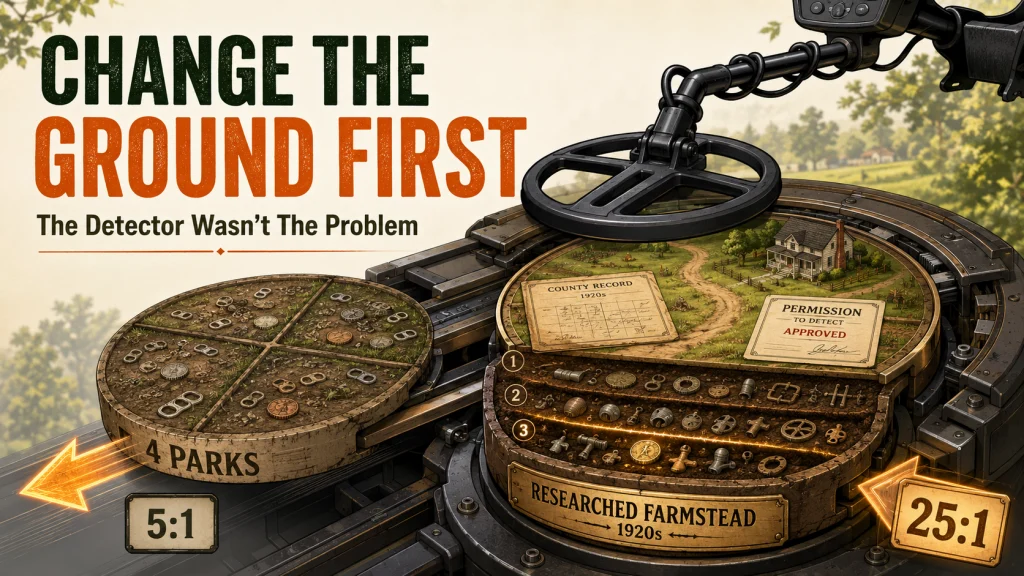
The clearest change was not a single coin. It was the ratio between the targets I dug and the targets I wanted to keep. In those familiar parks, I was digging approximately 25 targets for each keeper. On researched private permissions, that figure moved closer to 5 targets per keeper.
Those numbers are my field comparison, not a universal promise. Soil, target type, site age, previous detecting pressure, land use, and the definition of a keeper can all change the result. I use the ratio because it shows what changed in my own hunts more honestly than claiming a certain number of coins per hour. Better site selection did not eliminate trash; it placed more historically relevant targets inside the same amount of digging effort.
| What I compared | Same four parks | Researched private permissions |
|---|---|---|
| Approximate targets per keeper | About 25 to 1 | About 5 to 1 |
| Typical target mix | Modern coins, recent drops, and heavy aluminum trash | More site-related hardware, older coins, and household material |
| Previous detecting pressure | Repeatedly searched by many detectorists | Unknown or apparently minimal at the first farmstead |
| Main value of the site | Learning the machine and recovery technique | Testing land research against physical evidence |
The comparison also kept me from blaming my equipment for a location problem. My detector had not suddenly become five times better, and my technique had not transformed between one weekend and the next. The major change was target density shaped by site history and prior recovery. That is why buying a more capable machine can disappoint when it is taken back to the same exhausted ground without a new reason for searching it.
This is where metal detecting parks versus private land is often framed too broadly. Parks offer access, repeatability, and excellent practice, while private permissions can offer less disturbed history when the parcel was chosen well. Neither label guarantees results. The stronger question is whether the site still contains the kind of targets you want, and whether you have a documented reason to believe they were lost there in the first place.
What I Tell Detectorists Who Are Tired of Their Parks
I do not tell a frustrated beginner to abandon parks. I tell them to decide what job the park is doing for them. If they are still learning target tones, coil control, pinpointing, clean recovery, or how local soil affects the machine, a familiar park is one of the best classrooms available. Predictable ground lets technique improve without adding a landowner conversation and site-research problem to every hunt.
The warning sign comes when every outing follows the same route, produces the same target mix, and ends with the assumption that a different detector must be the missing piece. That is metal detecting boredom in practice: not a lack of interest in the hobby, but a lack of new questions for the ground. When the site no longer teaches you much and rarely produces material that matches your goal, continuing out of convenience can turn repetition into discouragement.
Finding better metal detecting locations begins with changing the order of the decision. Do not start with where you can park the truck or where detecting feels socially easy. Start with the target era or activity you care about, then look for land that supported that activity, determine who controls access, and only then decide whether the site is realistic to pursue. That thought process matters more than collecting a long list of random new spots.
The deeper location methodology belongs in a separate resource, because this story is about why I changed rather than every step I now use. Readers ready to move beyond the same familiar parks can continue with researching productive metal detecting locations. The goal is not to reject public ground. It is to stop expecting one convenient type of ground to serve every stage of the hobby.
Final Thoughts: The Sites Wear Out Before the Hobby Does
I spent eighteen months thinking better results would come from searching the same four parks more carefully. Those months were not wasted, because they gave me the technique needed to recognize what changed when I finally reached different ground. The mistake would have been staying there indefinitely and treating declining returns as proof that the hobby had nothing left to offer.
The 1917 Barber quarter was memorable, but the lasting change was understanding that finding new productive sites is a skill of its own. Equipment matters, technique matters, and patience matters, but none of them can create old target density where the history and prior hunting pressure do not support it. When a detectorist feels the hobby going flat, I look at the site before I look at the machine.
FAQs
🏞️ Are hunted-out parks really empty?
No. They can still hold recent drops, deep targets, and good items masked by trash, but the easy targets may be much less common after years of detecting pressure. Treat them as difficult ground, not guaranteed dead ground.
🪙 Should a beginner skip parks and seek private land?
Usually not at first. Parks can be useful for learning tones, swing control, pinpointing, and clean recovery before adding research and permission conversations to the process.
🚪 Do I need permission to detect private property?
Yes, get approval from the landowner before entering or detecting. Written permission can make the terms clearer, especially when access dates, find ownership, crops, livestock, or sensitive areas need to be discussed.
🗺️ Does researching an old property guarantee better finds?
No. Research improves the reason for choosing a site, but previous disturbance, fill dirt, detecting pressure, land use, and the actual location of past activity can still change the outcome.
⚙️ Should I upgrade my detector when park finds slow down?
Not automatically. First decide whether the limitation is the machine, your technique, or the target density of the site. A new detector cannot replace history that is no longer in the ground.
Sources and References
- Kellyco Metal Detectors, Metal Detecting as a Hobby: used for its discussion of detecting slumps and how searching different sites can restore motivation.
- Metal Detecting Life, Researching Places To Go Metal Detecting: used for its overview of historic maps, local records, libraries, plat maps, and other location-research methods.
- MetalDetector.com, Asking Permission to Detect on Private Land: used for its practical guidance on requesting access and documenting permission.
- Virginia Department of Historic Resources, Metal Detecting and Permits: used to confirm that private-property detecting requires the property owner’s permission and that public-land rules vary by location.