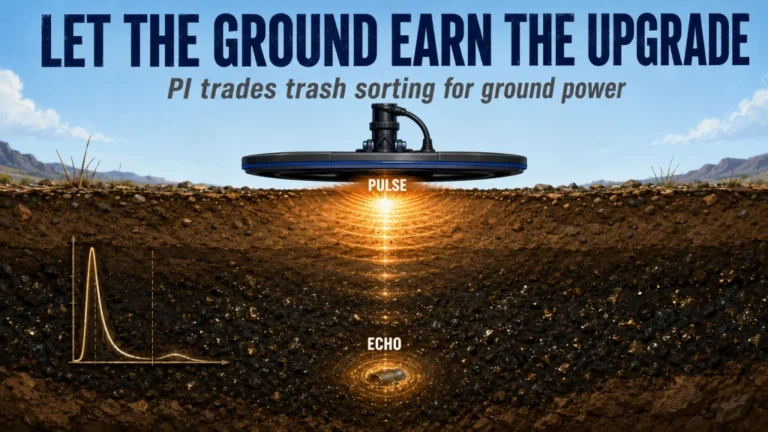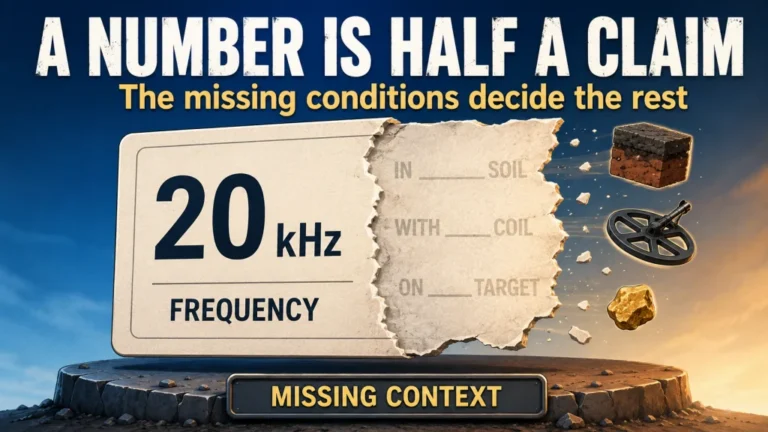
A detector’s operating frequency influences how strongly it responds to different target sizes, shapes, conductivities, and ground conditions, but the kHz number cannot predict performance by itself. Higher-frequency implementations often respond well to very small or low-conductivity targets, while lower-frequency implementations may favor larger or higher-conductivity targets, yet coil design, recovery behavior, filtering, ground handling, and software can reverse a simple paper comparison. The useful buying question is not which frequency is best, but whether the entire detector is built for the target and ground you will actually hunt. By the end, you will know how to read a frequency specification without turning it into a false depth or target-identification promise.
Metal Detector Frequency Explained: Why kHz Is Only One Part of Performance
Frequency matters, but it does not work alone. A detector operating at one frequency may respond differently from another machine at a nearby frequency because the two units also use different coils, gain structures, filters, recovery settings, search modes, and target-processing software. Reading only the kHz line is like judging a truck by engine speed while ignoring gearing, tires, and the ground under it.
I treat frequency as a clue about design intent, not a final verdict. It can help explain why a machine is responsive to tiny natural gold, why another behaves calmly around conductive salt, or why a particular mode favors larger targets. It cannot tell me, without field conditions and the rest of the specifications, which detector will go deeper or identify a buried object more accurately.
This article stays with frequency as a specification. It does not assign universal frequency tiers, promise a depth at any kHz value, or replace a full explanation of reading metal detector specifications. It also does not turn a single-frequency comparison into a claim about every selectable or simultaneous multi-frequency system.
What the Frequency Number Represents
Frequency is the rate at which the detector’s transmitted electromagnetic field changes. One kilohertz means 1,000 cycles per second, so a detector operating at 15 kHz cycles 15,000 times each second. That number describes the timing of the transmitted signal, not the number of inches it can detect and not a scale of target quality.
The search coil creates a changing magnetic field. A conductive target in that field develops induced electrical currents, and those currents create a secondary response that the detector receives and processes. The usable signal depends on far more than the target’s metal name. Size, thickness, shape, orientation, alloy, distance from the coil, surrounding soil, and nearby metal all change what returns to the detector.
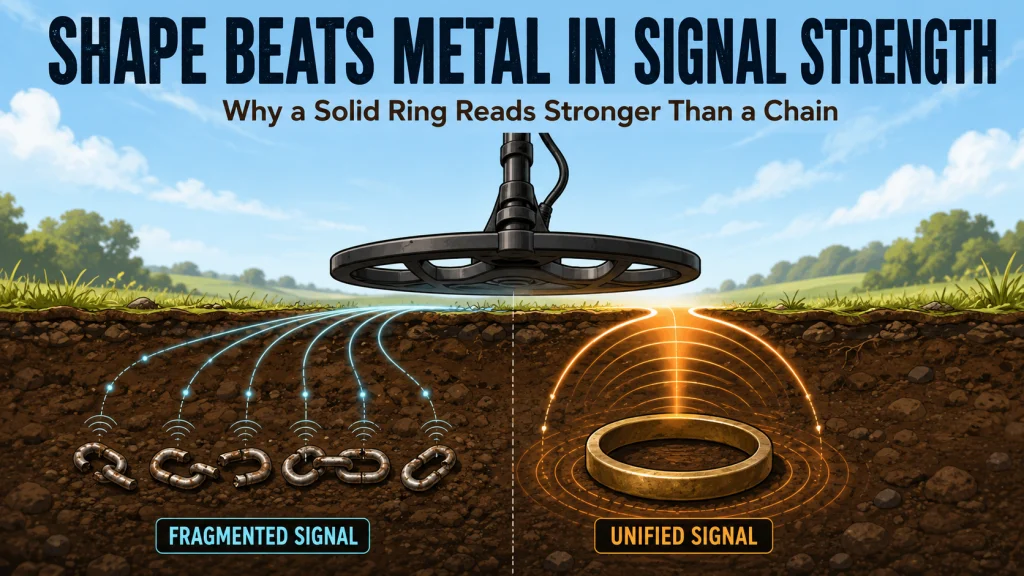
A thin chain is a good example. Even when the chain is made of a highly conductive metal, the detector may respond to its individual links as a collection of very small targets rather than as one solid object. A thick ring made from a mixed alloy can produce a stronger response than the chain, while a tiny natural gold flake may be harder again because its mass is so small. The operating frequency interacts with all three, but it does not erase their physical differences.
That is why I place the kHz number beside the coil, search mode, ground-balance system, and target-processing controls when I compare machines. The signal path described in how metal detectors detect targets is a chain, and frequency is only one link in it.
Useful Frequency Tendencies Without Turning Them Into Rules
Some higher-frequency designs are especially responsive to small targets and weak conductors. That can help with tiny natural gold, fine jewelry, small lead, thin hammered-style coins, or other low-mass objects. The same sensitivity can also make the detector hear more small foil, hot ground, or salt response unless its ground handling and signal processing control those effects.
Some lower-frequency designs can favor larger, higher-conductivity targets and may run more calmly in certain difficult ground conditions. That does not mean every lower-frequency machine reaches deeper on every silver coin. It means the frequency may support that target response when the coil, power, gain, filtering, recovery behavior, and soil conditions also support it.
| Frequency tendency | Where it may help | What can change the result |
|---|---|---|
| Greater response to very small or low-mass targets | Tiny natural gold, fine chains, small lead, thin low-conductivity items | Mineralization, salt, coil size, recovery speed, gain, and target orientation |
| Stronger emphasis on larger or higher-conductivity targets | Large coins, bigger brass or copper objects, larger gold masses | Target masking, depth, search mode, filtering, coil geometry, and soil response |
| Calmer operation in a difficult environment | Some salt or mineralized conditions | Ground subtraction, noise canceling, sensitivity, and the detector’s complete platform |
The table is a starting point, not a shopping chart. The correct next step is to identify the target and ground first, then check whether the machine’s entire design supports that job. A frequency tendency becomes useful only after those conditions are named.

The MINELAB Gold Monster 1000 uses a 45 kHz VLF platform with a 24-bit signal processor. Its listing highlights fully automatic noise canceling, ground balance, and sensitivity control. This version includes a 5-inch waterproof search coil and is designed for gold detection across a range of nugget sizes.
Check On AmazonIf you click this link and buy, we earn a commission at no additional cost to you.
Why Direct kHz Comparisons Usually Fail
Two detectors labeled 10 kHz and 15 kHz are not the same detector with one number changed. One may use a larger coil, slower recovery, stronger filtering, a different transmit waveform, more aggressive ground subtraction, or a search mode designed around a particular target range. If the 15 kHz machine gives a cleaner response in one test, the frequency may have contributed, but the result does not prove that 15 kHz is universally better.
The closest practical frequency comparison uses the same detector, the same coil, the same search mode, and the same target while changing only the selectable frequency. Even then, the software may alter supporting parameters when the frequency changes. A clean air test can reveal relative signal response, but it cannot reproduce mineralized soil, wet salt, target masking, or a coin standing on edge beside iron.
Field Note: I do not accept a frequency claim from one pass over one target. I want repeated sweeps from two directions, stable settings, a clean patch of ground, and a written record of what changed. If the coil, mode, sensitivity, recovery setting, or ground balance changed with the frequency, the result belongs to the complete setup, not to the kHz number alone.
Use this control list before treating any comparison as evidence:
- Keep the detector, coil, target, target depth, and target orientation the same.
- Use the same search mode unless the manual confirms that only frequency changes.
- Record sensitivity, recovery, discrimination, filtering, and ground-balance settings.
- Test in the ground you intend to hunt, not only in open air.
- Repeat the pass from more than one direction and note stability as well as signal strength.
This method will not turn a backyard test into a laboratory result, but it prevents the most common mistake: crediting frequency for a difference created by five other settings.

The MINELAB Equinox 900 lets you choose among six single frequencies or use Multi-IQ to employ five frequencies at once. It provides Park, Field, Beach, and Gold modes for different target and ground types. The listing also states that the detector is waterproof and submersible to 16 feet.
Check On AmazonIf you click this link and buy, we earn a commission at no additional cost to you.
Gold Is Not One Target With One Best Frequency
The search phrase “what frequency metal detector for gold” hides several different jobs. Tiny natural gold in mineralized ground, a larger nugget, a solid wedding band in park soil, a fine chain in dry sand, and a mixed-alloy earring do not present the same electromagnetic target. A frequency chosen for one of those jobs may be a poor shortcut for another.
Small natural gold often benefits from a detector platform designed to retain weak responses from tiny low-mass targets while managing mineralized soil. A larger nugget has more mass and may respond well under a different balance of frequency, coil size, threshold behavior, and ground handling. The key distinction is not “gold versus non-gold.” It is target mass and geometry combined with the ground around it.
Jewelry widens the problem. A broad ring can give a solid response, while a broken chain may sound only at the clasp or where several links overlap. Alloy composition changes conductivity, and target shape changes the current path through the object. No single operating frequency guarantees all gold jewelry, and no universal Target ID range can separate gold from foil, pull tabs, or other low-to-medium conductors.
Frequency and identification should therefore stay separate in your reasoning. The detector transmits and processes a signal at its operating frequency, then assigns audio and visual information through its identification system. The limits of that second step are covered in metal detector discrimination and Target ID, where target size, shape, depth, and adjacent trash matter as much as the metal label.
Silver and Relics Still Require Equivalent Test Conditions
A lower operating frequency does not automatically detect a silver coin deeper than a higher one. A silver dime lying flat in mild soil is not the same test as a worn dime standing on edge in red clay beside a square nail. The second target gives the detector less favorable geometry, more ground response, and possible masking before frequency is even considered.
Relics make universal claims even less useful. A large brass buckle, a thin button, a lead projectile, a small cuff link, and an iron tool vary in size, shape, conductivity, and magnetic behavior. Saying one frequency is “for relics” compresses too many targets into one word.
When I evaluate a silver or relic claim, I ask whether the comparison used the same coil footprint, recovery setting, discrimination pattern, target orientation, soil, and sweep speed. I also check whether the cleaner signal came from more depth or simply from better target separation. A fast setup that unmasks a coin beside iron may recover a target that a slower setup misses, even when the slower machine has an operating frequency commonly associated with high-conductivity targets.
Key point: Depth is not a property of frequency alone. It is the result of target response, coil field, ground loss, signal-to-noise performance, filtering, recovery behavior, and the detectorist’s sweep.
The practical buying move is to look for controlled field evidence that resembles your site. Mild park soil, mineralized farm ground, wet salt, and iron-filled home sites should not share one depth conclusion.

The Garrett ACE 300 operates at 8 kHz and provides a 0-99 digital target ID scale. Its iron resolution is designed to improve target separation in trashy areas, and it includes electronic pinpointing. This bundle also includes a Pro-Pointer AT and search coil cover.
Check On AmazonIf you click this link and buy, we earn a commission at no additional cost to you.
How Selectable and Simultaneous Multi-Frequency Systems Address the Trade-Off
A selectable-frequency detector lets the operator choose one available frequency at a time. This can be useful when a site presents a specific problem, such as electrical interference, unstable ground response, or a target range that deserves more emphasis. Because the same coil and electronics remain in place, selectable operation can also provide a more meaningful comparison than testing two unrelated machines.
A simultaneous multi-frequency system transmits, receives, or processes more than one frequency as part of one detection platform. The purpose is not merely to stack several kHz numbers on a box. The manufacturer decides which frequencies or frequency ranges matter, how their responses are weighted, how ground or salt is subtracted, and how the final target signal is reported.
That implementation is the part buyers often miss. Two machines can both use simultaneous frequencies and still behave differently because their waveforms, mode design, coil, ground handling, and software are different. One system may prioritize wet-salt stability, another small-target response, and another target separation in iron.
Frequency choice is therefore connected to technology type, but it does not replace it. Use comparing metal detector technology types to separate single-frequency VLF, selectable-frequency designs, simultaneous systems, and pulse-induction operation before comparing individual kHz values.
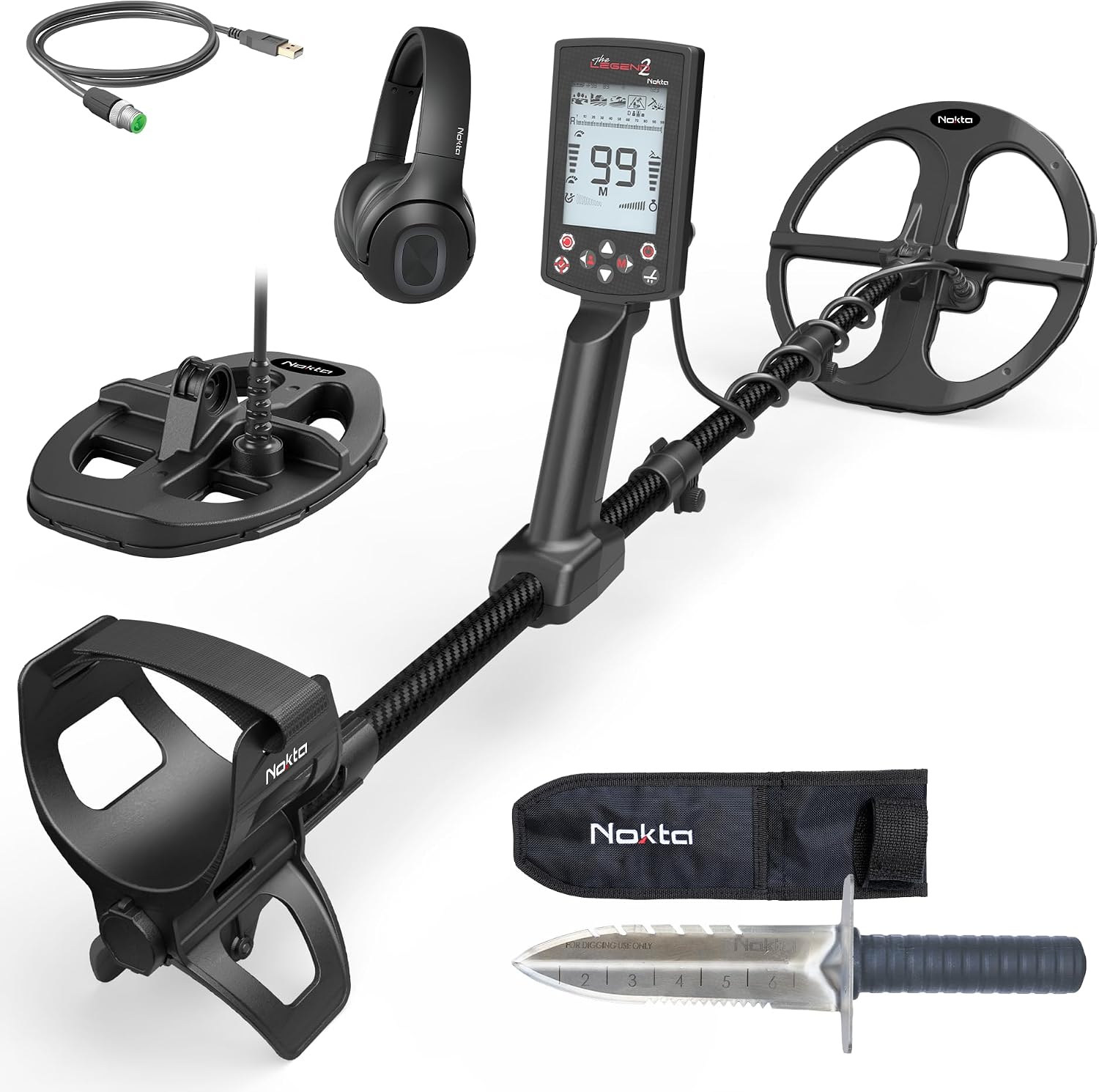
The Nokta Legend 2 is a simultaneous multi-frequency detector with 99 target IDs and adjustable-frequency harmonic tones. It provides 15 custom user profiles and multiple search modes for different detecting situations. This package includes two search coils and Bluetooth low-latency headphones.
Check On AmazonIf you click this link and buy, we earn a commission at no additional cost to you.
A Practical Checklist for Reading a Frequency Specification
Start with the hunt, not the number. A detectorist looking for tiny natural gold in mineralized ground needs a different balance of sensitivity and ground control from someone searching for larger coins in a mild park. A beach hunter must also separate dry sand from conductive wet salt because the ground itself can become a major part of the signal.
Then read the manufacturer documentation closely enough to learn what the frequency entry means. A single listed number, several selectable numbers, and a simultaneous operating range describe different systems. Confirm which frequencies are available in each mode, whether coil choice changes the options, and whether the manual connects particular modes to specific ground or target conditions.
- Exact frequency options: Is the detector fixed, selectable, or simultaneous, and which settings are available in the intended mode?
- Intended target: Are you after tiny natural gold, larger nuggets, rings, chains, coins, or mixed relics?
- Target geometry: Is the likely target thin, small, broken, irregular, edge-on, or a larger solid mass?
- Ground conditions: Is the soil mild, mineralized, wet, salty, or filled with hot rocks and iron?
- Coil: Which coil produced the claimed result, and is that the coil you will use?
- Search mode: Does the mode change filtering, recovery, ground subtraction, or audio along with frequency?
- Field evidence: Was the comparison controlled, repeated, and performed in ground similar to yours?
- Manufacturer documentation: Does the current manual confirm the frequency and explain its mode limitations?
My decision path is simple. First, reject any claim that turns one kHz number into a guaranteed target or depth result. Second, match the detector’s intended target and ground handling to the hunt. Third, use frequency to refine the choice or setting after the larger fit is already correct.
That order prevents an expensive mistake. A machine can carry an attractive frequency number and still be the wrong tool if its coil, mode design, salt handling, or recovery behavior does not match the ground you plan to cover.
Final Thoughts: Match the Whole Signal System to the Hunt
Operating frequency influences target response, but it never acts in isolation. Higher-frequency designs can be useful for tiny or weak targets, while lower-frequency designs can favor larger or higher-conductivity targets, yet those tendencies only become meaningful inside a complete detector, coil, mode, and ground condition.
Before buying a machine or changing frequency in the field, name the exact target and terrain. Then check the manual, control the comparison, and judge stability, separation, and repeatability along with signal strength. The kHz number should help you ask better questions, not give you a shortcut answer the ground will immediately disprove.
FAQs
⚙️ What does kHz mean on a metal detector?
kHz means thousands of cycles per second. A 15 kHz detector operates at 15,000 cycles per second, but that number does not state its detection depth or identification accuracy.
📏 Does a lower frequency always detect deeper?
No. Lower frequencies may favor some larger or higher-conductivity targets, but depth also depends on the coil, target size and orientation, soil, gain, filtering, recovery behavior, and signal processing.
✨ Is a higher frequency always better for gold?
No. Higher-frequency designs often respond well to tiny natural gold, but larger nuggets, solid rings, fine chains, and mixed-alloy jewelry are different targets. Ground mineralization and the detector’s ground handling can matter more than the frequency number alone.
🪙 What frequency is best for silver coins?
There is no universal best frequency. Compare results under equivalent conditions and pay attention to soil, coin orientation, masking, coil size, recovery settings, and the detector’s complete platform.
🏖️ Should I change frequency on wet salt sand?
Use the mode and frequency options the manufacturer assigns to conductive salt conditions. Stability matters more than choosing a number that looks ideal for a target in dry ground.
🔄 Is simultaneous multi-frequency always better than selectable frequency?
Not in every situation. Simultaneous systems can balance target and ground responses effectively, while selectable frequency can help isolate interference or emphasize a specific condition. Implementation determines the result.
Sources and References
- XP Metal Detectors, DEUS II Instruction Manual: manufacturer documentation showing how frequency combinations, maximum frequency, ground processing, recovery settings, and search programs work together rather than as isolated specifications.
- Minelab Product Manuals and Guides: official access point for current detector manuals used to verify fixed, selectable, and simultaneous frequency specifications.
- Minelab EQUINOX 900 Technical Specifications: manufacturer specification example listing simultaneous operation and multiple selectable single-frequency options on one platform.
- USGS, Vertical Spatial Sensitivity and Exploration Depth of Low-Induction-Number Electromagnetic-Induction Instruments: controlled numerical analysis showing that electromagnetic exploration depth changes with soil electrical conductivity and instrument conditions.
- USGS, Electrical and Magnetic Properties of Rock and Soil: technical background on how soil electrical properties vary with frequency and affect electromagnetic behavior.