A pulse induction detector can be the right tool when mineralized soil, conductive wet sand, or a deep all-metal search overwhelms a more conventional machine. It is not automatically deeper, quieter, or better in every location, and its reduced target information can turn a trash-heavy site into a long day of digging. The useful decision is not PI versus everything else in the abstract, but whether the ground is masking the targets you want badly enough to justify more uncertain recoveries, different coil behavior, and a more specialized setup. By the end, you will know how PI works, what still causes false responses, and when its trade-offs make sense for a real hunt.
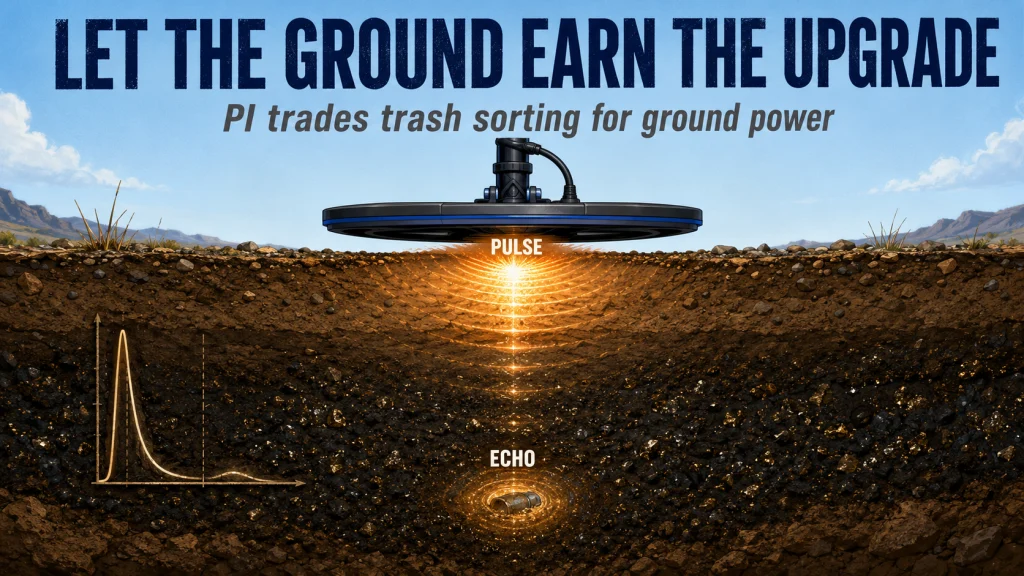
A PI Advantage Only Exists When the Site Creates One
A PI metal detector is not a universal upgrade from VLF. It becomes useful when the ground response is strong enough to hide or distort the target response, especially in some mineralized goldfields, conductive beach conditions, and low-trash sites where digging uncertain signals is acceptable. In mild soil with dense modern trash, the same machine can give up more useful information than it gains in signal response.
I treat PI as a ground-and-target decision, not a prestige decision. Before comparing machines, I want to know what the detectorist is trying to recover, what the soil does to the current setup, and how much iron or aluminum is scattered through the search area. That practical frame matters more than a dramatic air test or a claim that one technology always reaches farther.
This article stays within hobby metal detecting for US beginners and intermediate users. It does not cover airport screening, industrial detection, commercial survey equipment, or SCUBA salvage. For the wider context, start with how the main detector technologies differ, then use how metal detectors create and read signals to connect the electronics to what you hear over the ground.
How Pulse Induction Works After Each Transmit Pulse
A pulse induction metal detector sends a short burst of current through the search coil. That burst creates a magnetic field, and when the current stops, the field collapses. Metal within the field develops eddy currents that create a secondary response, which fades at a rate influenced by the target’s size, shape, composition, orientation, and distance from the coil.
The detector samples what remains after the transmit pulse rather than comparing a continuous transmit and receive signal in the same way a typical induction-balance VLF does. The timing of that sample is a major part of the design. An earlier sample may retain more response from small or low-conductive targets, but it can also include more ground response and residual coil effects. A later sample can improve stability in some conditions while losing part of a weak, fast-decaying target response.
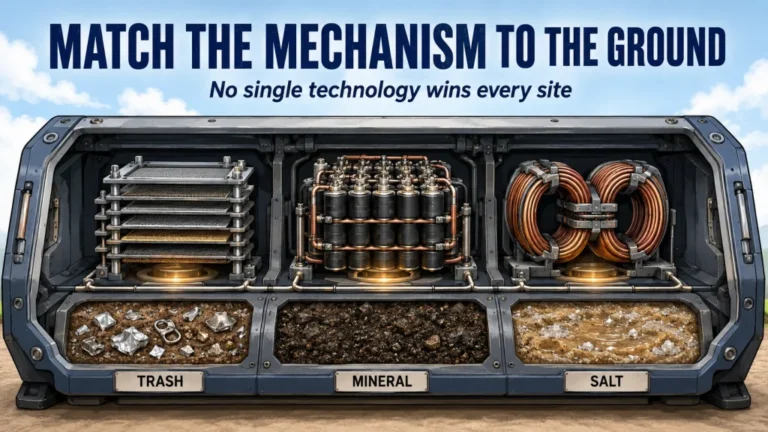
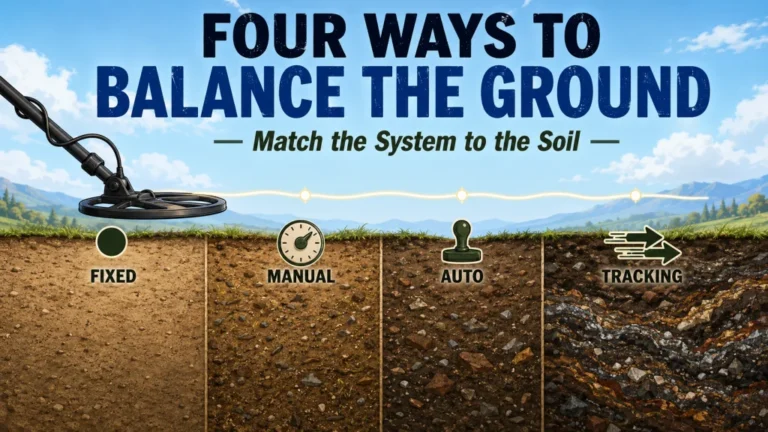
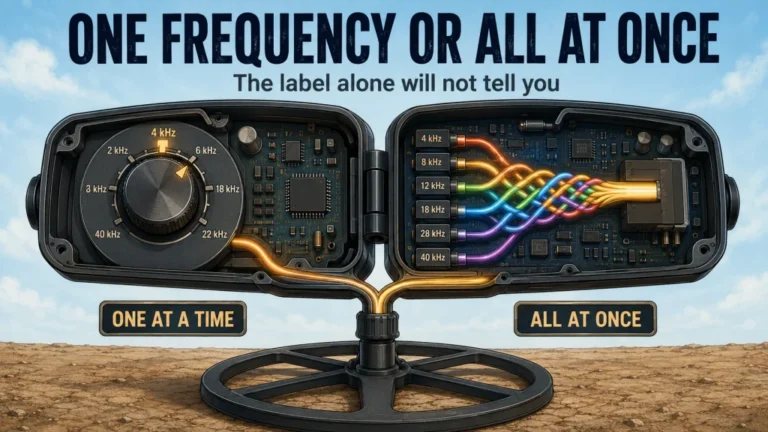
That is why the phrase “pulse induction” does not describe one identical circuit or one identical field behavior. Pulse timing, ground balancing method, coil configuration, signal processing, audio, and the way the machine handles conductive ground vary by design. Two PI detectors can react differently to the same hot rock or wet salt line even though both use transmit pulses and decay sampling.
Key point: The useful question is not how many pulses a machine sends in isolation. The useful question is how its timing and processing separate the target response from the ground response at the site you intend to hunt.
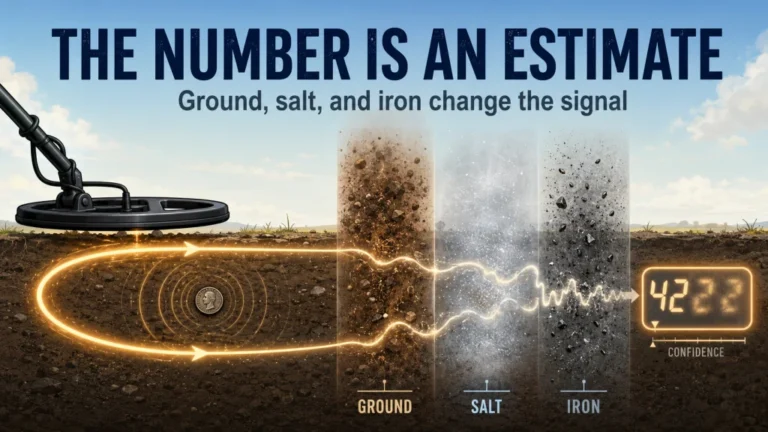
In the field, this means a setting that sounds powerful in clean ground may become too aggressive when the coil crosses variable mineralization. More sensitivity is only helpful while the threshold remains stable enough for a weak target to stand out. Once the ground and noise begin producing similar responses, the extra gain is no longer free performance.
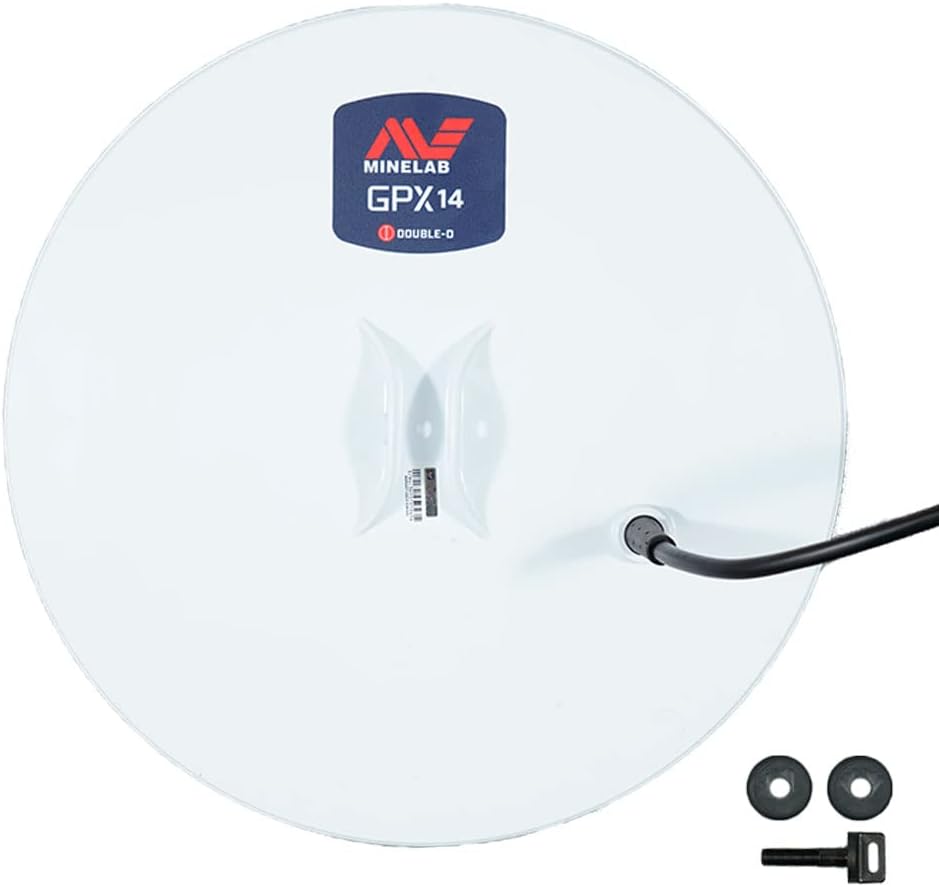
The MINELAB GPX 14 is a 14-inch Double-D search coil made for the GPX 6000. Amazon lists it as compatible with the GPX 6000 metal detector. The listing states that the coil is waterproof and submersible up to 3.3 feet.
Check On AmazonIf you click this link and buy, we earn a commission at no additional cost to you.
PI Handles Some Difficult Ground Better, Not All Ground Perfectly
Many ground-balancing PI designs can reduce the effect of mineralized soil better than many single-frequency VLF detectors. The advantage appears when a VLF must be detuned, slowed down, or run at a lower stable sensitivity because the ground signal is masking weak targets. PI can preserve a more usable target response in those conditions, but the word “better” still depends on the exact soil, target, coil, and detector configuration.
Hot rocks can still produce repeatable signals. Conductive salt can still require a suitable ground mode or timing. Electromagnetic interference can still make the threshold chatter, and a large or highly sensitive coil can make that problem harder to control. Wet soil can also behave differently from the same location after a dry period, so a setup that worked on the last visit is not automatically the correct starting point today.
When a PI becomes noisy, I would separate the possible causes before changing several controls at once:
- Hold the coil still and raise it away from the ground. Noise that continues in the air points more strongly toward EMI, a loose connection, coil movement, or another hardware-related cause.
- Sweep over a clean patch. Noise that follows the coil movement across the soil points more strongly toward ground response or hot rocks.
- Run the detector’s noise-cancel or retune procedure before reducing sensitivity.
- Rebalance on confirmed metal-free ground, then test a less aggressive ground or timing option if the threshold remains unstable.
- Check whether the coil type and size match the conditions rather than assuming the largest coil is the correct coil.
This sequence keeps one problem from being mistaken for another. Lowering sensitivity may quiet EMI, ground noise, and a loose coil cable, but it does not prove which one caused the instability. Diagnosis matters because each cause has a different fix.
Field Note: The fastest way I see a promising hunt go sideways is when every unwanted sound gets blamed on mineralization. If the noise remains while the coil is motionless in the air, ground balance is not the first control I would touch. A PI can reduce one type of ground response and still be unstable for a completely separate reason.
Coil configuration also changes the answer. On some PI systems, a monoloop coil can provide strong sensitivity and coverage but become harder to stabilize in severe ground or EMI. A Double-D coil may improve ground handling, interference control, or access to a model-specific iron-check feature. Those are design-dependent behaviors, so the manual for the exact machine and coil remains more reliable than a blanket rule.
PI Detector vs VLF: The Real Trade-Off Is Target Information
A VLF detector usually gives the operator more information before digging. Phase-based target identification, ferrous and nonferrous categories, notch patterns, and multiple tone regions can help separate a coin-sized response from common trash. That information is not perfect, but it can save enormous time in a park where every sweep crosses nails, foil, pull tabs, and bottle caps.
PI machines often emphasize an all-metal audio response, signal strength, polarity, or a limited model-specific iron check rather than a detailed target-ID scale. It is wrong to say every PI has no discrimination, but it is equally wrong to treat PI discrimination as equal to a good VLF target-identification system. Iron checks may require a particular coil, may work best on stronger targets, and can become less dependable with deep, oddly shaped, partially masked, or edge-of-coil signals.
| Decision factor | PI tendency | VLF tendency |
|---|---|---|
| Mineralized ground | Often maintains a more usable signal in difficult soil | May require lower sensitivity or more careful ground balance |
| Target classification | Usually limited, audio-led, or model-specific | Usually offers more detailed target ID and discrimination |
| Dense modern trash | Can require many uncertain digs | Usually provides a faster way to sort targets |
| Small targets in mild ground | Performance depends heavily on timing and coil | A suitable high-frequency design can be very sensitive |
| Setup priorities | Ground mode, timing, coil, threshold, and stable sensitivity | Frequency, recovery behavior, target ID, discrimination, and balance |
The table is not a winner chart. It shows why the same operator may prefer PI on a mineralized relic site and VLF fifty yards away around a nail-filled house foundation. The target population changes the value of discrimination even when the soil stays the same.
For a deeper explanation of the other side of that trade, read how VLF detectors separate target signals. The practical mistake is buying PI to gain response, then discovering that the intended sites demand target classification more than raw all-metal coverage.
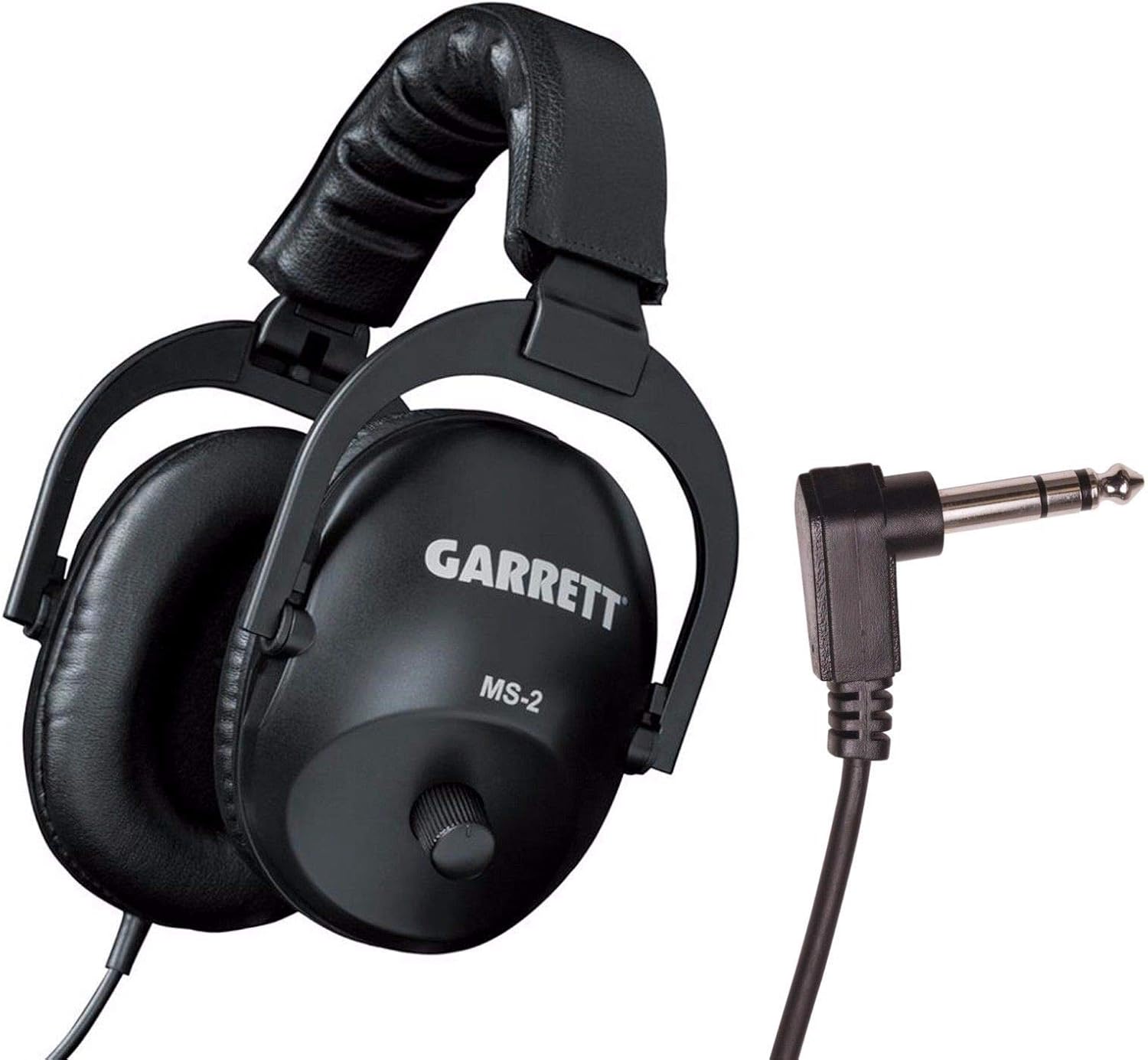
The Garrett MS-2 Headphones use a 1/4 inch right-angle stereo plug and are made for metal detecting use. They include volume control for adjusting signal levels and improving weak-signal listening. The design also uses padded ear cups, an adjustable headband, and a reinforced coiled cable.
Check On AmazonIf you click this link and buy, we earn a commission at no additional cost to you.
When a PI Metal Detector Is the Right Tool
PI makes the strongest case when the ground is the main obstacle and the targets are worth digging without precise identification. That combination occurs in some mineralized goldfields, some conductive wet-salt environments, cleaner beaches, and selected relic sites where the search goal is a broad metal response rather than cherry-picking one narrow target category.
| Hunt condition | Why PI may help | Condition that can change the answer |
|---|---|---|
| Mineralized goldfield | Can reduce ground masking and preserve signals a struggling VLF may lose | Tiny shallow gold, mild ground, or dense iron may favor a sensitive VLF |
| Wet salt or black-sand zone | A suitable PI design and timing can remain stable where some VLF setups struggle | Modern trash or a need for target ID may favor simultaneous multi-frequency |
| Clean beach | Digging most responses is manageable when trash density is low | A busy beach can turn every deep response into extra work |
| Deep relic site | All-metal response may be useful when target recovery matters more than neat classification | A square-nail concentration can overwhelm the time available |
Mineralized gold ground is the clearest example. A VLF can be excellent on tiny shallow gold in mild soil, but its advantage shrinks if the threshold is constantly reacting to the ground. PI becomes useful when the machine can hear through that response well enough to reveal targets that were masked, not because the letters PI create depth by themselves.
Beach hunting requires the same restraint. Wet salt and black sand are not one identical condition, and a PI that behaves well on one beach may still respond to the conductive layer, hot rocks, or changing water content on another. When target ID remains a priority, when simultaneous multi-frequency is the better fit becomes part of the decision rather than an afterthought.
On a researched permission property, I may accept more uncertain digging in a relatively clean field if the goal is recovering a wider range of relic responses. I would make a different choice beside an old structure where square nails, wire, and sheet metal are concentrated. The historical potential may be identical, but the amount and type of iron changes whether PI is productive or punishing.

The GADFISH Sand Scoop is made from 201 stainless steel and is designed for beach and underwater searching. It can be used with its long pole to sift sand while standing. The kit also includes a separate sand shovel for moving and recovering material around a detected target.
Check On AmazonIf you click this link and buy, we earn a commission at no additional cost to you.
Where PI Usually Becomes the Wrong Compromise
An iron-heavy park is the obvious poor fit. The ground may be mild enough for a VLF to run smoothly, while the real challenge is separating desirable targets from dense trash. Giving up detailed target information in that setting can increase digging without solving the actual problem.
Dense modern aluminum creates a similar issue. Gold jewelry can overlap foil and pull-tab responses even on a VLF, so target ID cannot eliminate every uncertain recovery. Still, a useful conductivity scale and tone system let the operator make controlled decisions. With a PI, many of those targets may collapse into a smaller set of audio clues that require more digging and more experience to interpret.
A first-time buyer also needs to consider the learning and physical burden. Some PI setups are heavier, use larger coils, demand more attention to threshold changes, or require power planning for a full day. None of those factors makes PI bad, but they matter if the detector stays in the truck because the operator dislikes swinging it.
PI is also a weak match when the hunt depends on recovering only a narrow target class within limited time. School fields, picnic areas, and short after-work hunts often reward fast target sorting. A specialized machine that provides a stronger response but less classification can reduce the number of useful holes dug per hour.
Use This Checklist Before Choosing Pulse Induction
The safest buying decision starts with the site, not the control box. Do not freeze the comparison around one current model or one price. Availability, coil choices, waterproof ratings, ground modes, iron-check behavior, weight, batteries, and included accessories change, while the underlying decision remains the same.
Work through these questions before spending money:
- Target: Are you searching for natural gold, jewelry, coins, relics, or large deep metal? The useful timing and coil can change with target size and conductivity.
- Ground: Has your current detector shown that mineralization or conductive soil is masking targets, or are you assuming PI will be better without testing the site?
- Trash density: Can you dig most signals, or will iron and aluminum consume the available hunt time?
- Required discrimination: Do you need reliable target categories, or can you work from audio and recover uncertain responses?
- Coil fit: Does the available coil size and configuration suit the terrain, ground, EMI, and target size?
- Weight and balance: Can you swing the complete setup for the length of your normal hunt, not just lift it in a store?
- Power: Does the battery system support the actual day, travel, charging access, and replacement plan?
- Budget: Can you cover the detector, the coil needed for your ground, power accessories, headphones, and any carrying support without cutting the rest of the detecting setup?
- Digging tolerance: Are you genuinely willing to recover weak and uncertain signals after the first hour, not only while the idea is new?
If the ground is stable, trash is dense, and target classification drives the hunt, keep PI off the shortlist. If the ground is masking worthwhile targets and the site is clean enough for broad recovery, PI deserves a controlled field comparison. If wet salt is the problem but target ID still matters, compare PI with an appropriate simultaneous multi-frequency setup before deciding.
Pro Tips: Test the decision with three real sites you hunt or plan to hunt. Write down the ground behavior, trash density, target goal, and maximum number of uncertain holes you are willing to dig. A detector that fits only an imagined trip is rarely the best first purchase.
The final check is evidence for the exact configuration. Read the current manual, confirm which controls work with which coil, verify what is actually waterproof, and separate manufacturer claims from the conditions in which the feature was tested. Avoid any seller who turns a conditional advantage into a promise of universal depth.

The Minelab carry bag uses reinforced canvas with padding to protect metal detecting equipment during storage and transport. It is designed to accommodate a wide range of metal detectors. An exterior zippered pocket provides additional space for accessories such as diggers and headphones.
Check On AmazonIf you click this link and buy, we earn a commission at no additional cost to you.
Final Thoughts: Let the Ground Earn the PI Upgrade
Pulse induction is valuable because it can preserve a usable target response in conditions that force other detectors to give up stability or sensitivity. That advantage is real, but it comes with a narrower role, less target information on many designs, and more uncertain digging. The better question is not whether PI is powerful. It is whether your ground problem is large enough to justify those costs.
I would rather use a capable VLF in mild, trashy ground than carry a specialized PI simply because it has a reputation for depth. I would also rather use PI where mineralization is masking the targets than spend an entire hunt forcing a VLF to behave in soil it cannot read cleanly. Match the technology to the limiting condition, then choose the controls, coil, and search strategy that support the site.
FAQs
These are the questions that matter most when a detectorist is deciding whether PI solves a real field problem or only sounds like an upgrade.
⚡ Does a PI metal detector always go deeper than VLF?
No. PI often gains an advantage when mineralized or conductive ground forces a VLF to lose stability, but depth still depends on the target, coil, soil, timing, sensitivity, EMI, and detector design. In mild soil on a small target, a suitable VLF may match or outperform it.
🧲 Can pulse induction ignore mineralized ground completely?
No. Many PI designs handle certain mineralized conditions better, but hot rocks, salt response, variable ground, coil choice, and aggressive settings can still produce noise. Ground balance and timing still matter.
🗑️ Can a PI detector discriminate iron?
Some PI detectors provide model-specific iron checks, tone clues, or limited discrimination, while others are primarily all-metal machines. Treat any rejection feature as conditional, especially on deep, oddly shaped, or partially masked targets.
🏖️ Is PI always the best choice for a saltwater beach?
No. PI can work very well in some conductive wet-salt and black-sand conditions, but trash density and the need for target ID may make simultaneous multi-frequency more practical. Waterproofing must also be verified for the full detector, not assumed from the coil rating.
⛏️ When should a beginner choose PI over VLF?
Choose PI when the planned sites have a confirmed ground problem, the target goal fits all-metal searching, and the beginner accepts more uncertain digging. For mild parks and mixed-use hunting, VLF is usually easier to learn and more informative.
The repeated pattern is simple: PI should solve a known ground or search problem. It should not be chosen only because a depth claim sounds impressive without conditions.
Sources and References
These technical references were used to verify the operating principles, ground behavior, coil differences, and model-specific limits described above.
- Minelab, how metal detectors work: overview of electromagnetic search coils, target response, ground balance, and detector technologies.
- Minelab, detector and coil technical FAQ: guidance on target identification, mineralized ground, EMI, ground balance, and differences among coil configurations.
- Minelab, current product manuals and guides: current documentation used to check that PI controls, ground modes, coils, and environmental ratings vary by exact detector.
- Garrett, current pulse induction documentation: model-specific evidence showing pulse timings, ground tracking, coil-dependent iron checking, weight, power, and coil options.
- DetectorProspector, PI and VLF field trade-offs: practical discussion of mineralization, hot rocks, small-gold sensitivity, trash handling, weight, and the reasons experienced operators may use both technologies.
Specifications and available configurations can change. Confirm the current manual and official product documentation for the exact detector and coil before making a purchase or relying on a particular feature.