The best metal detectors for gold nuggets are not the machines with the loudest Gold label. The right choice depends on the size of gold you realistically expect, how strongly the ground responds, how much control you can use well, and how long you can carry the detector over rough terrain. A sensitive machine that cannot stay stable in your ground may recover less gold than a calmer detector with a weaker air-test response. This guide gives you a practical way to choose the technology, controls, coil system, and physical setup that fit your prospecting conditions.
Start With the Gold and Ground, Not the Gold Label
The phrase best metal detectors for gold nuggets sounds as though one machine should sit above every other choice. Natural gold does not cooperate with that kind of ranking. A detector that responds sharply to a tiny shallow picker in mild soil may become noisy and tiring in magnetic ground, while a machine built to settle difficult soil may give up some response on the smallest pieces.
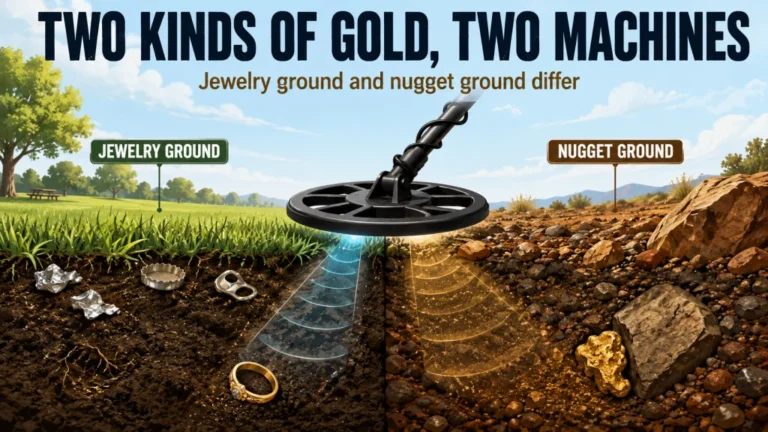
I would not choose a gold prospecting metal detector from frequency, price, or mode name alone. The useful question is whether the complete setup can keep a small target audible while the coil passes over the actual ground you plan to hunt. That means target size, mineralization, hot rocks, salt, coil choice, audio behavior, and operator workload must be considered together.
This article covers natural-gold nugget prospecting in US washes, creek beds, mining districts, and desert ground. Gold jewelry recovery, commercial detection, underwater salvage, and product-by-product rankings are outside its scope.
Define the Nugget Size You Are Really Chasing
Small gold is not merely a smaller version of large gold. As a target becomes lighter, thinner, flatter, or more irregular, its signal can weaken faster than a simple weight comparison suggests. Orientation also matters. A flat piece presented broadside to the coil may sound different from the same piece turned edge-on, even when its weight has not changed.
For shopping and testing, use target classes as decision bins, not geological standards. The exact boundaries matter less than testing every detector with the same weighed targets.
| Practical target class | What it demands from the detector | Common buying mistake |
|---|---|---|
| Very fine gold, below about 0.1 gram | Strong small-target response, a stable threshold, a suitable small coil, and disciplined ground control | Choosing a deep-seeking setup that is physically and electronically optimized for larger targets |
| Small nuggets, about 0.1 to 0.5 gram | A balance of sensitivity, ground handling, and repeatable audio from more than one sweep direction | Trusting a clean air test without checking mineralized soil |
| Medium nuggets, about 0.5 to 2 grams | Useful depth, stable operation, and coil coverage that matches the terrain | Assuming the highest available frequency is automatically best |
| Larger or deeper gold | Ground penetration, a suitable coil, manageable noise, and enough coverage to search efficiently | Using a tiny coil everywhere because it performed well on a small test piece |
A depth claim means little unless target weight, shape, orientation, soil, coil, settings, and test method are known. Tiny gold is often shallow, yet mineralization and hot rocks can bury its response in noise before depth becomes the main limitation.

Minelab Gold Monster 1000 uses 45 kHz VLF technology with a 24-bit signal processor for gold detection across a range of nugget sizes. It provides automatic noise canceling, ground balance and sensitivity adjustment. Its touchpad includes a Gold Chance indicator, Gold iron-reject mode and Deep All-Metal mode.
Check On AmazonIf you click this link and buy, we earn a commission at no additional cost to you.
Read the Ground Before You Choose the Technology
Ground conditions decide how much of a detector’s theoretical sensitivity remains usable. Mild soil lets many Very Low Frequency (VLF) and multi-frequency systems run close to their stronger settings. Magnetic mineralization, rapidly changing ground, hot rocks, or conductive salts force the machine to separate a weak metal response from a much larger ground response.
A buyer who does not classify the ground can pay for a strength the site does not need. Use these ground categories before comparing controls or technology.
- Benign soil: The threshold stays fairly smooth after ground balance, and normal coil motion does not create repeated false signals.
- Magnetic mineralization: Iron-bearing ground produces a strong response, reduces usable sensitivity, and may make a VLF detector sound busy.
- Variable ground: The soil response changes over short distances, so a balance point that works in one patch may not work twenty feet away.
- Hot rocks: Individual rocks differ enough from the surrounding ground to produce target-like responses.
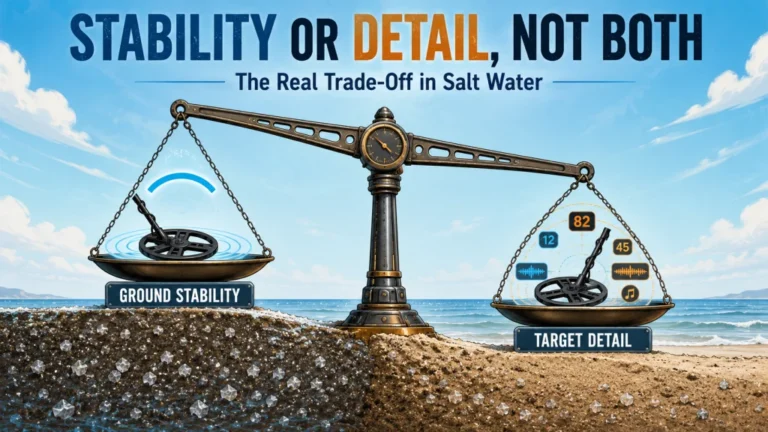
- Conductive salt: Wet salt, alkali, or saline soil creates a different ground problem from magnetic mineralization and may require a dedicated salt response or a different technology.
- Electromagnetic interference (EMI): Power lines, nearby electronics, storms, and other detectors can create instability that should not be mistaken for mineralization.
Field Note: The ground balance question comes up on almost every permission hunt I run in this region. New detectorists assume one setting works everywhere, but mineralized soil near an old foundation can read completely differently from open pasture only a short distance away. Gold ground can change just as quickly, so the detector must either track those changes well or give the operator enough control to respond.
Before spending more money, test the site with a magnet, inspect the wash for black sand or unusual rock bands, note whether false signals follow specific stones, and move away from possible EMI. Those observations do not identify the perfect detector by themselves, but they eliminate many poor matches. For a deeper explanation of why the machine reacts to the soil, read how ground balance handles soil.
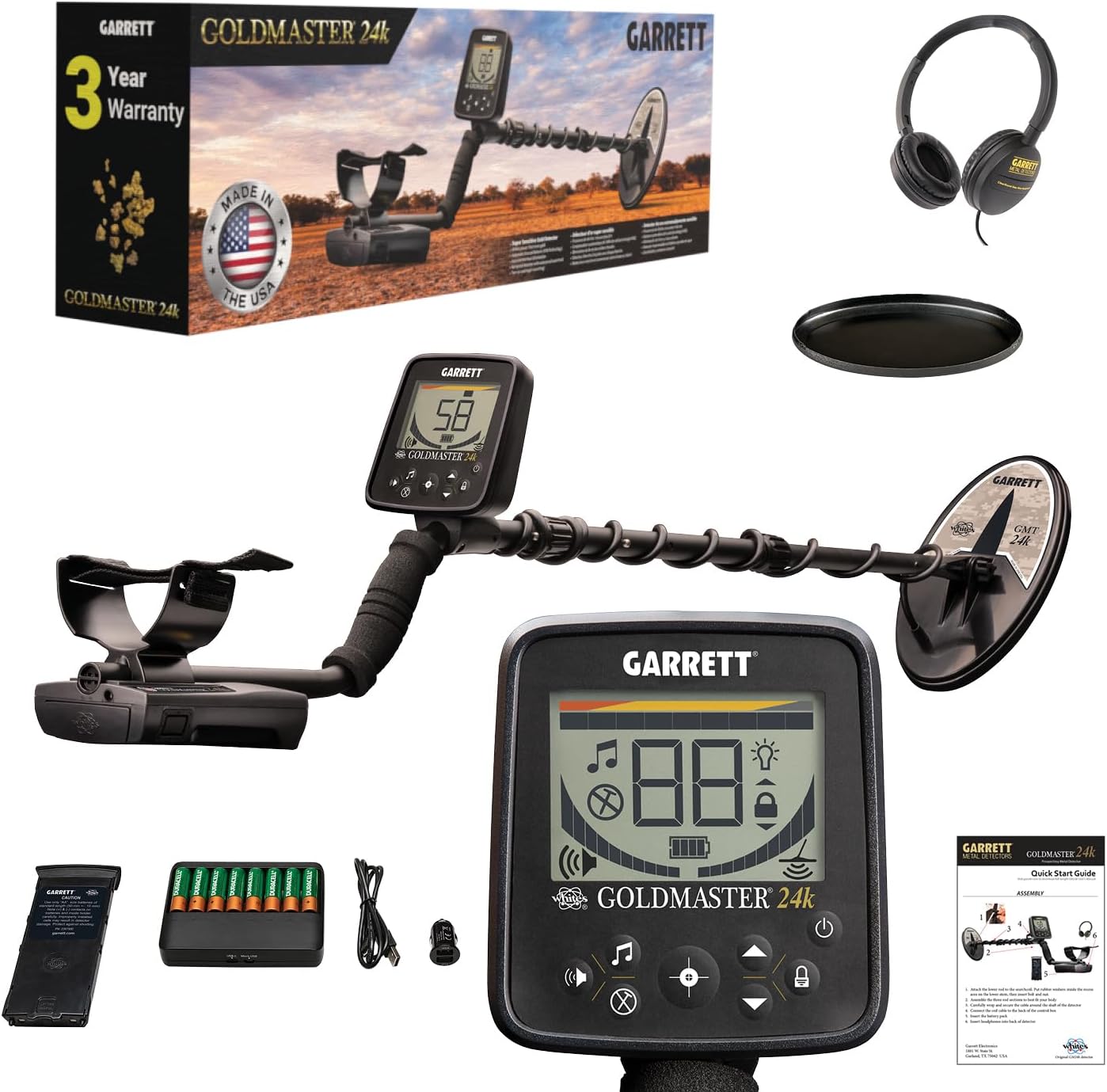
Garrett Goldmaster 24K operates at 48 kHz and is designed for sensitivity to small gold nuggets. Its XGB Ground Balance system automatically tracks changing soil conditions to reduce ground noise. The listed package also includes wired headphones.
Check On AmazonIf you click this link and buy, we earn a commission at no additional cost to you.
Evaluate the Whole Prospecting System
A good detector for small gold needs more than raw sensitivity. It must produce a repeatable response while the coil moves through real terrain. A strong indoor response means little if the threshold wanders, ground balance lags, or the coil cannot fit between rocks.
I would score each candidate in the order below. The first four factors determine whether the detector can separate gold from ground. The remaining factors determine whether you can use that performance for a full hunt instead of only a short demonstration.
| Evaluation factor | What to verify | Why it matters in the field |
|---|---|---|
| Small-target response | Repeatable audio on weighed targets from several directions | A single loud pass can be a false signal or an orientation advantage |
| Threshold and audio | Whether faint changes remain understandable after noise cancel and ground balance | Weak gold often appears as a change in the audio, not a perfect target ID |
| Ground handling | Stability over magnetic soil, variable patches, and representative hot rocks | Ground noise can erase the practical advantage seen in an air test |
| Manual control | Whether important controls are available and understandable when automatic behavior is not enough | Extra control helps only when the operator can identify the condition being corrected |
| Coil ecosystem | Small-coil access, larger coverage options, compatibility, and replacement availability | One coil rarely fits bedrock cracks, brush, open flats, and deeper ground equally well |
| Weight and balance | Actual swing comfort with the chosen coil and battery installed | Poor balance reduces coil control before total weight becomes unbearable |
| Battery and weather protection | Real operating time, charging method, spare-power plan, and protection level | Remote terrain punishes proprietary or fragile power arrangements |
| Service and training burden | Manual quality, repair path, parts access, and time needed to recognize weak signals | A technically superior machine may be the wrong first detector if it is rarely practiced with |
Do not treat one tone as proof of gold. In prospecting ground, the useful audio cue is a faint change that repeats at the same point after you correct coil height, sweep speed, and direction. A hot rock may change after rebalancing or reveal that the response follows one specific stone, while trash can remain repeatable too, so audio tells you what deserves investigation rather than what the target must be.
Do not let one strong specification erase a serious weakness. A small coil improves access and fine-target response but reduces coverage. A larger coil covers open ground faster but can be harder to control and noisier over difficult soil. Match the coil to the target and terrain.
Choose a Technology Group by the Problem It Solves
Frequency affects target response, but frequency alone does not tell you how the detector handles ground, processes audio, tracks changes, or uses its coil. That is why two machines with similar frequency figures can behave very differently on the same patch. The practical comparison begins with the technology group and its intended trade-off.
Dedicated VLF or multi-frequency prospecting machines usually emphasize small-target sensitivity, threshold-based audio, and ground controls intended for nugget hunting. They make the most sense in mild to moderately difficult ground when fine gold matters and the operator is willing to listen closely. To understand why a high number on a specification sheet is not a complete answer, review how detector frequency affects targets.
Versatile Machines With a Credible Gold Mode
A versatile detector can be a sensible choice when nugget hunting is one part of a broader plan. The Gold mode should provide more than a label. Look for suitable audio processing, useful ground balance behavior, a compatible small coil, and enough control to run the machine near its stable limit.
The trade-off is specialization. A versatile platform may be easier to justify for a traveler who also hunts coins, relics, or beaches, but it may not match a dedicated prospecting machine on the smallest gold or a specialist ground-handling system in severe soil. The correct comparison is not whether it has more modes, but whether the nugget mode remains stable and informative in your test ground.
Pulse Induction Specialists
Pulse induction (PI) systems become attractive when magnetic mineralization or difficult ground removes too much usable performance from a VLF setup. Their value is not that PI automatically detects every nugget deeper. The value is that stronger ground handling can preserve a clear target response where a more sensitive VLF machine becomes too noisy to use effectively.
The cost may include higher price, greater physical burden, weaker discrimination, or less response to the smallest gold, depending on implementation and coil. A buyer working mostly mild creek benches should not pay for severe-ground capability without evidence that the site needs it. A buyer facing black-sand washes and repeated hot-rock responses should study how pulse induction handles ground before ruling PI out.
Newer Hybrid or Specialized Systems
Hybrid and specialized systems attempt to combine fine-target response with stronger soil processing, or to improve performance across a wider target range. These systems should be judged by demonstrated behavior, not by technology names. Ask what the ground-processing stage removes, what target class may weaken with that processing, and whether the operator can hear the difference.
A newer architecture may improve performance while bringing a closed coil system, heavier power demands, a steep learning curve, or limited independent testing. Separate promising controlled results from evidence built across varied field conditions.

Garrett Axiom uses advanced pulse technology for detecting large nuggets and sub-gram gold in difficult soil conditions. Its Terra-Scan dual-channel ground balance is designed for mineralized ground and saltwater. The detector weighs 4.2 pounds with an 11-inch coil and uses a built-in lithium-ion battery.
Check On AmazonIf you click this link and buy, we earn a commission at no additional cost to you.
Automatic Versus Manual Controls Depends on Implementation
Automatic control is not a beginner feature by definition, and manual control is not automatically more capable. A well-designed automatic ground system can keep a detector usable while the soil changes, especially when the operator is still learning threshold behavior. A poor or overly aggressive system can also track toward a weak target or hide what the machine is doing.
Manual control gives the operator a way to lock, offset, retune, or compare settings, but only when the control has a clear purpose. More adjustments can increase recovery in the right hands and reduce it in the wrong ones. The practical question is whether the detector lets you identify a problem, make one change, and hear whether that change improved the target-to-ground separation.
Automatic tracking may suit variable ground when it preserves target responses. Manual or locked balance may help when repeated passes cause tracking to retune toward a weak target. Test the behavior you expect in the field.

Garrett AT Gold operates at 18 kHz and includes a True All Metal mode for prospecting. Its Ground Balance Window provides both manual and automatic ground balance for varying soil conditions. The detector also includes Iron Audio and is fully submersible to 10 feet.
Check On AmazonIf you click this link and buy, we earn a commission at no additional cost to you.
Use a Controlled Test Before You Trust a Ranking
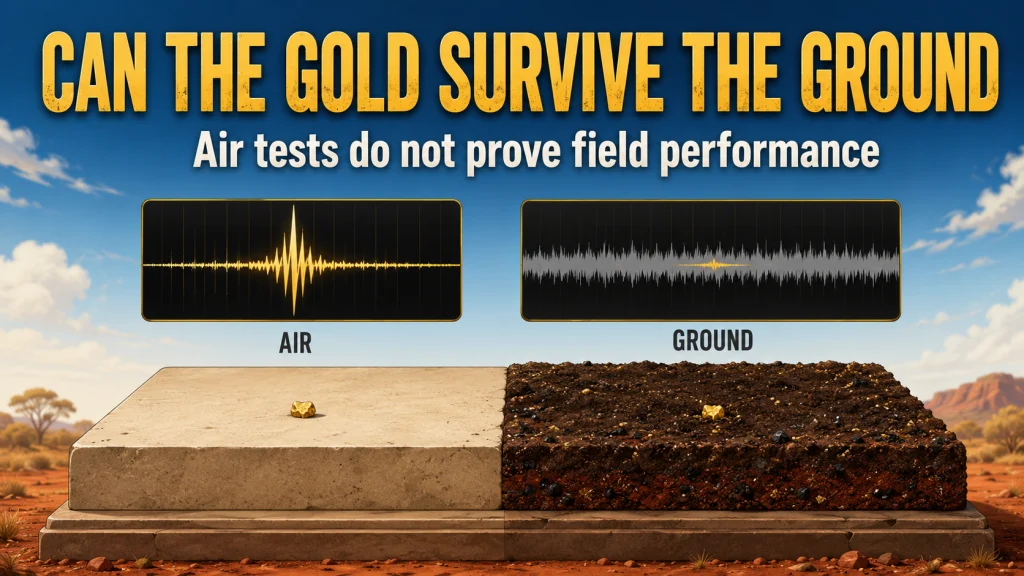
A useful comparison starts with weighed natural gold or representative gold targets, documented ground, the intended coil, and repeatable settings. An air test can show whether a detector responds at all, but it does not show how much of that response survives magnetic soil, hot rocks, conductive ground, or EMI. The controlled ground test is the part that turns a specification comparison into a buying decision.
I would use at least four target weights that match the intended hunt, then test each target flat, edge-on, and at more than one shallow depth. The exact weights can change, but every detector must see the same targets, positions, ground, and sweep path.
- Record the target weight, shape, and orientation.
- Scan the test patch for metal and note visible mineralization, moisture, hot rocks, and nearby EMI.
- Install the coil you would genuinely use in that terrain.
- Run the manufacturer’s normal startup, noise-cancel, and ground-balance sequence.
- Set sensitivity to the highest level that remains stable enough to hear weak changes.
- Sweep from at least two directions at a repeatable height and speed.
- Score the target only when the response repeats and can be separated from the ground.
- Repeat after changing one variable, such as ground mode, tracking, threshold, or coil.
- Document false signals, hot-rock behavior, recovery time, and operator fatigue.
Record whether the target is obvious, faint but repeatable, direction-dependent, masked by ground, or lost after a control change. A slightly clearer target is not an improvement if the rest of the patch becomes unmanageable.
The protocol also exposes training burden. One detector may give an obvious signal with little adjustment, while another recovers the same target only after careful tuning. They belong to different buyers.
Scott’s Field Judgment: Decide Where the Detector Belongs
I do not consider a detector proven because it wins one test. I want to know what evidence supports the result, which ground conditions favor it, what target class it handles well, and what limitation removes it from consideration. A recommendation without a disqualifying condition is usually a sales pitch with the uncomfortable parts removed.
Use five judgments for every candidate: evidence status, ground fit, learning burden, physical burden, and disqualifying limitation. This keeps a technically impressive detector from becoming the default recommendation for a person who cannot carry it, tune it, or justify its specialist capability.
| Judgment | Question to answer |
|---|---|
| Evidence status | Is the claim supported by controlled testing, documented field use, manufacturer information, or only promotional language? |
| Conditions where it belongs | Does it fit mild soil, variable ground, hot-rock areas, conductive soil, or severe magnetic mineralization? |
| Learning burden | Can the buyer recognize weak audio and adjust the machine without copying settings blindly? |
| Physical burden | Can the buyer carry, balance, and control the chosen coil for the length of the planned hunt? |
| Disqualifying limitation | What one condition makes this detector a poor choice for this buyer? |
The last question is the most valuable. A lightweight dedicated machine may be disqualified by severe magnetic ground. A powerful specialist may be disqualified by cost, weight, or the absence of a suitable small coil. A versatile detector may be disqualified when nugget prospecting is the buyer’s main purpose and the Gold mode cannot remain stable on the intended ground.
Choose by Role Instead of Chasing One Overall Winner
The final recommendation should place a detector into a role, not declare it universally best. That keeps the choice tied to the buyer’s ground, target size, experience, and physical limits. It also prevents a specialist machine from being compared unfairly with a versatile detector built for several hunt types.
Use the role descriptions below as a decision path. They do not identify specific products. They identify the kind of machine that deserves further testing for a specific user.
| Role | Best fit | Do not choose it when |
|---|---|---|
| Easiest dedicated detector | A new prospector who wants automatic setup, clear audio, and a short path to stable operation | The site needs manual intervention the machine does not provide |
| Versatile option | A buyer who prospects part-time and also hunts coins, relics, or beaches | Fine gold in difficult ground is the primary mission |
| Lightweight option | Long walks, steep terrain, brush, creek work, or an operator with limited swing endurance | Low weight is achieved by giving up the ground capability the site requires |
| Advanced-control option | An operator who understands threshold, tracking, ground balance, coil behavior, and single-variable testing | The controls will remain unused or be copied from other locations |
| PI specialist | Severe mineralization, difficult hot-rock fields, or sites where VLF stability collapses | The ground is mild, the expected gold is extremely fine, or the physical and financial burden is not justified |
A buyer working mostly difficult soil should continue with choosing for mineralized gold ground. A strict budget requires a different set of compromises, which is why gold detectors under 500 dollars should be evaluated as their own decision rather than compared directly with specialist systems.
Once you know which role fits, use choosing detectors for natural gold as the next comparison step, and eliminate any machine that fails your ground or target-size requirement before comparing convenience features. Return to matching detectors to hunt conditions when gold is only one part of your detecting plan.

Nokta The Legend uses simultaneous multi-frequency technology and also supports selectable 4, 10, 15, 20 and 40 kHz frequencies. It provides Park, Field, Beach and Gold Field search modes. The detector also offers automatic, manual and tracking ground balance for changing ground conditions.
Check On AmazonIf you click this link and buy, we earn a commission at no additional cost to you.
Final Thoughts: Buy the Detector That Keeps Gold Audible
The best gold nugget detector is the one that preserves a repeatable target response in your ground without exceeding your skill, budget, or physical limits. Start with expected nugget size, classify the ground, choose the technology group that solves that ground problem, and test with weighed targets under documented conditions.
I would rather see a beginner use a stable detector thoroughly than own a more capable specialist that stays in the truck because it is exhausting or confusing. The right machine is not the one that wins the cleanest demonstration. It is the one you can control long enough to cover productive ground and investigate weak, repeatable signals without letting the soil make every sweep sound important.
FAQs
⚖️ What nugget size should I use when testing a detector?
Use several weighed targets that represent the gold you expect, not one large piece that every detector can hear. Include at least one very small target, one small target, and one larger target, then test different orientations.
🧲 How do I know if my prospecting ground is highly mineralized?
Look for persistent ground noise after balancing, rapid changes across short distances, strong responses from black sand, and repeated signals from hot rocks. Confirm that the noise follows the ground before assuming the detector or EMI is responsible.
📡 Is a higher frequency always better for small gold?
No. Higher frequency can improve response to small, low-conductive targets, but ground handling, audio processing, coil size, and stability decide how much of that response remains usable.
🔊 Do I need a threshold tone for nugget hunting?
A stable threshold can make faint target changes easier to hear, but implementation matters more than the presence of the feature. Some systems use other audio processing effectively, so compare repeatability in real ground.
🪨 Should I choose PI whenever hot rocks are present?
Not automatically. First test whether the hot rocks can be balanced, identified, or handled with a suitable ground mode. PI becomes more compelling when hot rocks and mineralization make a VLF detector too unstable to recover weak targets efficiently.
🛠️ Are manual controls better than automatic controls?
Manual controls are better only when they solve a problem you can recognize. A strong automatic system may be more productive for changing ground, while manual or locked control may help when tracking weakens a repeated target.
🥾 How important is detector weight for gold prospecting?
Weight and balance affect coil control, coverage, and how long you can hunt. Test the complete setup with the intended coil and battery, because a poorly balanced detector can feel tiring even when its listed weight looks reasonable.
Sources and References
These sources support the technical distinctions used in this guide, including target response, ground mineralization, threshold behavior, coil trade-offs, Gold modes, and controlled testing.
- Minelab USA frequently asked questions: ground types, hot rocks, conductive soil, threshold behavior, and the overlap between gold and unwanted targets.
- Minelab nugget detecting techniques: threshold-based audio, Gold-mode behavior, mineralized ground, and the trade-off between sensitivity and stability.
- Minelab guide to search coils: coil size, small-target sensitivity, coverage, maneuverability, and terrain fit.
- Nokta prospecting detector specifications: automatic, manual, and tracking ground-balance implementation in a dedicated prospecting platform.
- DetectorProspector small-gold field evaluation: why air tests do not show how a detector behaves in mineralized soil and around hot rocks.
- DetectorProspector weak-target testing discussion: how ground and salt settings can weaken certain low-conductive gold responses.
Manufacturer information explains intended operation and specifications. Independent tests are most useful when the target, ground, coil, settings, and test method are documented clearly enough to repeat.