A single-frequency VLF detector remains a practical choice because it can combine useful target information, discrimination, manageable weight, and efficient battery use without forcing every beginner into a more complex system. It works by transmitting a continuous electromagnetic field, measuring the target’s returned response, and estimating what that response is likely to represent. The strength of VLF is not certainty, it is the amount of field information it can provide when the ground, salt, iron, and interference remain within the detector’s workable range. This page explains where the technology fits, where it loses stability or accuracy, and when another detector type deserves consideration.
Why Single-Frequency VLF Remains Common
A VLF metal detector can be operating exactly as designed while still giving poor results in the wrong conditions. That is the first point I want a new detectorist to understand. The technology is common because many VLF machines provide useful tones, visual Target ID, adjustable discrimination, interchangeable coils, reasonable weight, and long practical run time at approachable prices.
Those strengths make VLF a natural fit for many inland coin, jewelry, and relic hunts. They do not make it the automatic answer for every beach, goldfield, iron patch, or mineralized site. The exact detector still has to remain stable, separate nearby targets well enough for the site, and provide information the operator can use.
Scope: This page covers single-frequency VLF technology in recreational metal detecting. It does not explain simultaneous multi-frequency operation in depth, rank current machines, or provide a step-by-step settings sequence.
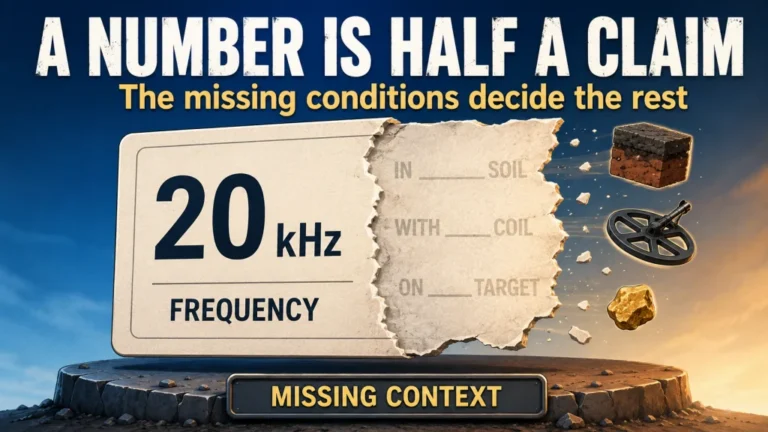
The hobby often uses “VLF” as a practical technology label for continuous-wave induction-balance detectors, not as a promise that every machine transmits at one identical frequency. The useful buying question is not whether the box says VLF. It is whether that particular implementation fits the target, ground, trash, water, and interference conditions of the hunt.
How Does a VLF Metal Detector Work?
A very low frequency metal detector sends a continuous alternating signal through the transmit side of the searchcoil. That signal creates an electromagnetic field around and below the coil. When the field reaches a conductive object, electrical currents are induced in the target, and the target produces a secondary electromagnetic response of its own.
The receive side of the coil detects the change created by that secondary response. The electronics compare the received signal with the transmitted signal, paying attention to its strength and timing relationship. In plain English, the detector is asking two questions: how much did the target disturb the field, and how did the returned response shift relative to the transmitted one?
- The transmit circuit drives the searchcoil at one operating frequency.
- The coil creates a repeating electromagnetic field.
- A conductive or magnetic object changes that field.
- The receive circuit measures the changed response.
- Signal processing converts the response into audio, visual Target ID, depth estimates, and discrimination decisions.
That sequence is a simplified view of a much more complicated signal chain, but it explains the practical behavior. A stronger, cleaner response gives the processor more usable information. A weak target, mineralized ground, conductive salt, nearby iron, poor coil control, or electromagnetic interference can distort or bury part of that information before it reaches the display.
For the broader electromagnetic principles shared by multiple detector types, start with how recreational metal detectors create and read signals. The rest of this page stays focused on what the single-frequency VLF process means during an actual hunt.

The Garrett Viper is a 6 x 11 inch DD search coil designed for the Garrett AT Pro, AT Gold, and AT Max. A protective search coil cover is included with the coil. Its narrower elliptical format provides another coil option for compatible AT Series detector setups.
Check On AmazonIf you click this link and buy, we earn a commission at no additional cost to you.
Phase Response Produces an Estimate, Not a Metal Certificate
VLF discrimination depends heavily on the relationship between the transmitted signal and the target response. Different targets produce different combinations of conductive and magnetic behavior, which alter the phase and strength of the received signal. The detector’s software maps those measurements into a tone category, Target ID number, accepted segment, or rejected segment.
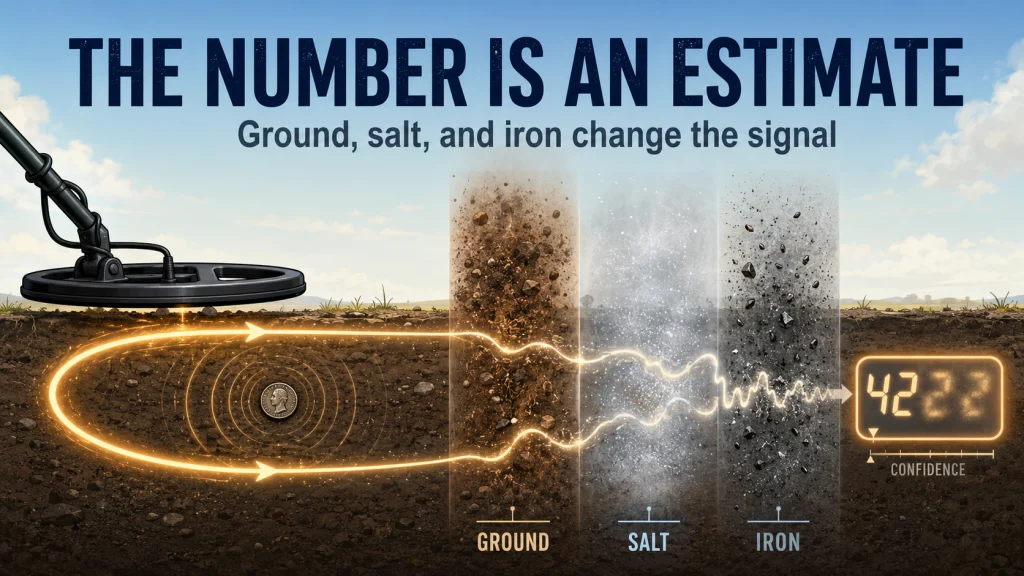
The number is not a laboratory identification of the buried object. It is the detector’s estimate based on the information available during that sweep. A coin can produce a different reading when it is deep, tilted, on edge, touching iron, surrounded by mineralized soil, or partly outside the strongest part of the coil field.
| Factor | How it can change the response | Practical consequence |
|---|---|---|
| Metal composition | Changes conductivity and magnetic behavior | Moves the target toward a different tone or ID range |
| Target size and thickness | Changes response strength and time behavior | Small foil and small gold can overlap; large iron can sound unexpectedly strong |
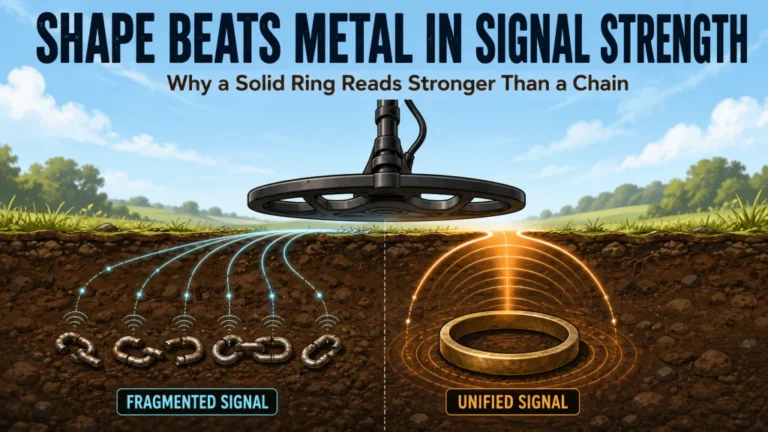
| Shape and orientation | Changes how the field couples with the object | A coin on edge may read weaker or less consistently than a flat coin |
| Depth | Reduces signal strength and signal-to-noise ratio | Target ID may become less stable before the audio response disappears |
| Ground response | Adds a competing magnetic or conductive signal | The detector may chatter, misidentify, or lose effective depth |
| Nearby targets | Combines more than one response under the coil | Iron can mask a valuable target or pull its ID toward another range |
| Coil and software | Change field shape, separation, filtering, and classification | Two VLF detectors can interpret the same target differently |
Tone ID and numeric Target ID are two presentations of the same measured response, not two independent tests. The number places the response on a finer scale, while multi-tone audio groups parts of that scale into broader sound categories. A detectorist may also hear whether a tone is short, clipped, broken, broad, or repeatable, but those traits are shaped by the selected mode, filtering, sweep direction, and nearby targets.
I use the screen to narrow the question and the audio to judge how consistently the target behaves. Discrimination saves time, but every rejected segment creates a trade-off because valuable and unwanted objects can share similar electrical responses.
As the target signal weakens or mixes with ground and adjacent metal, both the tone category and the displayed number can become less dependable. That is the point where confirmation from another direction matters more than chasing a perfect reading.
Where VLF Target Information and Separation Are Most Useful
Single-frequency VLF often performs well in parks, fields, yards, old home sites, freshwater shorelines, and similar inland locations when the detector is stable in the local soil. These sites reward the ability to hear different target categories, recognize repeatable responses, and separate adjacent objects well enough to make selective digging practical.
A park hunter may use target information to avoid some obvious iron while still digging likely jewelry ranges. A relic hunter working an old yard may rely more heavily on audio shape and repeatability because valuable brass, lead, and odd-shaped iron do not fit clean coin categories. The same technology supports both hunts, but the useful discrimination strategy is different.
- Inland coins: Target ID and repeatable tones can support selective digging where the ground remains manageable.
- Jewelry recovery: VLF can provide useful low-conductive target information, but gold and trash overlap means aggressive rejection can remove wanted targets.
- Relic sites: Audio detail and coil control can help sort mixed nonferrous targets from iron, though identification is less tidy than at a modern coin site.
- Freshwater areas: The absence of conductive salt may allow a suitable VLF detector to operate more calmly than it would in wet ocean sand.
- General learning: Audible and visual feedback helps a beginner connect target behavior with what is eventually recovered.
Operating frequency changes what a single-frequency VLF design emphasizes. Higher frequencies can improve response to small, low-conductive targets, while lower frequencies can favor larger or more conductive targets and may behave differently in the ground. That is a trade-off, not a universal depth rule, because coil design, signal processing, target size, mineralization, and EMI can change the result.
Target separation is not created by frequency or the letters VLF alone. Recovery behavior, coil size and shape, sweep control, software filtering, mode design, and target spacing all matter. A smaller coil may place fewer objects under the field at once, but it also covers less ground and changes the response to larger or deeper targets.
I match frequency, coil, and expectations to the site rather than looking for one specification that wins every hunt. Dense modern trash, scattered iron, and open pasture remain three different coverage problems.

The Garrett Pro-Pointer AT is a handheld pinpointer with three adjustable sensitivity levels. Its fast retune function can narrow the detection field and help pinpoint a target more precisely. The unit uses single-button controls and is listed as waterproof for detecting around beaches, rivers, and other wet environments.
Check On AmazonIf you click this link and buy, we earn a commission at no additional cost to you.
Mineralized Ground Competes With the Target Signal
Mineralized ground produces its own electromagnetic response. When that ground response becomes strong relative to the buried target, a VLF detector may sound unstable, lose effective depth, or produce less accurate target identification. The machine is trying to separate a small local change from a much larger background signal.
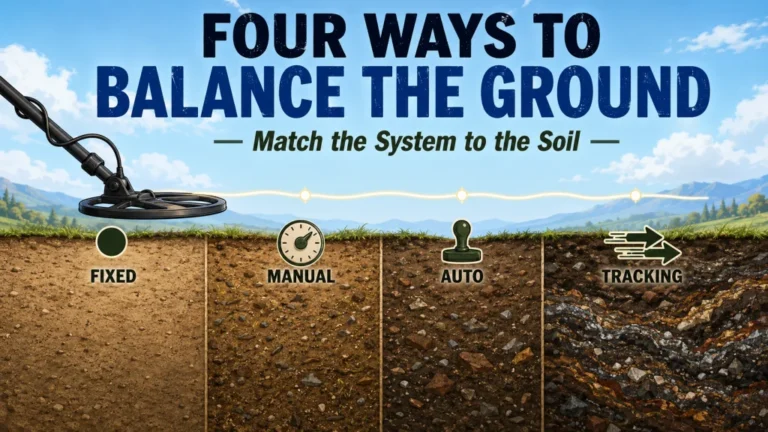
Ground balance helps the detector reduce the response from the dominant ground condition. Lowering sensitivity can also improve stability by preventing the machine from amplifying more noise than the operator can interpret. Neither adjustment removes every limitation, especially when mineralization is severe or changes rapidly across a short distance.
Field Note: The ground balance question comes up on almost every permission hunt I run in this region. New detectorists assume one setting works everywhere, and it does not. Mineralized soil near an old foundation can read completely differently from open pasture fifty yards away.
That difference changes how I diagnose a weak hunt. If chatter follows the coil movement and changes when the coil is pumped over clean ground, I investigate ground response before blaming a bad coil or an empty property. If the noise continues while the coil is still, I also consider EMI, cable movement, connections, and nearby electronic sources.
| Observed behavior | Likely question | Reasonable next test |
|---|---|---|
| Noise increases while sweeping but settles when still | Is the detector responding to the ground? | Ground balance over a clean patch and retest |
| ID becomes jumpy on deeper targets | Is the target signal weak relative to mineralization? | Confirm from another direction and judge audio repeatability |
| Stable operation returns after reducing sensitivity | Was the previous level amplifying unusable noise? | Use the highest stable level rather than the highest available level |
| Behavior changes sharply across the property | Did the soil, buried iron, or interference environment change? | Rebalance and diagnose the new zone separately |
The purpose of these tests is not to force VLF to behave like another technology. It is to learn whether the exact machine remains useful after reasonable adjustment. When the ground still overwhelms weak targets, the correct response may be different expectations, a different coil, another operating mode, or another detector type.
Wet Salt Can Look Like One Broad Ground Target
Wet ocean sand contains conductive salt and moisture that can create a broad response across the coil’s field. Many single-frequency VLF detectors struggle because the ground itself behaves like a large low-conductive target. The result can be false signals, unstable Target ID, reduced sensitivity, or a need to run less aggressively than the same detector would on dry inland soil.
That does not mean every single-frequency machine fails at every salt beach. Some designs include ground-handling methods or beach modes that improve stability within stated limits. Conditions also change between dry sand, damp transition zones, saturated wet sand, shallow surf, and fully submerged use.
Warning: Do not turn “VLF struggles in wet salt” into “VLF never works at the beach,” and do not turn one unusually capable single-frequency design into proof that all VLF machines handle salt equally well.
The practical test is whether the exact detector remains stable enough to hear and classify the target sizes you care about in the hardest salt condition you will actually hunt. A machine that works well on dry sand may become noisy at the tide line. A machine that can be stabilized by lowering sensitivity may still lose the weak-target performance that justified the purchase.
Buyers who expect regular wet-salt hunting should compare the behavior of simultaneous multi-frequency detection in conductive salt before assuming that single-frequency operation is the best fit. That comparison should remain conditional, since coil design, processing, settings, and the exact beach still affect results.

The GADFISH Sand Scoop is made from 201 stainless steel and is designed for beach and underwater searching. It can be used with its long pole to sift sand while standing. The kit also includes a separate sand shovel for moving and recovering material around a detected target.
Check On AmazonIf you click this link and buy, we earn a commission at no additional cost to you.
EMI and Dense Iron Create Different Kinds of Confusion
Electromagnetic interference enters through the detector’s receive system from power lines, buried utilities, electric fences, transmitters, charging equipment, other detectors, and nearby electronics. Because VLF continuously compares a weak received signal against its transmit reference, outside energy near the operating channel can create chatter or unstable identification. Frequency shift, noise cancel, lower sensitivity, distance, and a different time of day may help, but not every source can be removed from the site.
Dense iron is a different problem. The detector may be perfectly stable while several target responses overlap under the coil. Rejected iron can still mask an adjacent nonferrous object, and flat or irregular iron can produce mixed responses that do not behave like a clean nail.
A beginner often tries to solve both conditions by adding more discrimination. That can quiet the hunt without improving the information. If EMI is the cause, discrimination does not remove the external signal; if masking is the cause, stronger rejection may hide more of the mixed response that could have revealed a nearby target.
- When noise continues with the coil motionless, test for EMI and hardware causes.
- When responses change with sweep direction over a target patch, consider adjacent objects and iron masking.
- When a smaller coil separates responses more clearly, the problem may be target density rather than detector failure.
- When lowering sensitivity restores calm operation, judge whether the remaining target response is still useful.
- When no reasonable adjustment provides readable information, reconsider the site, coil, operating mode, or technology.
The decision should follow the cause. VLF can be very informative in iron when the coil, recovery behavior, and operator control fit the site, but it cannot make every desirable target fully visible through a dense layer of rejected metal. Quiet operation and complete target recovery are not the same thing.

The Garrett Ace Sniper is a compact 4.5 inch search coil for Garrett ACE Series detectors. Its concentrated detection field is intended for small targets and maneuvering through tight or trash-filled locations. The listing also describes the coil as suitable for working around roots, rocks, and crowded target areas.
Check On AmazonIf you click this link and buy, we earn a commission at no additional cost to you.
The Best Fit Is a Stable Detector That Gives Usable Information
Single-frequency VLF is usually easiest to justify in parks, yards, fields, freshwater areas, and other inland sites where the exact detector remains stable and its audio or Target ID helps the operator make better dig decisions. Mild to moderate ground, manageable trash, and a target range suited to the detector’s frequency create the clearest use case.
The technology may still work outside those conditions, but the burden of proof changes. In severe mineralization, wet salt, heavy EMI, or dense iron, ask whether the detector is merely producing signals or producing information you can act on. A noisy machine that can technically detect metal is not necessarily a productive field setup.
| Site condition | VLF fit | Decision rule |
|---|---|---|
| Inland park with moderate modern trash | Often strong | Prioritize useful ID, recovery behavior, and comfortable coverage |
| Old yard with mixed iron and relic targets | Conditional | Judge audio detail, coil choice, masking, and willingness to dig uncertain signals |
| Freshwater shoreline | Often practical | Confirm waterproof limits and stability in local sand or gravel |
| Highly mineralized ground | Site dependent | Test ground balance, stability, ID quality, and weak-target response |
| Wet ocean sand or surf | Detector dependent | Verify model-specific salt performance rather than relying on the VLF label |
| Severe EMI | Time and location dependent | Test channel changes, sensitivity, distance, and alternate operating conditions |
I judge fit by consistency across the planned site. The detector should remain calm enough to reveal repeatable targets, responsive enough for the expected target size, and informative enough to support the amount of selective digging the hunt requires. A machine that meets those conditions is a better fit than one with a stronger paper specification but unstable field behavior.
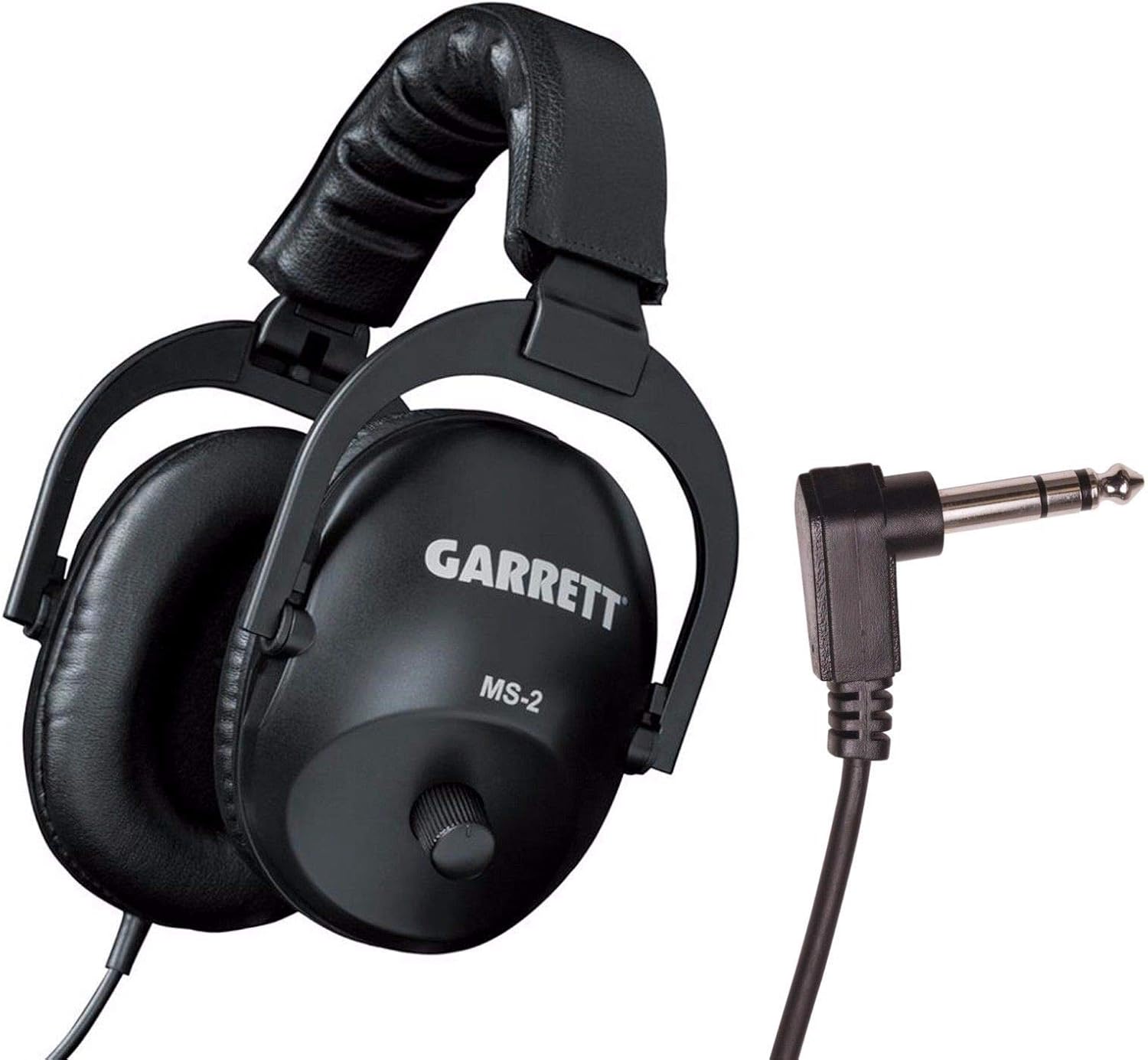
The Garrett MS-2 Headphones use a 1/4 inch right-angle stereo plug and are made for metal detecting use. They include volume control for adjusting signal levels and improving weak-signal listening. The design also uses padded ear cups, an adjustable headband, and a reinforced coiled cable.
Check On AmazonIf you click this link and buy, we earn a commission at no additional cost to you.
When Another Detector Type Deserves Comparison
A difficult site does not automatically require abandoning VLF. First determine whether the limitation comes from the ground, conductive salt, EMI, target density, coil choice, an unsuitable mode, or unrealistic identification expectations. One test should answer one question rather than turning every noisy hunt into a technology verdict.
Once the cause is reasonably clear, compare technologies by the problem they solve. The broader detector technology decision framework separates continuous-wave VLF, pulse induction, and simultaneous multi-frequency systems without declaring one universal winner.
Pulse induction deserves attention when severe mineralization or conductive conditions dominate and detailed discrimination is less important than stable detection. The trade-off is that target classification and iron handling may be less informative for the kind of selective digging many inland hunters expect. Read how pulse induction handles difficult ground before assuming it is simply a deeper version of VLF.
Simultaneous multi-frequency deserves attention when the target range and ground response benefit from processing more than one transmitted frequency together, especially in wet salt or mixed target conditions. It is not automatically necessary for every inland hunt, and it does not remove coil, software, site, and operator trade-offs.
Decision rule: Stay with single-frequency VLF when it remains stable and gives enough target information for the intended hunt. Compare another technology when the site repeatedly removes that stability or information after reasonable setup and diagnosis.
This rule prevents both extremes: defending familiar equipment long after the site has exposed its limit, or buying a more complicated machine before identifying what the current detector is doing wrong.
Final Thoughts: Let the Site Decide Whether VLF Fits
Single-frequency VLF earns its place by combining target response, discrimination, tone options, manageable operation, and efficient power use in one practical system. Its limitations appear when the ground or surrounding signals become too strong for the detector to separate from the target reliably.
Before changing technology, identify the limiting condition and test it directly. If the machine remains stable and repeatable on the targets and terrain that matter, VLF still fits the job. If mineralization, conductive salt, severe EMI, or masking repeatedly controls the hunt after reasonable adjustment, compare another detector type for that specific problem.
FAQs
⚙️ What does VLF mean on a metal detector?
VLF means very low frequency, but recreational detectorists commonly use it as a practical label for continuous-wave induction-balance technology. The exact operating frequency, coil, processing, and controls still vary by detector.
🧲 Can a VLF detector identify the exact metal?
No. It estimates a target category from the received signal, including phase and strength information. Composition, shape, depth, orientation, ground, nearby metal, coil design, and software can all change the result.
🪨 Why does mineralized soil make Target ID jump?
The ground adds a competing response that can weaken or distort the target signal. Ground balance and lower sensitivity may improve stability, but deep or weak targets can remain less accurately identified.
🌊 Can a single-frequency VLF detector work on wet salt sand?
Some can operate usefully in certain salt conditions, while many struggle with the broad conductive response from wet salt. Verify the exact detector in the wettest zone you plan to hunt rather than judging from dry-sand performance.
🔩 Can VLF discrimination reject all iron without losing good targets?
No. Valuable and unwanted targets can overlap, and rejected iron can mask a nearby nonferrous object. Discrimination is a time-saving trade-off, not a perfect filter.
📡 How can I tell EMI from ground noise?
Ground noise often changes with coil movement and may improve after ground balancing. EMI can continue while the coil is still and may change with frequency shift, distance from electrical sources, or time of day.
🌀 Does a smaller coil make a VLF detector better in trash?
A smaller coil can place fewer targets under the detection field at once, which may improve separation. It also covers less ground and changes the response to larger or deeper targets, so the benefit depends on the site.
🔋 Are VLF detectors always lighter and more power efficient?
Many recreational VLF machines are designed that way, but weight and battery use depend on the complete detector, coil, electronics, battery system, and construction. Treat those as model-specific specifications rather than automatic properties.
Sources and References
- Minelab, How Detectors Work: Used for the basic transmit-field, target-response, Target ID, discrimination, and ground-balance explanations.
- Minelab, Detecting in Mineralized Soils: Used for the effects of magnetic and conductive ground on noise, signal distortion, identification, and effective depth.
- Minelab, Frequently Asked Questions: Used for the discrimination trade-off, mineralized-ground diagnosis, sensitivity reduction, and manufacturer statements showing that single-frequency salt performance is implementation specific.
- Minelab, How to Choose Metal Detector Frequency: Used for the practical relationship between operating frequency, small low-conductive targets, larger conductive targets, and changing ground conditions.
- Garrett, Frequency Shift and Target Information Reference: Used for manufacturer documentation on frequency adjustment for electrical interference, Target ID, iron response, and mixed-target interpretation.
- U.S. Patent 8,729,902, Metal Detector Analysis and Display Methods: Used for the technical relationship between frequency-domain target identification and target phase response.