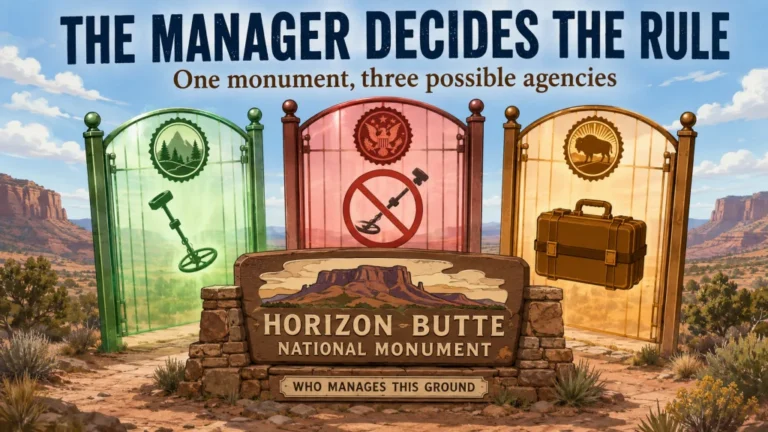
Metal detecting city and county parks is not governed by one national rule, and two nearby parks can have opposite policies because different agencies control them. The reliable process is to identify the managing authority, locate the current rule or permit page, classify exactly what the policy allows, and verify the park, zone, tools, recovery method, hours, and reporting duties before arriving. A permit to operate a detector may still restrict digging, sports fields, planted areas, historic material, or identifiable lost property. I use the park manager’s current written rule as the decision point, not a forum post, an old permit, or an assumption based on another park.
Identify the Managing Authority Before Reading Rules
Start with the individual park’s official page. Record the department, contact information, facility classification, and links to rules or permits. Treat third-party maps and listings only as leads because names, boundaries, and policies can be outdated.
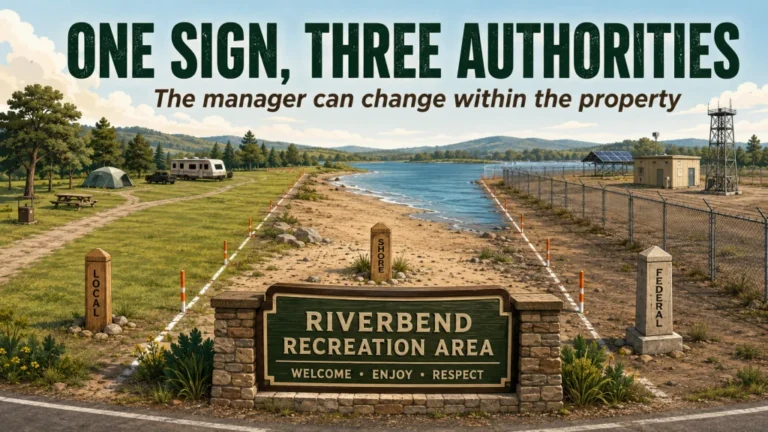
If management is unclear, check the property map, parks directory, parcel record, or agency contact page. A park crossing a city boundary or containing facilities run by another authority may have more than one controlling rule. Confirm the manager for the exact search area.
- City department: Look for a municipal parks and recreation department, city code, or director’s policy.
- County authority: Check county park regulations, ordinances, and facility-specific pages.
- Regional or special district: Verify the district’s own code, permit office, and property map.
- State agency: Use the state park agency’s rules and the individual park page, not the neighboring city’s code.
- Contracted operation: Confirm whether a nonprofit, concessionaire, or other operator can set activity rules under an agreement.
Write down the exact agency name and the official page where you found it. That one note keeps the rest of the research tied to the correct authority and gives you a clear contact when the written policy is incomplete.
Locate the Document That Actually Controls the Activity
Park metal detecting rules may sit in a code, ordinance, administrative rule, park regulation, permit, approved-site list, manager order, map, closure notice, or written agency response. A recreation page that never mentions detecting does not create permission.
Search the official domain for “metal detector,” “digging,” “excavation,” “probing,” “resource removal,” “lost property,” “permit,” and the park name. Read nearby definitions and exceptions because a digging or removal rule may control the hunt even when detector operation is not named.
| Document type | What it may establish | What to verify next |
|---|---|---|
| Municipal or county code | General prohibitions, permit authority, removal and disturbance rules | Whether a department policy or permit creates a limited exception |
| Administrative or park rule | Activity restrictions across the park system | Whether the individual park has stricter posted conditions |
| Permit page and conditions | Eligibility, tools, areas, reporting, expiration, display, revocation | Whether the permit is currently issued and valid at the chosen park |
| Approved-site list | Which parks participate | Whether only certain zones within each park are open |
| Posted map | Exact detecting boundaries and excluded facilities | Whether the map is current and tied to the present permit period |
| Manager order or closure notice | Temporary, seasonal, event-related, safety, or resource restrictions | Effective dates and whether the order overrides normal access |
| Written agency response | How the authority applies an unclear rule to a named park and activity | Whether the response has conditions, an expiration, or a named contact |
Save the rule, permit conditions, map, verification date, and a dated page copy or screenshot together. That record does not replace a fresh closure check. One favorable sentence is not enough if nearby language limits the zone, recovery method, or ownership of finds.

Sea to Summit TPU Guide Map Case is designed to protect maps and documents from water and dirt. It uses welded construction with a ZipLoc top closure and includes a detachable neck strap. The PVC-free TPU material is flexible and resistant to UV exposure and extreme cold.
Check On AmazonIf you click this link and buy, we earn a commission at no additional cost to you.
Classify the Rule Before Planning the Hunt
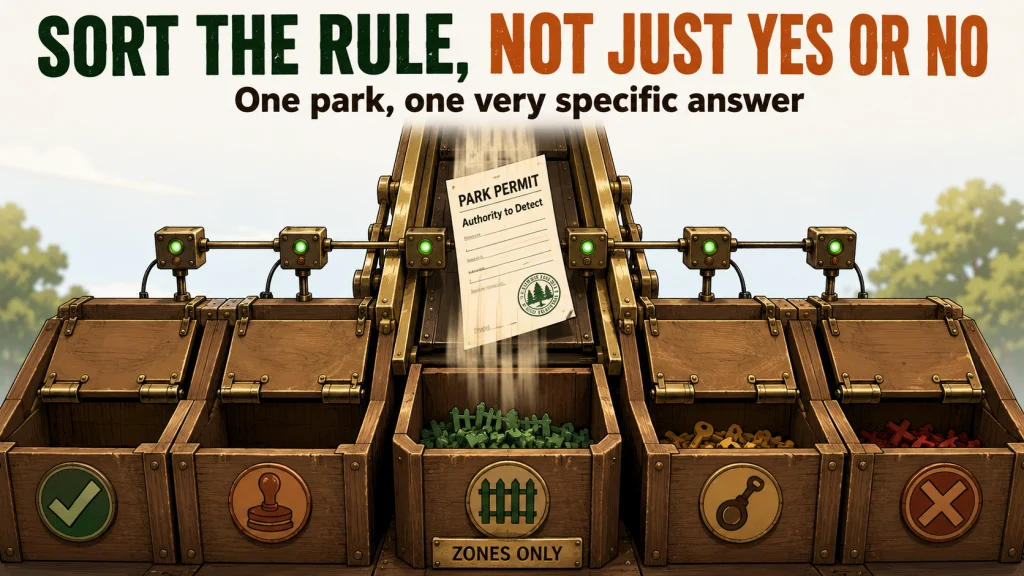
Do not reduce every policy to “allowed” or “prohibited.” Detector operation may be authorized while recovery is restricted, or access may be limited to named parks, mapped zones, or a supervised lost-item search.
Use the narrowest accurate category. One mapped area means “designated zones only,” while approval to locate a named ring under supervision means “lost-item recovery only.”
| Rule class | What it means | What you need before going |
|---|---|---|
| Allowed | The current policy permits the activity under general park rules | Park-specific restrictions, hours, closure status, tools, and reporting duties |
| Permit or registration required | Detector use depends on a current authorization | Application, approval, validity dates, copy or display requirements |
| Approved parks only | Only named properties participate | Current approved-site list and confirmation of the exact park |
| Designated zones only | Only mapped or described portions of the park are open | Current map, boundary description, and a way to remain inside it |
| Restricted tools or disturbance | Detector operation may be allowed while recovery methods are limited | Exact tool dimensions, probing rules, surface type, and restoration standard |
| Surface recovery only | Visible items may be collected without probing or excavation | Written confirmation that no ground penetration is allowed |
| Lost-item recovery only | A search is limited to a specifically identified item or owner request | Prior permission, search area, supervision, and property-return procedure |
| Prohibited | Detector operation, digging, or both are not authorized | Choose another property rather than trying to create an exception |
Official examples show the range: New York City uses permits and designated parks; Washington requires registration in specified portions of approved state parks; Oregon lists no-permit areas and allows some others only with approval; Minnesota limits state-park use to approved, supervised recovery of a specifically identified lost item. Other systems prohibit the activity.
These examples do not predict your local rule. They show that the authority, park, zone, purpose, permit, and recovery method can each change the answer.
Read Every Permit Condition, Not Just the Approval
A permit is a set of conditions, not a general pass. Verify eligibility, fee, validity, approved parks, zones, tools, reporting, and carry or display requirements. A club hunt or organized event may require a separate reservation, group permit, insurance, or supervision. Free registration can be as binding as a paid permit.
Check suspension and revocation conditions as well. A permit may require compliance with staff directions, resource protection, trash removal, surface restoration, reporting, or surrender of certain finds, and it never overrides a closure or manager order.
- Who may apply, and is proof of address or photo identification required?
- Is the authorization valid for one visit, one park, a calendar year, or another period?
- Must a paper or digital copy be carried during the hunt?
- Does the permit name approved parks, or must each park be selected separately?
- Are maps part of the permit conditions?
- What tool sizes and recovery methods are permitted?
- Which finds must be reported or surrendered?
- Can staff direct the detectorist to stop or move without a separate violation?
- Does a club, group hunt, or organized event require separate approval, insurance, or supervision?
- What conduct can cause revocation or denial of renewal?
Save the complete conditions with the approval. Keep them for reference, while following any newer closure or manager order in force on the hunt date.
Detector Possession, Operation, Probing, and Removal Are Separate Actions
A common mistake is treating detecting as one indivisible activity. A policy may allow possession but prohibit operation, or allow operation while restricting probing, plug cutting, excavation, scooping, or removal. The answer can change by surface, tool, target, and zone.
Read the verbs: “use,” “operate,” “dig,” “disturb,” “probe,” “collect,” and “remove” control different conduct. Permission to sweep a coil does not authorize a recovery hole.
| Action | Question to answer | Why the distinction matters |
|---|---|---|
| Possessing a detector | Can the equipment be carried through the property? | Some sensitive facilities regulate equipment even when it is not operating |
| Operating the detector | Where and for what purpose may the coil be used? | Approved parks or zones may be narrower than general public access |
| Probing | May a narrow tool enter the surface? | Surface recovery permission may stop before any ground penetration |
| Plug cutting | May turf be cut and lifted? | A rule may prohibit turf disturbance even when small probing is allowed |
| Excavation | How is digging defined, and what dimensions or tools are allowed? | A broad excavation ban can eliminate ordinary target recovery |
| Sand scooping | Does the surface and tool policy cover beaches or sand areas? | Beach rules may differ from turf rules within the same agency |
| Removing an object | May the item be kept, reported, turned in, or left in place? | Lost property and cultural material can trigger separate duties |
Follow the authority’s exact restoration standard. “Fill every hole” does not satisfy a policy that limits recovery to a small probe or prohibits ground disturbance entirely.

The Garrett Pro-Pointer AT is a handheld pinpointer with three adjustable sensitivity levels. Its fast retune function can narrow the detection field and help pinpoint a target more precisely. The unit uses single-button controls and is listed as waterproof for detecting around beaches, rivers, and other wet environments.
Check On AmazonIf you click this link and buy, we earn a commission at no additional cost to you.
Verify Restricted Areas From the Applicable Policy
Gardens, natural areas, archaeological sites, memorials, athletic fields, golf courses, planted beds, tree-root zones, construction areas, event spaces, and closed facilities are commonly sensitive, but they are not governed by one universal list. Use only the exclusions stated by the controlling authority, posted map, permit, or current manager order.
New York City’s current permit conditions illustrate how detailed these limits can become, including restrictions around athletic fields, manicured and newly seeded lawns, monuments, memorial plantings, golf courses, gardens, woodlands, native vegetation, and tree drip lines. That list applies to its permit system. It should teach you what to look for, not be copied into a different jurisdiction as though it were national law.
Sports fields deserve special attention because “park open” does not mean the field is available. Maintenance, irrigation, league reservations, turf recovery, and scheduled events can create restrictions that never appear on the general park landing page. Natural and archaeological areas may have tighter protection even when nearby developed lawns are open.
Warning: Do not interpret the absence of a restriction on one webpage as permission. Check the park map, facility page, posted signs, permit conditions, temporary notices, and direct staff instructions together.

Garmin eTrex 32x is a handheld GPS navigator with a 2.2-inch sunlight-readable color display. It comes with TopoActive maps and supports GPS and GLONASS satellite systems. It also includes 8 GB of internal memory, a microSD card slot, a 3-axis compass, and a barometric altimeter.
Check On AmazonIf you click this link and buy, we earn a commission at no additional cost to you.
State Parks, Beaches, and Other Public Facilities Need Separate Checks
State park metal detecting rules come from the state agency and can differ sharply from city and county policies. Check the statewide administrative rule, the activity page, the approved-park list, and the individual park page. A statewide statement that detecting exists in the system does not prove that the chosen park or chosen zone is open.
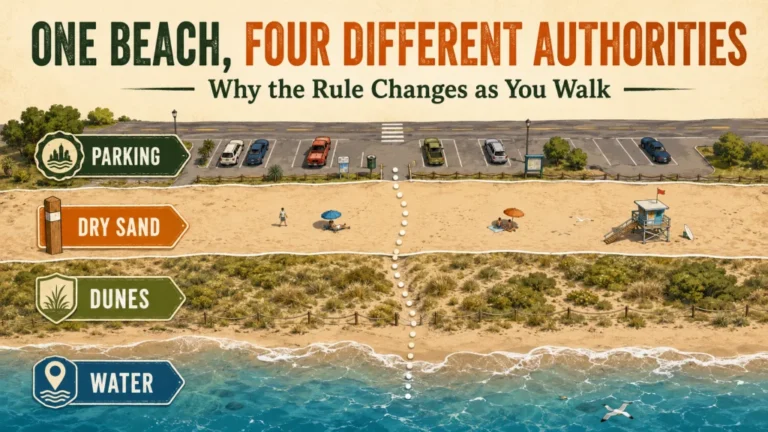
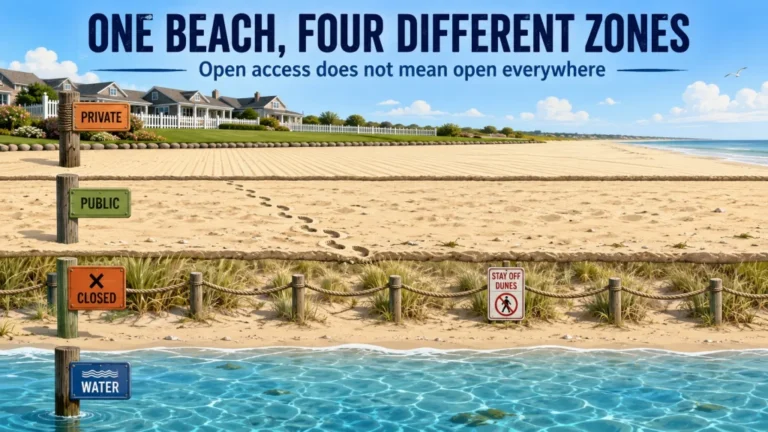
Public beaches also need a beach-specific review even when a city, county, or state park agency manages them. The dry sand, wet sand, dunes, vegetation line, swimming zone, protected habitat, shipwreck area, and seasonal closure may follow different rules. Do not carry a turf-park conclusion onto the shoreline.
School grounds, libraries, fairgrounds, cemeteries, airports, transit property, and utility land have their own controlling authorities and purposes. A property may look like open public space while being governed by a school district, library board, fair authority, cemetery commission, airport authority, or utility. Ordinary park rules do not transfer automatically.
For a focused overview of how public recreation properties fit together, use checking parks and public land rules. Keep the categories separate until ownership, management, and the exact activity rule are confirmed.
Check Hours, Closures, Found Property, and Cultural Material
Permission to detect does not authorize entry outside posted hours. Check the park’s hours, access, events, maintenance, weather, construction, and emergency notices on the hunt date. Wildlife notices also matter because nesting seasons, restoration windows, or protected-area boundaries can temporarily close normally available ground. A temporary closure can override the permanent activity page.
Found-property rules can also change what happens after recovery. Identifiable jewelry, keys, phones, tags, and other personal items may need to be turned over to the park office or local law enforcement. Some agencies use value thresholds, reporting periods, receipts, or retention procedures, while others place special conditions directly in the detector permit.
Potentially historic or archaeological material requires a different response from an ordinary lost coin. Stop disturbing the area, leave the object and surrounding context in place, note the location without expanding the hole, and follow the park manager’s reporting instructions. Removing the item can destroy the context the agency needs to evaluate it.
Key point: The detector permit answers where and how you may search. Found-property and cultural-resource rules answer what you may do with the object after it is located.
Use a Written-Confirmation Workflow When the Rule Is Unclear
If official material is silent, contradictory, undated, or too general, contact the managing authority. Name the park, zone, planned date, detector use, recovery method, and tools. “Is metal detecting legal?” is too vague because it may not address digging or removal.
Write to the park manager, permit office, ranger station, or listed agency contact. Ask for the controlling rule, permit, or map and keep the response, while remembering that an email cannot override a later closure or higher-level law.
- Is detector operation allowed at the named park?
- Is a permit, registration, reservation, or prior approval required?
- Which exact areas are open, and is there a current map?
- Are probing, plug cutting, digging, or sand scooping allowed?
- What tool dimensions and surface-restoration rules apply?
- Which areas, facilities, events, or seasons are excluded?
- What must be done with identifiable property or valuable finds?
- What is the required response to possibly historic material?
- Are there current closures or operating-hour limits for the planned date?
The result is a record tied to one park and one activity. Do not reuse it for another property without checking that manager’s current rules.
Follow One Official Rule From Agency to Approved Area
Washington State Parks shows the complete lookup path. Its activity page identifies the agency, requires registration, limits access to approved parks and specified portions, and directs visitors to individual park pages and maps.
At a participating park, the detectorist must confirm the designated area, carry the required registration copy, remain inside the boundary, follow site restrictions, and leave potentially historic or archaeological objects in place for reporting.
| Lookup step | Question answered | Decision produced |
|---|---|---|
| State activity page | Does the state system allow this activity at all? | Yes, but registration and approved locations are required |
| Approved-park list | Does the named park participate? | Continue only if the park appears on the current list |
| Individual park page | What park-specific conditions apply? | Confirm hours, contact, registration, and designated-area language |
| Detecting map | Where may the coil be operated? | Stay inside the marked boundary |
| Registration conditions | What conduct and reporting duties apply? | Carry proof, protect resources, and report protected material |
The value is the sequence, not Washington’s answer. Another jurisdiction may prohibit the activity, require a city permit, open only listed lawns, or authorize only supervised lost-item recovery.
Complete the Park Verification Record Before Leaving Home
A reliable park record should be short enough to review in the parking lot but complete enough to prevent a mistaken assumption. I record the agency, rule class, permit status, park, zone, tools, recovery limits, hours, closures, reporting duties, source links, and verification date. If one required field remains unknown, the hunt is not ready.
Use this final check after the research, not as a substitute for it:
- The managing authority is confirmed from an official source.
- The current code, rule, policy, permit, or written response is saved with a dated page copy or screenshot.
- The rule is classified accurately.
- The exact park appears on any required approved-site list.
- The designated area is identified from a current description or map.
- The individual or group authorization is approved, unexpired, and available to carry.
- Detector operation and recovery methods are separately authorized.
- Tool dimensions and surface-restoration requirements are understood.
- Restricted facilities and sensitive areas are marked.
- Operating hours, events, wildlife windows, and temporary closures are checked.
- Found-property and cultural-resource procedures are known.
- The date and official sources used for verification are recorded.
This record is also useful when someone tells you a different rule in the field. Stay polite, stop if directed by an authorized employee, and ask which current policy applies. Protecting access matters more than winning an argument beside an open recovery hole.

This pocket notebook uses weatherproof paper designed for outdoor fieldwork. Each notebook has 100 pages with a top-spiral format and an impact-resistant Wire-O binding. The Polydura cover helps protect field notes from scratches and stains during use.
Check On AmazonIf you click this link and buy, we earn a commission at no additional cost to you.
Final Thoughts: Verify the Authority, Activity, and Area
A park being public does not make every public activity lawful there. The workable answer comes from three linked facts: who manages the property, what exact conduct the current rule authorizes, and where that authorization applies. Miss any one of those, and a permit or general policy can be misread.
I approach park research the same way I approach a parcel record: identify the controlling authority first, preserve the document trail, and do not extend one property’s answer beyond its boundary. Confirm again before each hunt because policies, maps, permit periods, events, closures, and manager orders can change.
FAQs
🏙️ Can you metal detect in city parks?
Only when the controlling city rule, permit, or written policy allows the activity at that park and in that area. Some cities use permits and designated sites, while others prohibit detecting or digging.
🗺️ How do I know whether a park is city or county property?
Check the individual park’s official page, department contact, property map, and agency directory. Do not rely only on the park name or its location inside municipal boundaries.
🪪 Does a metal detecting permit allow me to dig anywhere in the park?
No. A permit may apply only to approved parks, designated zones, certain surfaces, specified tools, or limited recovery methods. Read the complete conditions and current map.
🧰 Can I use a small hand digger if the rule allows detecting?
Only if the applicable rule or permit also authorizes that recovery method and tool size. Detector operation, probing, plug cutting, excavation, and removal can be regulated separately.
🌳 Are sports fields and landscaped areas automatically off limits?
Not under one universal national rule, but many authorities restrict sensitive or heavily managed areas. Verify the exact exclusions in the park policy, permit, map, signs, and temporary notices.
🏞️ Do state park rules apply to county parks?
No. State parks and county parks normally have different managing authorities and rules. Check each system separately even when the properties are close together.
💍 What should I do with identifiable jewelry found in a park?
Follow the park’s found-property procedure, which may require turning the item over to staff or law enforcement. Do not assume that recovery gives you immediate ownership.
🏺 What if a target may be historic or archaeological?
Stop disturbing the area, leave the object and context in place, note the location, and contact the managing authority. Follow the manager’s reporting instructions before doing anything further.
📧 Is an email from park staff enough when no rule is posted?
A written response tied to the named park and activity is useful, but it does not override a code, higher-level rule, posted closure, or later manager order. Save the response and ask for the controlling policy when possible.
Sources and References
- NYC Parks, Metal Detector Permits: Used for the permit requirement, designated parks, expiration, tool limits, restricted areas, restoration, identifiable-property handling, and significant-object reporting example.
- Washington State Parks, Metal Detecting: Used for the registration requirement, approved parks, designated areas, maps, occupied-campsite limits, group-event permits, and cultural-resource response.
- Washington State Parks, Metal Detecting Registration Form: Used for the requirement to carry a registration copy, the one-year validity period, participating-park selection, and resource-protection conditions.
- Oregon State Parks, Where Can I Metal Detect?: Used for the permit and no-permit area distinction, current approved locations, tool limits, surface restoration, historic-material response, and found-item value rule.
- Minnesota Administrative Rules, Chapter 6100: Used for the state-park example limiting metal detector use to specifically identified lost personal property with prior written manager permission and supervision.
- Montgomery Parks, Rules and Regulations: Used for the county example separating detector or magnet use from digging and authorizing exceptions only by permit or park directive.
- Fairfax County Park Authority, Activities Prohibited on Park Land: Used for the county example where metal detecting and digging are listed as prohibited activities that will not be approved through the ordinary special-permission process.
- City of Phoenix Parks, Code of Conduct: Used for the municipal example prohibiting operation of a metal detector and removal of found items, and for the importance of posted operating hours.