Ground balance helps a detector reduce the broad response from mineralized soil or conductive ground so a real target signal remains usable. Fixed, manual, automatic, and tracking systems solve that problem in different ways, and none is automatically best for every detectorist or every site. Beach, salt, gold, and other dedicated modes may also change ground processing in ways that cannot be described by one balance number. By the end, you will know what each ground-balance feature actually offers, what can go wrong without suitable ground handling, and what to verify before choosing a machine.
Metal Detector Ground Balance Explained: What It Controls and Why the Type Matters
Metal detector ground balance is the part of the system that manages the detector’s response to the ground itself. In mild conditions, that response may stay quiet enough that the feature seems unimportant. In mineralized soil, conductive wet sand, altered ground, or patches containing hot rocks, the same detector can become noisy, lose stable Target ID, or struggle to separate a weak target from the background.
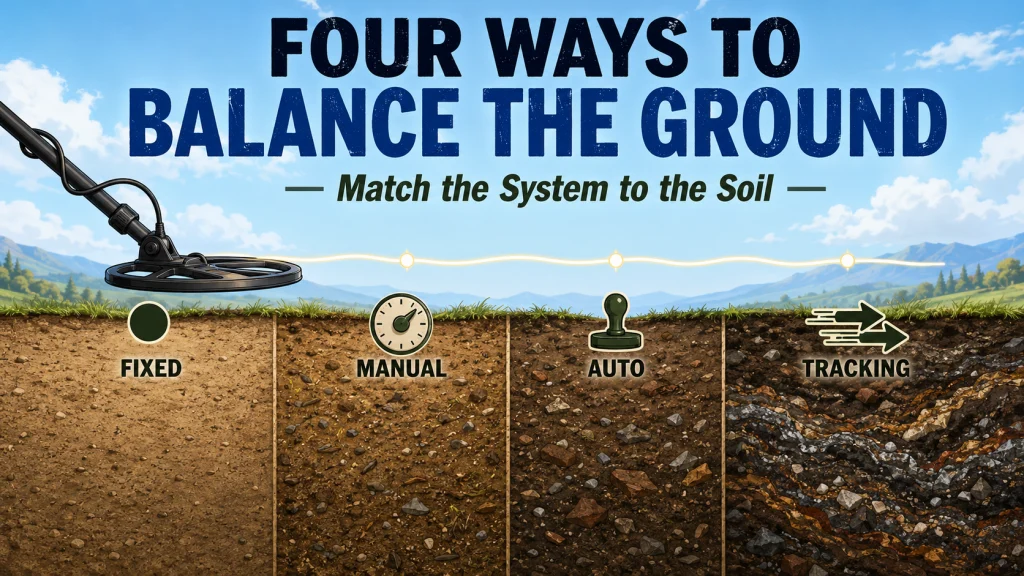
The important point is that ground balance is not one universal switch. A fixed system relies on a factory-selected response, a manual system lets the operator change the value, an automatic system estimates a setting from sampled ground, and a tracking system keeps updating while the coil moves. The labels sound simple, but their accuracy, speed, range, and interaction with search modes depend on the detector’s design.
I treat ground balance as one part of the whole signal path, not as a repair button for every unstable machine. Frequency, coil design, sensitivity, recovery behavior, search mode, salt processing, and software still matter. That wider relationship is easier to see when you understand how metal detectors separate ground from targets and how to approach reading metal detector specifications as a connected system.
What Ground Response Does to a Target Signal
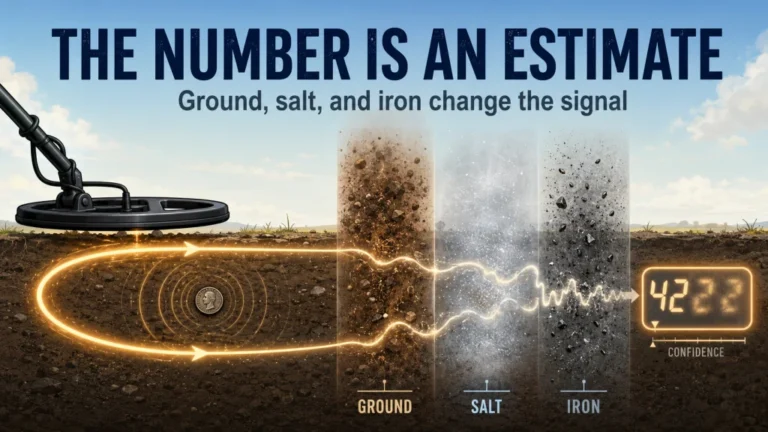
The soil under a coil is not electronically identical from place to place. Iron-bearing minerals can create a magnetic response, while dissolved salts and wet conductive ground can create a different kind of response. Disturbed soil near a foundation, a strip of red clay, a pocket of black sand, and clean sandy loam may therefore affect the same detector differently.
That does not mean every grain of soil produces the same signal or that every noisy sweep is a ground-balance problem. A detector is reacting to the combined properties of the ground inside the coil’s field, along with nearby metal, electrical interference, coil movement, and the chosen settings. Ground balance is intended to reduce the broad, repeatable ground component so a target that differs from that background is easier for the detector to process.
When the ground response is not being handled well, the symptoms can overlap with other problems. The detector may sound off as the coil approaches the surface, produce false responses over clean-looking ground, show unstable identification on a real target, or require lower sensitivity to remain usable. Weak targets may also become harder to hear because the detector is spending part of its usable signal range responding to the ground.
Field Note: The ground-balance question comes up most often when a machine changes character within the same property. Open pasture may sound calm, then altered soil near an old foundation starts producing background responses that look like a settings failure. The useful observation is the change between ground patches, not the assumption that one balance value should work everywhere.
That field change is a clue, not proof. Before blaming ground balance, I still separate a ground response from a buried target, electromagnetic interference, a loose coil connection, or sensitivity set beyond what the site will support. Ground balance can only correct the problem it was designed to manage.
Fixed Ground Balance: Simple Operation With a Defined Operating Range
A fixed or preset ground-balance system uses a factory-selected response, a built-in design range, or limited ground compensation that the operator does not directly adjust. Its advantage is convenience. The detectorist can turn on the machine, select an appropriate search mode, and begin hunting without learning another control.
Fixed does not mean defective, shallow, or incapable. A well-designed detector can remain stable in the ordinary park, yard, or mild-soil conditions it was built to handle. For a beginner who hunts consistent ground, fewer controls can prevent a bad manual adjustment from creating more trouble than the original ground response.
The limitation appears when the actual site falls outside the conditions the fixed system handles comfortably. Strong iron mineralization, rapidly changing soil, concentrated hot rocks, or conductive salt may expose less flexibility than an adjustable design. The buying question is therefore not whether fixed ground balance is bad, but whether the expected terrain matches the detector’s intended operating conditions and dedicated modes.
Manual Ground Balance: More Control, Not an Automatic Precision Advantage
Manual ground balance allows the operator to change the balance value rather than accept only a factory preset or machine estimate. That control can be useful when the detector supports fine adjustments, when the ground is stable enough to evaluate carefully, or when an automatic result needs a small correction within the manufacturer’s intended procedure.
Manual control is often described as the expert or most precise option, but that is too broad. An operator who cannot identify clean ground, cannot hear the remaining ground response, or does not understand how the control behaves may set it farther from useful balance than the automatic system would have. The adjustment range and resolution also differ by model, so a larger number of steps does not prove better field performance.
The real benefit is choice. A detectorist can hold a setting in consistent soil, return to a known value allowed by that machine, or make a deliberate correction when the manual explains why one is needed. The trade-off is attention: once the ground changes, a manually held setting does not update itself unless the operator checks it again.

The Garrett AT Gold operates at 18 kHz and includes both manual and automatic ground balance. Its Ground Balance Window is designed to help manage changing soil conditions. The detector also provides a True All Metal mode and Iron Audio for identifying iron targets.
Check On AmazonIf you click this link and buy, we earn a commission at no additional cost to you.
Automatic Ground Balance: A Machine Estimate From Sampled Ground
Automatic ground balance lets the detector estimate a suitable setting from the ground presented to it during the manufacturer’s balancing routine. It is usually a one-time or operator-triggered measurement, not continuous tracking. After the estimate is accepted, the machine generally holds that result until the operator repeats the process, changes mode, resets the detector, or follows another model-specific action.
The convenience is real because the detector performs the comparison quickly and removes some guesswork. That does not make automatic ground balance universally more accurate than manual control. Its result depends on the sampled patch, the search mode, the coil, the ground-processing algorithm, and whether metal or an unusual mineralized object was inside the sample area.
A useful way to read this feature on a specification sheet is to ask what “automatic” actually means. Does it produce a visible value, work in every mode, save separately by mode, permit manual correction, or refuse a result in highly conductive ground? Those details tell you more than the word automatic by itself.

The Nokta Simplex Ultra provides automatic and manual ground balance along with 30 sensitivity levels. It uses an 11-inch search coil and a carbon-fiber shaft. The detector is also fully waterproof to 16 feet according to the Amazon listing.
Check On AmazonIf you click this link and buy, we earn a commission at no additional cost to you.
Tracking Ground Balance: Continuous Adaptation With Real Trade-Offs
Tracking ground balance updates the detector’s ground estimate as the coil moves across changing terrain. That can help when a field contains alternating soil structures, scattered mineralized rocks, or transitions that make one held value less useful. The operator spends less time stopping to reassess every visible change.
The trade-off is that tracking must decide which repeated responses belong to the ground and which should remain available as possible targets. Manufacturers use different update speeds, limits, and mode rules to manage that decision. Some manuals warn that tracking may behave poorly in particular hot-rock concentrations or around certain weak targets, while other systems make tracking the default in a specialized ground mode.
That is why I do not prescribe tracking as an always-on setting, and I do not treat it as the universal beach choice. Wet salt, black sand, changing mineralization, and moving water are different problems that may require dedicated processing beyond continuous ground adjustment. The correct use depends on the detector’s own instructions and the mode selected.

The Nokta Double Score provides automatic, manual, and tracking ground balance. It uses simultaneous multi-frequency technology and includes Park, Field, and Beach search modes. The detector also offers three recovery-speed levels, an iron filter, a notch filter, and two custom user profiles.
Check On AmazonIf you click this link and buy, we earn a commission at no additional cost to you.
Why Beach, Salt, Gold, and Ground Modes Are More Than a Balance Number
A dedicated search mode can change several parts of the detector at once. A beach mode may alter frequency weighting, transmit power, salt subtraction, recovery behavior, sensitivity limits, or Target ID processing. A gold mode may change threshold audio, ground tracking defaults, recovery behavior, and the way weak responses are presented.
This matters because conductive salt is not simply “more mineralized dirt.” Dry sand, wet salt sand, surf, and submerged ground can produce different responses even along one short shoreline. A manual ground-balance value that quiets one zone may not reproduce the processing used by a purpose-built salt mode in another zone.
The same principle applies in gold country. A machine may combine ground tracking with a mode designed to preserve weak low-mass targets, while another implementation may use a different ground algorithm or no user-facing number at all. Operating frequency still influences the target and ground response, but how operating frequency affects detector performance cannot be separated from the mode that processes it.
The Four Ground-Balance Types Compared by Field Decision
The four labels describe who controls the adjustment and when it changes. They do not rank detectors from worst to best. The practical comparison is whether the feature matches the variation in your ground, the amount of control you want, and the time you are willing to spend checking the machine.
| Ground-balance type | What it does | Where it can make sense | Main limitation to check |
|---|---|---|---|
| Fixed or preset | Uses factory-selected or limited ground compensation without a user adjustment. | Consistent, expected conditions where simple operation matters. | May offer less flexibility when the ground falls outside its intended range. |
| Manual | Lets the operator set or fine-tune the balance value. | Detectorists who want direct control and can evaluate a stable ground response. | Quality depends on the operator, the adjustment range, and the model’s procedure. |
| Automatic | Estimates a setting from sampled ground and usually holds the result. | Fast setup when the detector can sample representative clean ground. | A bad sample or mode restriction can produce an unhelpful result. |
| Tracking | Continually updates the ground estimate as the coil moves. | Ground that changes enough to make a single held value inconvenient. | Update behavior and target trade-offs vary, so it is not an automatic default. |
The table is a starting point, not a substitute for the manual. Two detectors can both list automatic and tracking ground balance while using different ranges, mode restrictions, defaults, and update behavior. Compare implementation, not just the checkmark on a feature list.
Why a Ground Balance Number Is Not a Universal Soil Rating
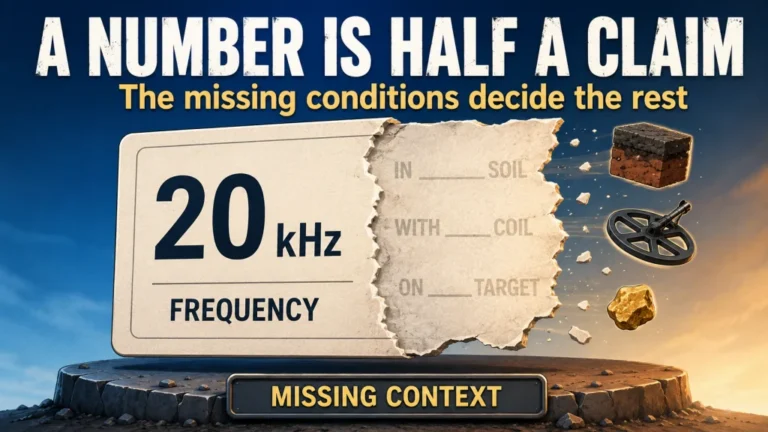
A displayed ground-balance value belongs to that detector’s internal scale and current mode. It does not automatically measure the amount of mineralization, predict depth, or translate directly to another brand or model. A high number on one machine is not proof that the site is more difficult than a lower number shown by another machine.
The value can still be useful within the same setup. It may help a detectorist notice that the ground estimate changed after moving to another patch, confirm that a mode stores a separate balance, or return to a documented setting when the manual permits it. What it cannot do is replace a mineralization indicator, a stability check, or an actual target test in that ground.
Key point: Treat the number as a control value used by one detector, not as a universal laboratory reading of the soil.
This distinction prevents a common buying mistake. A display that shows more digits may offer useful feedback, but it does not prove the detector handles difficult ground better than a system that presents less information and processes the ground differently.

The Fisher Gold Bug Pro operates at 19 kHz and uses computerized Ground Grab ground balancing. Its display provides continuous ground-condition and mineralization information. The detector also includes adjustable threshold and gain controls plus V-Break tone discrimination.
Check On AmazonIf you click this link and buy, we earn a commission at no additional cost to you.
How to Choose the Ground-Balance Features You Will Actually Use
Start with the places you expect to hunt, then work backward to the feature. Someone staying in maintained parks with fairly consistent soil may value a stable fixed or automatic system more than a deep manual menu. Someone crossing red clay, altered farm ground, hot rocks, and mineralized goldfields may value manual adjustment, tracking, mode-specific storage, or a dedicated ground process.
Salt exposure deserves its own question. A detector that lists ground balance but lacks a suitable wet-salt mode may not solve the beach problem you expect it to solve. Likewise, a gold mode label is not enough unless the documentation explains how the mode handles mineralized ground and weak targets.
- Confirm whether the detector uses fixed, manual, automatic, tracking, or a combination of systems.
- Check whether each search mode stores its own ground-balance result.
- Look for restrictions in beach, salt, gold, all-metal, or specialized ground modes.
- Find out whether automatic balance is a one-time estimate or continuous tracking.
- Check whether manual correction is available after an automatic result.
- Read what the manufacturer says about changing soil, hot rocks, and conductive ground.
- Verify whether the displayed number is a control value, a ground indicator, or both.
- Prefer field evidence that keeps coil, mode, target, sensitivity, and soil conditions comparable.
That checklist keeps the decision tied to terrain and use rather than marketing language. It also prevents the opposite mistake of paying for controls you do not intend to learn. More adjustment is useful only when it helps you keep the detector stable without sacrificing the targets you came to find.
Understanding the Feature Is Different From Setting It in the Field
This article explains what the systems do and how to compare them. It does not provide a universal pumping routine, tell you which direction to change a manual value, or prescribe when to re-balance. Those steps differ by detector, search mode, coil, and ground condition, and a procedure copied from another machine can produce the wrong result.
For the actual field sequence, use the detector’s current manual and follow a procedure written for the controls in front of you. The separate guide to setting ground balance in real conditions covers setup and troubleshooting without turning one manufacturer’s button sequence into a rule for every machine.
The separation matters because theory answers “what problem is this feature solving?” while procedure answers “what should I press, observe, and verify on this model?” Keeping those questions apart makes it easier to diagnose the ground before changing a setting.
Final Thoughts: Match the Ground System to the Ground You Will Hunt
Ground balance is valuable because the soil can become part of the signal, not because every detector must expose the same control. Fixed, manual, automatic, and tracking systems each represent a different balance between simplicity, operator control, and adaptation. Dedicated modes can add another layer of ground processing that a single displayed number does not explain.
My buying rule is straightforward: identify the ground changes you are likely to face, then read the manual for how the detector handles those exact conditions. Do not buy manual control because it sounds advanced, do not assume automatic means more accurate, and do not leave tracking on simply because it can update. The useful feature is the one that keeps the machine stable while preserving a target response in your actual terrain.
FAQs
These questions cover the distinctions that matter when comparing ground-balance features. For button sequences and calibration steps, use the manual written for your detector.
⚙️ What does ground balance do on a metal detector?
It reduces the detector’s broad response to mineralized or conductive ground so a different response from a metal target remains usable. It does not remove every false signal or correct interference, coil problems, and excessive sensitivity.
🌱 Do I need adjustable ground balance in every type of soil?
No. A fixed or internally managed system can work well in the conditions it was designed to handle. Adjustable control becomes more valuable when the ground is difficult, variable, or outside the detector’s expected range.
🎛️ Is manual ground balance better than automatic ground balance?
Not as a general rule. Manual control offers flexibility, while automatic balance offers a machine estimate based on sampled ground. The better result depends on the implementation, the sample, the operator, and the current mode.
🔄 Should tracking ground balance stay on all the time?
No universal setting works for every detector or site. Tracking can help across changing ground, but manufacturers may recommend different behavior for stable soil, concentrated hot rocks, weak targets, or specialized modes.
🏖️ Is beach mode the same as ground balance?
No. A beach mode may combine salt processing, frequency behavior, transmit changes, filtering, and mode-specific ground adjustment. One ground-balance number does not describe the entire wet-salt system.
📟 Does a high ground-balance number mean highly mineralized soil?
Not necessarily. The number is usually part of that detector’s internal control scale and may change with mode or frequency. Use the manufacturer’s mineralization indicator or documented interpretation rather than comparing numbers across machines.
🧭 How does ground balance work on a metal detector when the soil changes?
A held fixed, manual, or automatic result may need to be reassessed when the ground changes enough to affect stability. A tracking system can update during the sweep, but its behavior and limitations remain model-specific.
The safest rule is to identify the symptom first, confirm that the ground is the cause, and then use the method documented for that detector. Changing ground balance blindly can hide the original problem rather than solve it.
Sources and References
The technical distinctions in this article were checked against current manufacturer manuals and official documentation. These sources illustrate how ground-balance names, ranges, mode restrictions, and tracking behavior vary by implementation.
- Nokta The Legend User Manual, Software V1.17: automatic, manual, and tracking ground balance, mode-specific values, conductive beach behavior, and stated tracking limitations.
- Minelab Product Manuals and Guides: official access to current instruction manuals used to verify model-specific ground-balance controls and dedicated search modes.
- Minelab VANQUISH Series Technical Comparison: official examples showing that machines within one product family can use fixed, automatic, or tracking ground-balance implementations.
- Minelab Frequently Asked Questions: manufacturer guidance showing that some detectors require no user ground balance while others use manual or tracking systems.
Always check the current manual for the exact detector and software version in use, because a familiar feature name does not guarantee the same behavior across models or modes.