A budget below 500 dollars can buy a capable general-purpose detector for lost gold rings, chains, and other jewelry, but that does not make it a dedicated natural-gold prospecting machine. The useful choice depends on whether the target is jewelry in parks, freshwater, or beach sand, or small nuggets in mineralized gold country. Current price checks found several jewelry-capable new detectors within the budget, while no verified current dedicated natural-gold detector from the major manufacturers reviewed had a normal new U.S. price below 500 dollars. The practical decision is to define the gold target first, then judge the detector, complete package, seller, warranty, and ground capability against that job.

Below 500 Dollars Covers Two Very Different Gold Searches
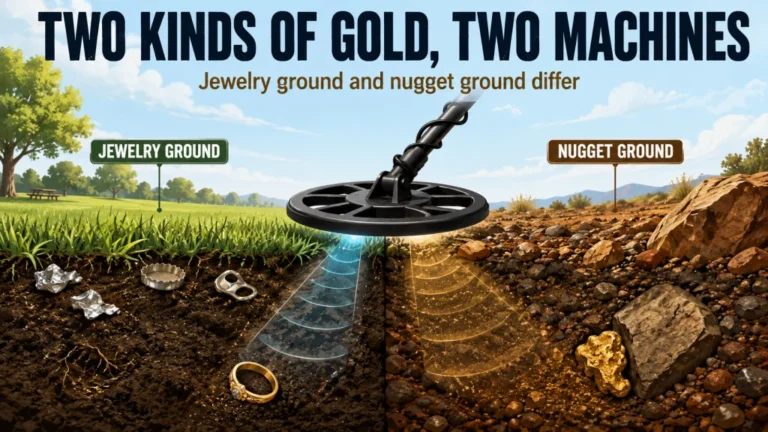
The best metal detectors for gold under 500 dollars are not one interchangeable group. A general-purpose machine can respond well to a lost gold ring because the target is relatively large, shaped into a continuous band, and often located in a park, yard, swimming area, or beach. Natural gold can be far smaller, irregularly shaped, mixed with hot rocks, and buried in ground that produces a stronger response than the nugget itself.
That difference matters more than the word “gold” printed on a search mode. Jewelry recovery usually rewards usable target separation, target identification, waterproofing matched to the site, and stable operation around common trash. Nugget prospecting puts more pressure on sensitivity to very small low-conductive targets, ground balance, coil choice, threshold behavior, and performance in mineralized soil.
Key point: A detector that is a sensible buy for lost gold jewelry can still be the wrong machine for natural nuggets. The budget question cannot be answered until the target and ground are separated.
This article stays inside that gold-specific decision. Buyers comparing all target types at the same price should use the broader guide to choosing a detector below 500 dollars, while anyone still deciding between major machine categories should begin with matching a metal detector to its job.
Use a Strict Price Eligibility Rule
Last Price Checked: July 24, 2026. A detector qualifies for this budget only when its normal new U.S. price is 500 dollars or less. A temporary coupon, clearance event, short holiday promotion, open-box listing, trade-in credit, or private offer does not turn an otherwise more expensive machine into a permanent under-500 recommendation.
The price also needs a package definition. Detector-only price means the normal price of the base machine with its standard search coil, shaft, and the power components the manufacturer normally supplies. A complete functional package must be capable of turning on and hunting without an additional mandatory coil, proprietary battery, charger, control module, or other essential part.
| Price question | What counts | What does not count |
|---|---|---|
| Normal new price | The regular U.S. selling price shown by the manufacturer or a verifiable authorized seller. | Flash sales, coupons, clearance, open-box units, and negotiated private prices. |
| Detector-only price | The base detector with the standard components required by its normal configuration. | Optional second coils, premium headphones, digging tools, bags, and promotional extras. |
| Functional package | A machine that can be assembled, powered, and used with the supplied stock coil. | A listing missing an essential battery, charger, shaft section, coil, or control component. |
| Budget ceiling | The detector package before variable sales tax and optional accessories. | A base price below 500 dollars that requires mandatory additions pushing the usable package above it. |
This rule keeps the comparison honest. A buyer should know whether the price covers a working detector or only creates the appearance of fitting the budget.
What the Budget Can Buy for Lost Gold Jewelry
Current manufacturer listings show several new general-purpose detectors between 199 and 499 dollars that can find gold jewelry, but they are not interchangeable. The useful candidates fall into three profiles based on site, trash density, ground behavior, and water exposure.
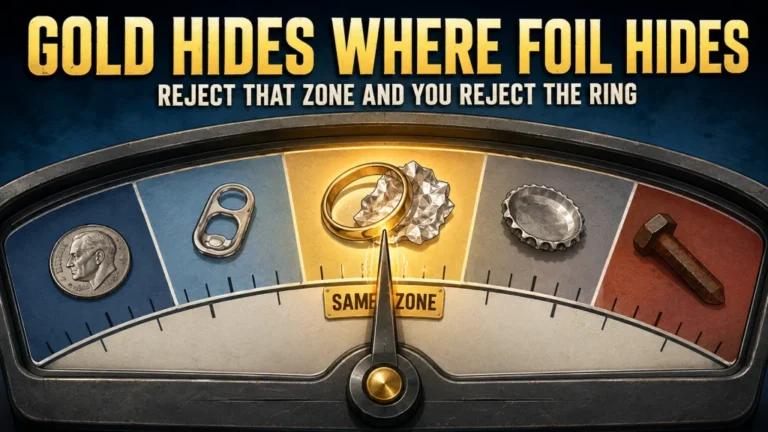
Gold jewelry overlaps foil, pull tabs, and other low-conductive trash. A suitable candidate must do more than respond to gold. It needs stable operation in the intended ground and enough usable audio to investigate that conductive range without rejecting most of it.
| Candidate profile | Normal price band | Best fit | Verify before buying | Skip when |
|---|---|---|---|---|
| Basic dry-land jewelry detector | 199 to 249 dollars | Parks, yards, playgrounds, permitted school fields, and dry sand. | Complete package, stable local-soil performance, useful audio separation, and a pattern that leaves the jewelry range open. | The regular hunt involves water, wet salt, severe mineralization, or dense trash beyond its controls. |
| Versatile land and freshwater detector | About 330 to 399 dollars | Mixed parks, field permissions, freshwater edges, and dry beaches. | Whole-detector versus coil-only waterproofing, frequency behavior, and audio clarity around common trash. | The main destination is wet salt without a verified salt-capable mode, or the buyer only hunts simple dry ground. |
| Upper-budget multi-site jewelry detector | 479 to 499 dollars | Parks, freshwater, variable soil, and some beach conditions where broader settings solve a known problem. | Frequency system, submersion rating, included package, support, and a normal complete price below 500 dollars. | The extra capability does not match a named site problem, or small natural gold is the actual priority. |
The lowest band is legitimate for someone who will hunt dry parks regularly. The middle band earns its cost when water exposure, changing sites, or trash handling creates a real limitation. The upper band makes sense only when its ground, frequency, or waterproof capability matches a location the buyer can name.
A jewelry buyer should choose by location before price tier. The guide to selecting a detector for gold jewelry explains why a trashy park, freshwater swimming area, dry beach, and wet salt line can require different capabilities even when the target is the same metal.

Garrett ACE 300 provides Digital Target ID for identifying detected metals. Its Iron Resolution helps separate desirable targets from nearby iron trash. Electronic pinpointing helps narrow the location of a detected target before recovery.
Check On AmazonIf you click this link and buy, we earn a commission at no additional cost to you.
No Current Dedicated Nugget Detector Qualified in the Audit
As of the price-check date, the manufacturer and authorized-seller pages reviewed did not show a current dedicated natural-gold detector with a normal new U.S. price at or below 500 dollars. The lowest verified specialist price in the audit was 549 dollars. Other dedicated high-frequency VLF machines were listed at 679.99 dollars, 699 dollars, and 899 dollars, while specialist pulse induction choices began much higher.
This does not mean a general detector below 500 dollars cannot respond to a nugget. A larger nugget in mild ground may produce a clear signal. The limitation is that an occasional response is not the same as having a machine designed around small-gold sensitivity, difficult ground, specialized coils, threshold audio, and the controls prospectors may need.
Warning: Do not treat an all-metal mode, a high-frequency option, or a search profile named for gold as proof that a general detector equals a dedicated prospecting machine.
Anyone whose primary goal is natural gold should compare the budget against detectors built for finding gold nuggets. Where magnetic soil and hot rocks dominate the decision, the more relevant comparison is gold detectors for mineralized ground.
Use the Target-and-Ground Decision Matrix
A budget machine becomes a good or bad choice through the conditions around the target. Jewelry hunting in a maintained park may demand separation and disciplined discrimination. A freshwater swimming area adds waterproofing. Wet salt sand adds conductive ground. Nugget country can add magnetic mineralization, hot rocks, tiny targets, uneven terrain, and long periods of listening for marginal responses.
The matrix below keeps the decision tied to the real hunt rather than the product page. It also shows when the 500-dollar ceiling remains reasonable and when the budget itself is causing the mismatch.
| Primary use | Can the budget work? | What matters most | Main limitation |
|---|---|---|---|
| Gold rings in parks | Yes, several general detectors qualify. | Target separation, useful low-conductor audio, coil control, and restrained discrimination. | Foil and pull tabs overlap common jewelry responses. |
| Jewelry in freshwater | Yes, when the complete detector has the required waterproof rating. | Control-box waterproofing, stable operation, secure coil connection, and recovery method. | A waterproof coil alone does not make the complete detector submersible. |
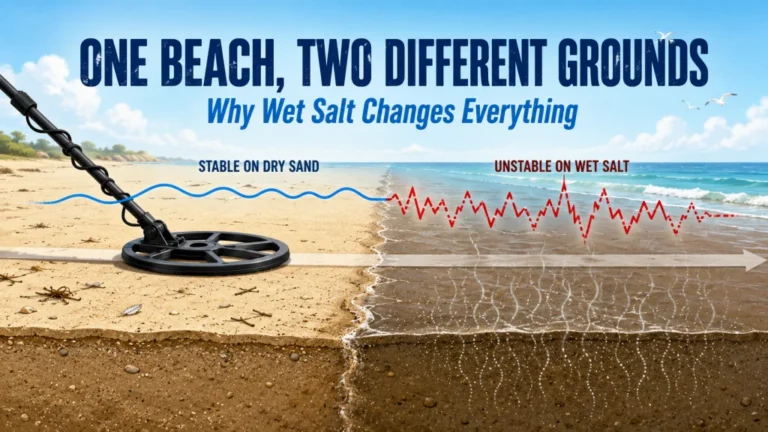
| Jewelry on wet salt sand | Sometimes, with a suitable salt-capable platform and realistic expectations. | Salt stability, ground handling, recovery speed, sensitivity discipline, and coil coverage. | A machine can become unstable or lose usable sensitivity when pushed too hard. |
| Occasional larger nuggets in mild ground | Possible, but not the same as specialist performance. | Ground balance, suitable coil, all-metal response, and patient overlap. | Small-gold sensitivity and hot-rock handling may remain limited. |
| Tiny nuggets in mineralized goldfields | Not a reliable new-machine expectation below 500 dollars. | Dedicated sensitivity, ground system, coil selection, threshold behavior, and operator control. | The current specialist market begins above the stated budget. |
The broad guide to choosing a detector for different gold targets is the next step when jewelry and nuggets are both still on the list. One machine may cover some overlap, but the buyer should know which side of the overlap receives priority.

Minelab X-Terra PRO provides Park, Field and Beach search modes for different detecting environments. Its Pro-Switch system provides selectable frequency operation. The detector is IP68 waterproof to 16 feet and includes multiple audio options for interpreting targets.
Check On AmazonIf you click this link and buy, we earn a commission at no additional cost to you.
What 500 Dollars Cannot Reliably Solve
A budget ceiling cannot force one machine to handle every combination of tiny gold, severe mineralization, salt, deep targets, dense iron, waterproofing, low weight, and broad coil support. Trade-offs remain even above this price. Below it, those trade-offs become more visible because most qualifying machines are designed first as versatile general detectors rather than dedicated goldfield tools.
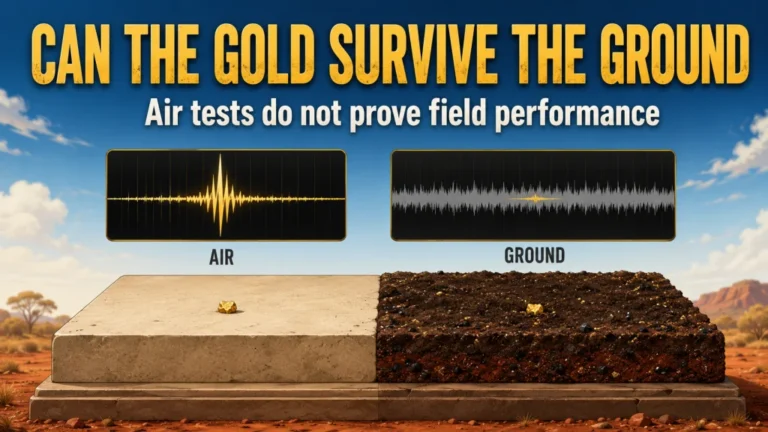
The hardest limitation is not a missing menu item. It is the signal-to-ground problem created when a very small nugget responds weakly while the soil, hot rocks, or salt produce strong changing signals. A machine may detect the test piece in air and still struggle to give a stable, recognizable response in the ground where the buyer plans to prospect.
- Do not expect universal performance on tiny or porous natural gold.
- Do not assume a stock general-purpose coil is the best footprint for bedrock cracks or dense hot rocks.
- Do not assume target identification will remain reliable on weak nuggets at the edge of detection.
- Do not expect discrimination to remove every iron target without risking small or irregular gold.
- Do not treat full waterproofing as proof of stable wet-salt performance.
- Do not use an air-test distance as a field-depth promise.
The right response is not always to spend more immediately. A jewelry-focused buyer may be fully served below 500 dollars. A nugget-focused buyer may be better served by saving, renting, borrowing through a club, or learning the intended ground before purchasing a compromise machine.
Scott’s Field Judgment: Buy for the First Real Hunt
My field judgment is to buy for the first repeatable use case, not the most exciting possibility mentioned in the advertising. If the realistic weekends involve parks, school fields with permission, freshwater swimming areas, or local beaches, a jewelry-capable general detector below 500 dollars can be a sensible purchase. The machine will have regular places to work, and the operator can build skill on targets that actually exist nearby.
If the plan is to travel specifically to mineralized goldfields and search for small natural gold, I would not call the same general-purpose purchase equivalent. The evidence status is different: the current dedicated machines checked sit above the budget, and the main limitation is not whether the detector beeps on gold. It is whether the complete system can hold a usable threshold or target response in the actual ground while remaining sensitive to the nugget sizes likely to be present.
Saving is the better decision when the intended use is specialist prospecting and every qualifying new detector is outside the budget. Buying a compromise now and replacing it after one trip can cost more than delaying the purchase.

Nokta Score uses simultaneous multi-frequency technology to handle varied ground conditions without forcing you to commit to a single operating frequency. Its fully waterproof construction makes it practical for parks, fields, freshwater edges, and wet beach hunts. The rechargeable design also makes it a straightforward choice for someone buying a capable detector for regular real-world hunting.
Check On AmazonIf you click this link and buy, we earn a commission at no additional cost to you.
Treat Used and Legacy Machines as a Separate Market
A used or discontinued dedicated prospecting detector may fall below 500 dollars, but that does not make it directly comparable with a new general-purpose machine carrying a current warranty. Condition, coil availability, battery health, seals, repairs, serial-number authenticity, and replacement parts can change the real value by hundreds of dollars.
Evaluate the complete package rather than the control box alone. A low price becomes less attractive when the correct search coil is damaged, the proprietary charger is missing, the battery no longer holds capacity, or the manufacturer no longer supports a critical part. Older specialist machines may also demand more ground-balancing and threshold skill than a first-time buyer expects.
- Confirm the exact model generation and serial number.
- Check whether the manufacturer still provides manuals, repairs, and replacement parts.
- Inspect coil ears, cable strain relief, connectors, shaft locks, battery contacts, and waterproof seals.
- Test ground balance, threshold stability, controls, display, speaker, and headphone output.
- Verify every included coil and accessory rather than accepting a package photo as proof.
- Assume no warranty transfer until the written policy says otherwise.
This section is intentionally non-ranking. A good used purchase depends on the individual unit’s condition and support path, not the reputation the model had when it was new.
A Temporary Sale Does Not Reset the Market
A specialist detector may occasionally drop below 500 dollars during clearance, an authorized promotion, or a replacement-model transition. That can be a legitimate buying opportunity, but it should be labeled as a temporary exception rather than added to a permanent list of normally qualifying machines.
Check the regular price, promotion end date, stock status, included components, return policy, and whether the discount signals discontinuation. A sale-only unit can still be a good purchase when parts, warranty, and service remain available. It becomes risky when the low price is paired with missing accessories, unclear seller status, or no support path after the return window closes.
Temporary-sale rule: Use the normal new U.S. price for eligibility. Mention a sale only as a dated opportunity after confirming the authorized seller, full package, warranty, and stock.
This rule also prevents an article from becoming inaccurate the moment a weekend promotion ends. The permanent conclusion should survive normal price changes, while the visible check date tells readers when the market was reviewed.
Verify the Seller, Warranty, Authenticity, and Support
Budget pressure makes unusually low marketplace listings tempting. It also increases the cost of getting the seller wrong. A counterfeit detector, gray-market import, incomplete return, or unit without valid U.S. warranty support can erase the apparent savings before the first season ends.
Start with the manufacturer’s dealer locator and warranty terms. Confirm that the seller is authorized for the exact brand, obtain a dated itemized receipt, record the serial number, and register the product when the manufacturer provides registration. Where an authenticity label or online verification system exists, use it before the return period expires.
| Check | What to confirm | Red flag |
|---|---|---|
| Seller | Listed by the manufacturer or verifiably authorized for the brand. | A seller cannot explain warranty coverage or product origin. |
| Warranty | Length, covered components, registration requirements, and U.S. service path. | “Manufacturer warranty” appears in the listing but not in written terms. |
| Authenticity | Security label, serial number, packaging, and manufacturer verification process. | A price far below every authorized source or a missing serial label. |
| Replacement status | Whether the model is current, replaced, discontinued, or on final clearance. | The seller presents old stock as a current release without disclosure. |
| Support | Manuals, firmware, coils, batteries, repairs, and service-center access. | No clear source for essential replacement components. |
A legitimate normal price from an authorized seller is more useful than a lower number that cannot be supported. The detector is a long-term tool, and the service path is part of the package.
Use This Final Buying Checklist
Do not place the order until the budget, target, ground, and package all describe the same purchase. The checklist below is designed to expose a category mismatch before the return period has to solve it.
- Is the priority lost gold jewelry, natural nuggets, or one clearly defined mix?
- What are the first three realistic hunt locations?
- Will the detector face dry soil, freshwater, wet salt, hot rocks, or magnetic mineralization?
- Is the quoted price the normal new U.S. price rather than a temporary sale?
- Does the price cover a complete functional package?
- Is the whole detector waterproof where submersion is planned, or only the coil?
- Does the frequency system and ground control fit the intended site?
- Are compatible coils, manuals, batteries, repairs, and firmware support available?
- Is the seller authorized, and is the warranty valid in the United States?
- Would saving for a dedicated prospecting category solve the main limitation better than buying now?
If the first use is jewelry recovery, the budget offers several realistic new choices. If the first use is serious natural-gold prospecting, the current evidence says the buyer should either revise the budget, consider a carefully inspected used specialist machine, or delay the purchase.

Nokta Triple Score PRO Pack uses simultaneous multi-frequency technology for detecting across different environments. It is IP68 waterproof and submersible to 16 feet. The detector has multiple search modes, a rechargeable battery and online firmware update support.
Check On AmazonIf you click this link and buy, we earn a commission at no additional cost to you.
Final Thoughts: Let the Gold Target Define the Budget
Five hundred dollars can buy a real metal detector, not merely a toy, and several current machines in that range can be useful for lost gold jewelry. The mistake is turning that truthful statement into a promise about tiny natural nuggets in difficult goldfield ground. Jewelry and prospecting place different demands on sensitivity, ground handling, coils, audio, waterproofing, and target information.
Define the first hunt, apply the normal-price and complete-package rules, and verify the seller before comparing features. For jewelry, buying now may make sense. For dedicated natural-gold work, saving for the correct category is often the more honest and less expensive decision.
FAQs
These answers use normal new U.S. prices checked on July 24, 2026. Promotions, stock, packages, and replacement models can change, so confirm the current listing and warranty before purchasing.
💍 Can a detector under 500 dollars find a gold ring?
Yes. Several general-purpose detectors in this budget can find gold rings when the machine, coil, settings, and site are suitable. The harder problem is separating jewelry-range responses from foil and pull tabs without rejecting the ring.
⛏️ Can a cheap metal detector find natural gold?
It may respond to a sufficiently large nugget in favorable ground, but that does not make it a dedicated prospecting machine. Small nuggets, mineralization, hot rocks, and limited coil or ground controls can expose the difference quickly.
🏜️ Is there a new dedicated gold detector below 500 dollars?
None qualified in the current manufacturer and authorized-seller audit. The lowest verified normal price for a current dedicated specialist machine was above 500 dollars on the price-check date.
🏖️ Is an under-500 detector suitable for wet salt sand?
Some are, but the exact frequency system and salt mode matter. Full waterproofing and a beach label do not by themselves guarantee stable wet-salt performance.
🏷️ Should a sale price determine whether a detector qualifies?
No. Use the normal new U.S. price for a permanent comparison. Treat a verified authorized sale as a dated opportunity, not proof that the machine normally belongs below 500 dollars.
🔧 Is a used specialist detector better than a new general machine?
It can be better for natural gold if the exact unit is genuine, complete, stable, repairable, and supported. A damaged coil, weak battery, missing charger, or unavailable parts can make the used bargain more expensive.
🧾 What should I verify before ordering?
Confirm the normal price, complete package, waterproof rating, authorized seller, U.S. warranty, serial authenticity, return policy, parts support, and whether the machine fits jewelry or natural-gold work.
The budget becomes useful only after the target and ground are defined. Recheck the current market whenever a price, package, or model status changes.
Sources and References
These current manufacturer and authorized-seller pages were used to verify normal U.S. price bands, dedicated prospecting categories, package details, dealer status, warranty coverage, authenticity checks, and support considerations.
- Minelab USA, Current Metal Detector Listings: Normal U.S. prices and current general-purpose detector availability below 500 dollars.
- Minelab USA, Gold Prospecting Detector Range: Current dedicated and prospecting-capable detector pricing used in the specialist-market audit.
- Garrett, Current Dedicated Prospecting Detector Listing: Verified normal price and complete-package information for a current high-frequency specialist detector.
- Nokta Detectors, Current Gold Detector Range: Current dedicated gold-product status and manufacturer support pages.
- Nokta Detectors, Authorized U.S. Dealer Record: Verification that the seller used for a U.S. price check is listed by the manufacturer.
- Authorized Dealer, Current Dedicated Detector Price: Normal advertised U.S. price used to identify the lowest verified specialist price in the audit.
- Current U.S. Specialist Detector Listing: Current package and price evidence for another established dedicated prospecting machine.
- Minelab USA, Authorized Store Locator: Manufacturer dealer-verification resource for checking seller status.
- Minelab, Counterfeit Product Guidance: Authenticity checks, warning signs, and risks associated with unauthorized sellers and unusually low prices.
- Minelab, Product Warranty Information: Current warranty periods, registration guidance, and covered product categories.
Prices and availability can change after the stated check date. Verify the normal price, package contents, seller authorization, warranty, and support directly before buying.