Correct settings cannot recover a target the coil never passes over correctly. A useful swing keeps the coil controlled, joins individual passes into accountable coverage, and narrows a response before the digging tool touches the soil. The motion has to match detector fit, coil shape, terrain, target density, and the response speed of the machine. This guide gives you a physical system for fitting the detector, controlling the coil, covering a site, and locating targets accurately.

Metal Detecting Swing Technique Starts Before the First Sweep
A stable detector can still miss targets when the coil rises, tilts, races past weak responses, or leaves strips of untouched ground between passes. That is why metal detecting swing technique is not a cosmetic detail added after the settings are finished. It determines which part of the ground enters the search field and how consistently the machine receives each response.
I separate physical execution from the electronic side of the detector. This article covers body fit, coil control, coverage, terrain changes, and target location. It does not teach sensitivity, discrimination, ground balance, tone interpretation, or fault diagnosis. Those topics have their own procedures, while the broader guide to practical metal detecting field skills connects technique with the rest of a hunt.
The first question is not how far the coil should travel. It is whether the operator can repeat the same useful motion without fighting the shaft, wrist angle, or weight of the setup. Fixing that relationship makes every later step easier to judge.
Fit the Detector to the Operator, Not the Other Way Around
A poorly fitted detector encourages bad motion. When the shaft is too long, the coil tends to run too far ahead and the operator reaches with the shoulder. When it is too short, the coil can crowd the feet, the back may bend, and the sweep becomes a cramped wrist movement. The correct fit lets the coil travel in front of the body while the elbow, wrist, and shoulder remain controlled rather than locked or overextended.
Start by adjusting the shaft and arm cuff while wearing the footwear and clothing normally used in the field. The grip should sit naturally in the hand, the cuff should support the forearm without squeezing it, and the coil should reach the ground with room to move over small changes in terrain. The goal is not a perfectly upright pose at every moment. It is a position that allows the coil to remain controlled without forcing the operator to lift it through the arc.
- Shaft length: Set it so the coil reaches the working surface without a straight, overextended arm.
- Arm cuff: Position it where the forearm is supported and the detector does not twist freely during a change of direction.
- Grip pressure: Hold firmly enough to guide the coil, but not so tightly that the wrist becomes the hinge for the entire sweep.
- Coil angle: Adjust the joint so the coil can follow the working surface without continually folding backward or nosing down.
- Balance: Judge how the detector feels while moving, not only while holding it still beside the truck.
A heavier setup is not automatically harder to control than a lighter one because balance changes where the strain appears. If the operator spends the first hour correcting a front-heavy coil with the wrist, the sweep will usually become less level as fatigue builds. Persistent wrist, shoulder, or lower-back strain is a fit warning, not something to push through. When shaft and cuff adjustments cannot remove the burden, a better-balanced shaft arrangement, a smaller suitable coil, or a support harness may solve the physical problem, but each aid should earn its place by improving control.
Detector fit should be checked again after a short practice session, not treated as a one-time assembly step. Proper metal detecting technique begins with a setup the operator can guide consistently after the initial fresh-arm feeling has worn off.

The KwikSafety SUPERCELL is a full body fall protection harness with three heavy-duty D-rings, including two hip D-rings and one dorsal D-ring. It uses cushioned shoulder pads, adjustable buckles, and polyester load-bearing straps. The listing states that it meets or exceeds ANSI/ASSE Z359.11-2021 standards and supports users from 130 to 310 pounds.
Check On AmazonIf you click this link and buy, we earn a commission at no additional cost to you.
Keep Coil Height, Level, and Speed Consistent
The coil should follow the usable ground surface instead of tracing a high pendulum through the air. Raising it reduces the strength of the field reaching the soil, and lifting at the end of the arc creates shallow outer sections that look covered from above but were not searched like the center. Tilting the coil can produce the same problem because one edge moves farther from the ground than the other.
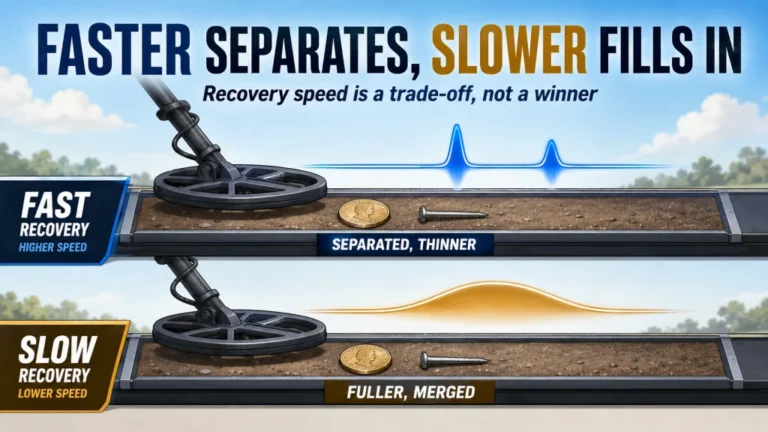
Speed matters for the same reason. A sweep that is too fast for the detector, target, and ground can shorten or weaken a response before the operator recognizes it. A sweep that is unnecessarily slow can waste coverage and may not suit every motion-based mode. The correct pace is the one that produces repeatable responses while the coil remains stable and the operator can maintain the same motion across the site.
Field Note: When I check someone’s coil control, I watch the outer part of the arc first. The center often looks fine, but the coil tip starts climbing as the hand changes direction, which removes useful coverage exactly where the operator believes the sweep is complete.
Do not solve end lift by forcing a wider arc. Shorten the movement until the coil can remain low and level from one direction change to the other. The detailed guide to controlling coil height and sweep speed explains how target size, terrain, coil shape, and detector response change the useful motion.
Good metal detector coil technique feels repeatable rather than dramatic. The shoulders and torso may contribute to the movement, but the coil should not surge ahead, twist at the edge, or bounce every time the operator takes a step.
Build Coverage with Lanes, Overlap, and Repeatable Direction
Coil control searches one pass well. Coverage determines whether those good passes add up to a searched area or a collection of random arcs. A detectorist can spend hours in productive ground and still miss most of it by wandering, turning around obstacles without resetting the lane, or allowing the walking direction to create gaps between sweeps.
Overlap should match the search field, coil geometry, target size, terrain, and confidence required at the site. A coil does not necessarily search every point beneath its visible shell with equal strength, and different coil configurations produce different field shapes. That is why one universal overlap percentage would be misleading. The practical test is whether the next pass covers the weaker edge of the previous one under the current conditions.
| Coverage method | Where it helps | Common failure |
|---|---|---|
| Parallel walking lanes | Open parks, fields, beaches, and other areas with clear reference lines. | Lanes gradually drift wider as the operator watches the screen instead of the ground path. |
| Small marked sections | Promising ground, permission properties, and areas where precise recovery matters. | The section grows while searching, so the boundary stops controlling coverage. |
| Cross-grid repeat | Sites where target orientation, iron masking, or uneven coverage may hide responses from one direction. | The second direction repeats the same walking errors instead of creating a true cross-check. |
| Feature-based lanes | Fence lines, paths, old foundations, trees, creek edges, and other visible site features. | The operator follows the feature but neglects the ground between it and the next reference line. |
The best metal detector search pattern is the one the operator can see, repeat, and resume after digging a target. Use footprints, stakes where allowed, natural edges, a drag line, or another harmless reference that fits the site. The full guide to building a metal detecting coverage pattern separates open-area lanes, grids, repeat passes, and irregular-site methods.
Coverage should tighten when the evidence improves. A quiet field may justify broad reconnaissance, while a concentrated group of older targets, iron, or structural debris can justify smaller marked sections and a second direction. The pattern follows the site’s information rather than staying fixed for the entire hunt.
Narrow the Target Before You Open the Ground
Pinpointing begins in the search motion, not after the detector enters a dedicated pinpoint mode. When a response repeats, shorten the sweep and identify where the signal is strongest or most centered. Then approach from another direction. A cross-sweep helps reveal whether the apparent center stays in the same place or shifts because of target shape, nearby metal, coil field geometry, or an elongated object.
The physical center of the coil is not always the exact response center used for every search coil and mode. Double-D, concentric, monoloop, round, and elliptical coils can localize targets differently. The operator should learn the fitted coil over known targets instead of assuming the logo, mounting bolt, or geometric center always marks the digging point.
- Shorten the normal sweep while keeping the coil level.
- Mark the strongest repeatable point from the first direction.
- Turn and repeat from another direction without moving the original reference.
- Use the detector’s pinpoint function when it adds a clearer center, following the manual for that mode.
- Check the plug or loose soil with a handheld pinpointer only after the main coil has narrowed the location.
A handheld pinpointer reduces the search area inside a plug or excavation, but it does not replace accurate localization with the detector. It becomes useful when a correctly centered response still takes too long to isolate in loose soil, roots, or the plug. Starting with a large hole because a handheld tool is available creates more disturbance and more chances to damage the target, so the accessory should shorten the final recovery rather than excuse a weak first location. The guide to pinpointing with the detector and search coil covers cross-sweeps, coil geometry, electronic pinpoint modes, and recovery checks in detail.
Accurate target location also provides feedback on technique. If the signal center repeatedly shifts far outside the expected coil reference on known targets, check coil angle, sweep direction, nearby metal, and the way the pinpoint mode is being engaged before assuming the detector is inaccurate.

The Garrett Pro-Pointer AT is a handheld pinpointer with three adjustable sensitivity levels. Its fast retune function can narrow the detection field and help pinpoint a target more precisely. The unit uses single-button controls and is listed as waterproof for detecting around beaches, rivers, and other wet environments.
Check On AmazonIf you click this link and buy, we earn a commission at no additional cost to you.
Adapt the Motion to Slopes, Stubble, Rocks, and Brush
Flat lawn technique does not transfer unchanged to every site. On a slope, swinging across the fall line can cause one side of the arc to climb away from the ground. In crop stubble or brush, forcing a wide arc can make the coil strike stems and roots. Around rocks or foundation debris, the visible opening may be smaller than the coil, so complete coverage requires shorter movements and deliberate changes in approach.
Terrain adaptation means preserving the same principles with a different motion. Keep the coil controlled relative to the searchable surface, shorten the arc where obstacles demand it, and reposition the body instead of reaching around objects with the shaft. On steep or unstable ground, safe footing takes priority over maintaining a continuous sweep.
| Terrain | Useful adaptation | What usually creates gaps |
|---|---|---|
| Slope | Use shorter controlled passes and reset body position as elevation changes. | Keeping the torso fixed while one end of the coil climbs uphill. |
| Stubble or tall grass | Work through manageable openings and keep coil movement smooth rather than forcing it downward. | Bouncing over vegetation and assuming the visible arc received equal depth. |
| Rocks and structural debris | Approach from several angles and use the accessible edges of the coil field. | Searching only the open center while leaving narrow spaces untouched. |
| Brush and roots | Reposition the operator and use compact passes around each obstruction. | Reaching with the shaft until the coil tilts or twists. |
| Water edge or moving water | Slow the body movement and account for resistance against the coil. | Letting water pressure lift or rotate the search coil. |
Terrain changes the amount of ground reached with each pass, but it does not justify losing track of coverage. Break difficult ground into smaller sections and finish one accessible area before stepping around the obstacle. That approach is slower than a wide lawn sweep and far more honest about what was actually searched.
Practice the Motion Over Known Targets
Random hunting gives poor feedback because the operator does not know which targets were missed. A short practice area with known, representative objects makes coil height, sweep speed, overlap, and localization visible. The targets can begin on the surface in clean ground, then move to a controlled test arrangement where their position and orientation are documented.
The purpose is not to create a universal depth claim. It is to find the range of motion that gives repeatable responses with the current detector, coil, mode, and ground. Keep the electronic setup unchanged while testing one physical variable at a time, otherwise a sensitivity or mode change can hide the technique lesson.
- Fit the shaft and cuff, then walk several passes without targets to check comfort and coil level.
- Sweep a known target from more than one direction and identify the pace that gives a clear repeatable response.
- Deliberately lift one end of the arc, tilt the coil, and increase speed so the lost response becomes recognizable.
- Lay out a small lane with known target positions and check whether the chosen overlap reaches each one.
- Practice narrowing each response with short sweeps, a cross-sweep, and the detector’s pinpoint function.
- Repeat on a mild slope or around a harmless obstacle to test terrain adaptation.
End the routine by searching the practice area without looking at the target marks, then compare the recovered locations with the layout. That final pass tests the complete physical sequence rather than one isolated motion. It also shows whether technique changes after the operator begins walking and dividing attention between the coil, ground, and display.

This pocket notebook uses weatherproof paper designed for outdoor fieldwork. Each notebook has 100 pages with a top-spiral format and an impact-resistant Wire-O binding. The Polydura cover helps protect field notes from scratches and stains during use.
Check On AmazonIf you click this link and buy, we earn a commission at no additional cost to you.
My Fit, Control, Cover, and Locate Framework
I use a four-part physical-technique framework because the checks follow the order in which problems appear. Fit determines whether the detector can be moved consistently. Control determines whether the coil searches each pass properly. Cover determines whether those passes reach the intended ground, and Locate determines whether a detected response becomes an accurate recovery point.
Skipping an earlier check makes the later one unreliable. A perfect grid does not help if the coil lifts through each arc. Accurate electronic pinpointing cannot repair a target that was only clipped at the weak edge of an inconsistent pass. The framework is therefore a sequence, not four independent tips.
| Check | Question | Correction |
|---|---|---|
| Fit | Can I hold and move the detector without reaching, bending, or correcting the weight with my wrist? | Adjust shaft length, cuff position, grip, coil joint, and the way weight is carried. |
| Control | Does the coil remain stable, level, and repeatable through both direction changes? | Shorten the arc, reduce pace, and move the body instead of flicking the wrist. |
| Cover | Can I show which ground was searched and where the next lane begins? | Use visible lanes, overlap suited to the coil field, marked sections, or a cross-grid. |
| Locate | Can I narrow the response from two directions before digging? | Use shorter sweeps, cross-sweeps, the correct coil reference, and pinpoint mode where helpful. |
Run the four checks again when the coil, terrain, footwear, shaft, or search purpose changes. A movement that works in open grass with one coil may not remain controlled in brush, shallow water, or dense target ground. The framework stays the same while the physical solution changes.
Separate Technique Problems from Settings and Equipment Faults
Not every missed or unstable response comes from the swing. A detector can be poorly balanced to the ground, set too aggressively, affected by electromagnetic interference, connected to a loose coil cable, or operating with a damaged component. This article does not diagnose those electronic or hardware problems, but the operator should know when physical corrections stop changing the symptom.
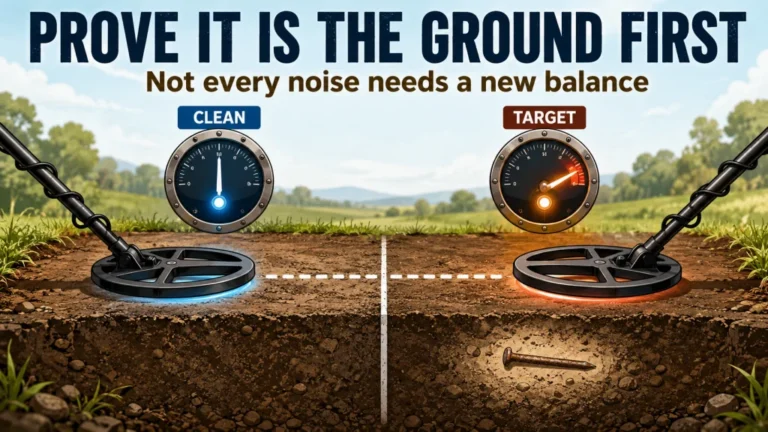
Use one controlled comparison. Hold the electronic setup constant and repeat the pass over a known target while correcting coil height, level, speed, and direction. If the response becomes repeatable, technique was at least part of the problem. If the symptom remains while the coil is controlled, stop changing the motion and move to the appropriate settings or equipment check.
| Symptom | Technique clue | Reason to check another cause |
|---|---|---|
| Signal appears at the end of each arc | It follows coil lift, tilt, or a sharp direction change. | It continues with a low, level, controlled pass over clean ground. |
| Known target is heard from one direction only | The second approach clips the target with the edge of the field or changes height. | Controlled cross-sweeps stay inconsistent in several positions and directions. |
| Coverage produces unexplained blank strips | Walking lanes drift or the next sweep does not cover the previous edge. | Known targets inside verified lanes remain absent with consistent coil control. |
| Target center shifts during pinpointing | The coil angle, approach direction, or reference point changes. | The shift remains repeatable with a controlled coil and isolated target. |
| Detector becomes noisy during every sweep | Noise follows coil strikes, cable movement, or abrupt motion. | Noise remains with smooth movement and also appears during a stationary check. |
The rule is simple: change one category at a time. Reworking settings while also changing sweep speed, coil height, and cable position makes the result impossible to interpret. Physical technique should be proven over known targets, then held steady while another problem is investigated.

VELCRO Brand ONE-WRAP Cable Ties are pre-cut straps made for bundling and organizing cables. Each tie measures 8 inches by 1/2 inch and can be adjusted and reused. This package contains 100 black cable ties.
Check On AmazonIf you click this link and buy, we earn a commission at no additional cost to you.
Final Thoughts: Make Every Pass Accountable
Good technique is not a perfectly shaped swing repeated on every piece of ground. It is the ability to account for what the coil searched, recognize when terrain changed the motion, and recover a target without pretending an uncertain pass was complete. That standard gives the operator useful feedback after every lane, obstacle, and dig.
I would judge progress by fewer unexplained gaps, more repeatable responses, smaller corrections after direction changes, and cleaner target localization over known objects. When those results begin to weaken during a long session, the answer may be a fit adjustment, a shorter controlled section, or a support aid rather than more effort. The goal is not to swing harder. It is to keep each pass trustworthy for as long as the site deserves.
Build Each Physical Skill Separately
Explore more in this section when one part of the physical sequence is limiting the hunt. Each guide isolates a major skill so the operator can correct it without changing every part of the search at once.
| Guide | What it helps with |
|---|---|
| Coil Height and Swing Speed | Explains level control, end lift, sweep pace, coil angle, and why one universal clearance does not fit every site. |
| Ground Coverage Patterns | Shows how lanes, overlap, grids, marked sections, and repeat directions turn individual sweeps into accountable coverage. |
| Pinpointing a Detected Target | Covers cross-sweeps, coil geometry, electronic pinpoint modes, handheld pinpointers, and accurate recovery location. |
Start with the earliest failed step. Coil control comes before coverage, and coverage comes before recovery accuracy can be judged across a site. Solving the physical sequence in order makes the next practice session easier to evaluate.
FAQs
🧭 How should I swing a metal detector?
Use a controlled pass that keeps the coil stable relative to the ground and produces repeatable target responses. Adjust the arc and pace to the detector, coil, terrain, and target conditions instead of copying one universal motion.
📐 Should the search coil stay level?
Keep it as consistent with the searchable surface as the terrain safely allows. Lifting or tilting one end moves part of the search field farther from the ground and can leave weak outer coverage.
🐢 How fast should I sweep the coil?
Use the pace that gives repeatable responses while you maintain coil control. The useful speed changes with the detector, active mode, target size, ground, coil, and target density.
🗺️ How much should each sweep overlap?
Overlap enough to cover the weaker edge of the previous pass. The correct amount depends on coil field shape, target size, terrain, search purpose, and how thoroughly the area needs to be covered.
🎯 Why does the target move when I pinpoint it?
The apparent center can shift because of coil angle, approach direction, target shape, nearby metal, or coil geometry. Use controlled cross-sweeps and learn the reference point of the fitted coil over known targets.
⛰️ Should I use the same swing on a slope?
No single lawn-style arc fits every slope. Shorten the pass, reset your body position as elevation changes, and prioritize stable footing while keeping the coil controlled relative to the surface.
🔧 How do I know whether the problem is my technique?
Repeat a known target with the electronic setup unchanged while correcting coil height, level, speed, and direction. If the symptom remains with controlled motion, move to the appropriate settings or equipment check rather than continuing to change the swing.
Sources and References
- Minelab metal detecting FAQ: official guidance on coil field shapes, sweep overlap, end-of-swing lift, coil control, and pinpointing behavior.
- Minelab getting-started guidance: official beginner guidance on practicing with a detector and using slow, overlapping sweeps for ground coverage.
- Minelab sweep technique guidance: official field advice on keeping the coil low and level, controlling pace, and overlapping passes.
- Garrett instructional resources: official documentation describing electronic pinpointing as a non-motion method for narrowing a detected target’s location.