The best metal detectors for gold jewelry are not the machines that promise to identify gold with certainty. Gold rings, earrings, chains, and bracelets can overlap foil, pull tabs, bottle-cap fragments, and other aluminum, so successful jewelry hunting still requires uncertain digs. Choose the detector class by the site first: inland trash, dry sand, conductive wet salt, surf, freshwater, or actual submersion. The right machine gives you a repeatable response, useful audio, suitable target separation, manageable weight, and the exact water protection your hunt requires.
Gold Jewelry Often Sounds Like the Trash Around It
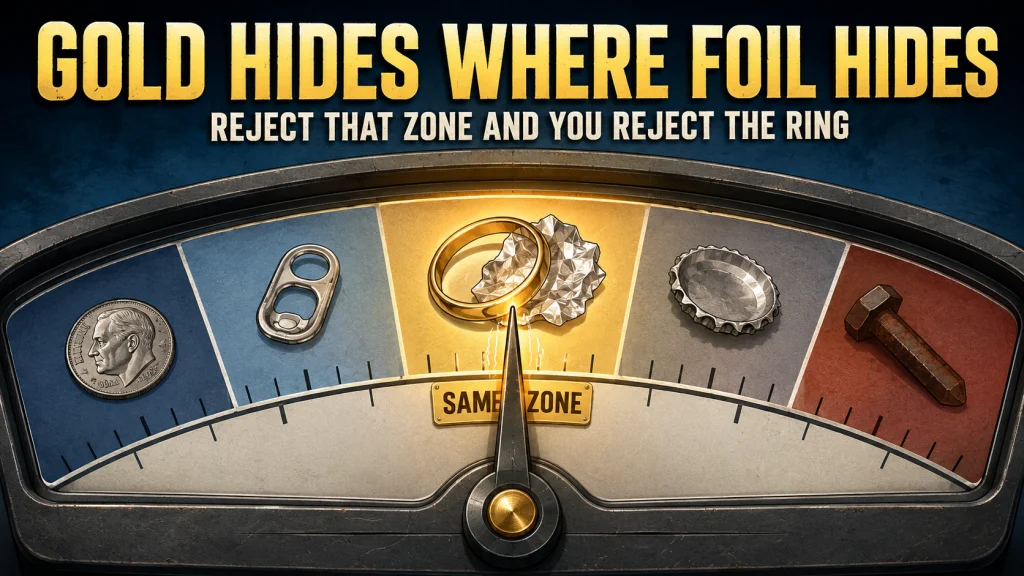
Finding gold jewelry while metal detecting still means recovering uncertain targets. A new buyer often expects a metal detector for gold jewelry to separate a ring from every pull tab before the hole is opened. That is not how the signal works. The machine responds to conductivity, size, shape, orientation, depth, nearby metal, and ground conditions, not to the word stamped inside a ring.
A broad wedding band may produce a stronger and more repeatable response than a thin earring. A fine chain can respond as several weak links instead of one solid object, and part of it may fall close to the same response region as small foil. Change the alloy, clasp, orientation, depth, or surrounding ground, and the audio and screen behavior may change again.
Key point: Buying a more capable detector can improve signal quality, separation, stability, and control. It cannot remove the physical overlap between desirable jewelry and common aluminum trash.
This is why aggressive rejection can make a trashy park quieter while also removing some of the targets you came to find. The useful buying question is not, “Which detector knows gold?” It is, “Which detector lets me interpret uncertain mid-conductive targets well enough in the environment where I will actually hunt?”
Gold Jewelry and Natural Gold Are Different Detecting Problems
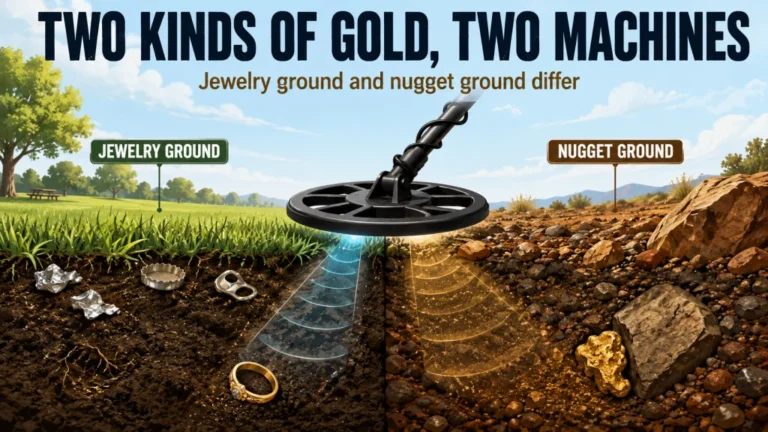
This guide is about lost rings, earrings, chains, bracelets, pendants, and similar jewelry at recreational sites in the United States. It does not cover natural nugget prospecting. The word “gold” appears in both searches, but the targets, ground, trash, and useful detector features are different.
Nugget hunting may involve very small natural gold in mineralized ground with comparatively little modern aluminum. Jewelry hunting often puts manufactured gold in the same ground as tabs, foil, caps, coins, hairpins, and other recent losses. A detector designed around tiny gold in difficult prospecting ground is not automatically the most practical choice for a littered picnic lawn or swimming beach.
Readers who are still deciding between those two goals should begin with choosing a detector for the correct gold target. The broader metal detector buying framework also helps separate hunt type, terrain, controls, and budget before a specialized feature list takes over the decision.
Once the target is clearly jewelry, the next decision is not a brand or price tier. It is the ground and water condition the machine must handle.
Choose the Site Class Before the Detector Class
The same gold ring can be an easy target in clean dry sand and a difficult target beside aluminum in a mineralized park. Move that ring into conductive wet salt, surf wash, or waist-deep water, and the machine now faces a different stability and hardware problem. I would not buy for all of those places unless I genuinely planned to hunt all of them.
Parks and Fields Put Separation Ahead of Water Depth
Inland recreational ground usually rewards controlled discrimination, informative audio, and recovery behavior that can separate nearby targets. Picnic areas, sidelines, shade trees, fairgrounds, and old gathering spaces may contain the exact aluminum objects that overlap jewelry. A detector that stays understandable around adjacent targets is often more useful here than one selected mainly for maximum submersion depth.
Ground handling still matters because mineralization and changing soil can make responses less stable. Coil options matter too. A smaller coil can reduce ground coverage, but it may make a dense trash patch easier to interpret by placing fewer targets under the detection field at once.
Dry Sand Is Usually the Least Demanding Beach Zone
Dry sand above the regularly wetted line is often closer to ordinary inland detecting than to true saltwater work. Jewelry losses can be concentrated around towel lines, access points, activity zones, and places where people handle clothing or apply sunscreen. Trash can still be heavy, so response quality and separation remain important.
A machine that works well in parks may perform acceptably in dry sand even when it is not the strongest choice for wet salt. The mistake is treating the word “beach” as one environment. A dry-sand plan and a surf plan may require different detector capabilities.
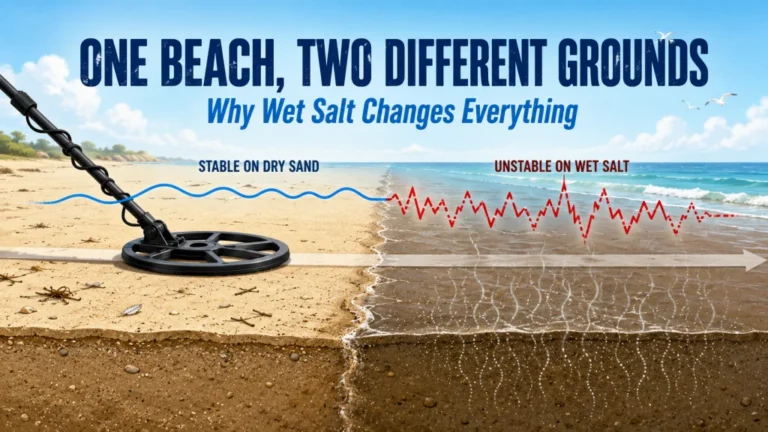
Wet Salt and Surf Add Conductive Ground and Moving Water
Saltwater-wetted sand is electrically conductive. That ground response can reduce stability or force compromises that were unnecessary on the dry upper beach. A useful saltwater-capable class should provide a mode or operating method specifically suited to wet salt rather than relying on a generic land profile and optimistic advertising.
Surf adds coil movement, changing water depth, wave pressure, black sand in some locations, and saltwater contacting more of the system. The best choice for a quiet park is not automatically the best detector for gold rings in this zone. For a deeper treatment of the ground problem, use the guide to choosing a detector for saltwater beaches.
Freshwater and Shallow Water Make Hardware Protection Decisive
Freshwater does not create the same conductive-ground problem as wet salt, but water still changes the buying decision. A waterproof coil on a detector with a weather-resistant control housing is not a fully submersible system. The control unit, battery compartment, connectors, headphones, and any wireless components need to match the depth and duration you intend to use.
A shoreline hunter who only rinses the coil has a different requirement from someone searching a swimming area with the control unit underwater. Before paying for a water rating, define whether you mean rain, splashes, coil immersion, brief control-box immersion, or sustained shallow-water use.

Garrett Vortex VX7 supports Multi-Salt and multi-frequency operation for different detecting environments. It includes Beach, Coins, Zero, Custom and Standard search modes plus pinpoint. Adjustable detection speed helps separate targets when hunting in trashy areas.
Check On AmazonIf you click this link and buy, we earn a commission at no additional cost to you.
What Actually Matters in a Gold Jewelry Detector
Feature lists become useful only when each control is tied to a field problem. I evaluate a jewelry-hunting setup by how clearly it helps the operator make repeated decisions, not by how many menu items appear on the screen.
| Criterion | Why it matters for jewelry | What to verify |
|---|---|---|
| Repeatable response | A repeatable signal from more than one direction is easier to investigate than random chirps. | Test targets at several orientations and realistic sweep speeds. |
| Useful audio | Subtle differences in shape, edge behavior, and nearby iron may be easier to hear than to read on a display. | Check tone options, volume control, iron volume, and headphone compatibility. |
| Target separation | Jewelry may sit beside foil, tabs, caps, coins, or iron in busy recreational ground. | Test desirable and unwanted targets close together, not only one at a time. |
| Adjustable discrimination | The operator needs control over rejection without erasing broad jewelry response regions. | Confirm the exact scale, notch behavior, and whether accepted regions can be restored easily. |
| Recovery behavior | Faster recovery can clarify adjacent targets, while excessive speed may weaken difficult responses. | Look for usable adjustment and test it in the intended mode. |
| Ground and salt handling | Mineralized soil and conductive wet salt can change stability and target response. | Verify the modes and ground controls intended for the actual site. |
| Coil options | Smaller coils can help in trash; larger coils cover more open ground but place more targets under the field. | Check compatible coil sizes, weight, and water rating. |
| Weight and balance | A machine that becomes tiring encourages a shorter, faster, less controlled sweep. | Judge the complete setup, including the intended coil and headphones. |
| Exact waterproofing | One waterproof component does not protect every electronic part. | Read the manual for the control unit, coil, connectors, headphones, and stated depth limit. |
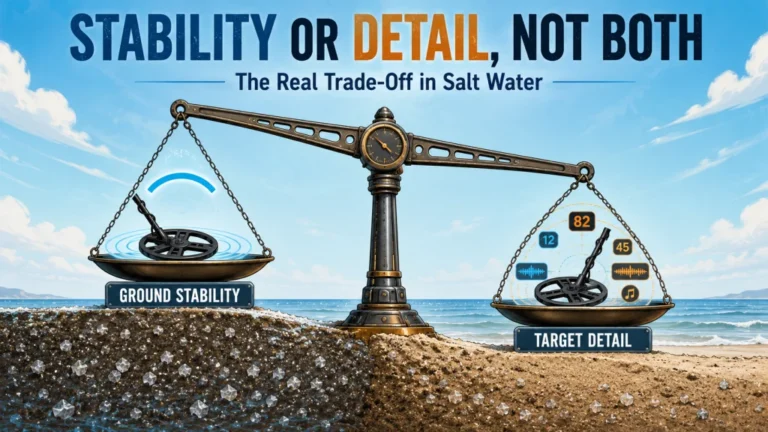
None of these criteria works alone. A highly adjustable detector that is tiring to swing may be a poor match for a long dry-sand hunt. A fully submersible machine with limited target information may work in clean swimming water but create too many uncertain digs in a foil-heavy park. The correct trade-off begins with the site class.

Fisher F22 combines a lightweight weatherproof design with a 9-inch waterproof concentric coil. Its Target ID uses a 1 to 99 numeric display for identifying detected targets. Four-tone audio provides another way to interpret target responses while hunting.
Check On AmazonIf you click this link and buy, we earn a commission at no additional cost to you.
Target ID Cannot Certify a Gold Ring
Universal Target ID charts are one of the easiest ways to make a jewelry buying decision look simpler than it is. A number has meaning only on the exact detector, scale, mode, coil, software version, and test target involved. Even then, depth, orientation, nearby objects, ground, and sweep quality can move or spread the response.
A wide ring, a thin ring, a stud earring, a clasp, and a fine chain should not be expected to share one number. Karat alone does not solve the problem because alloy composition, mass, geometry, and construction all influence the electromagnetic response. Two pieces marked with the same karat can behave differently when their shape and weight are different.
Warning: Rejecting every number associated with foil or pull tabs can reject jewelry that responds in the same region. A quiet detector is not automatically a productive jewelry detector.
I treat target ID as one clue beside audio, repeatability, signal width, directional consistency, depth indication, and the trash pattern at that site. The guide to understanding discrimination and Target ID explains why the screen reports a processed estimate rather than a confirmed object identity. When it is time to build a site-specific accept and reject pattern, use setting discrimination without erasing useful targets.
Three Detector Classes Cover Three Materially Different Uses
There is no responsible universal winner because the hardware and signal-processing problem changes by environment. I would narrow the purchase to one of three classes, then compare controls, ergonomics, coils, and evidence within that class.
Inland Value Class
This class fits parks, fields, dry sand, school grounds where permitted, fairgrounds, and other non-submerged recreational sites. It should provide a stable nonferrous response, enough audio information to distinguish clean repetition from broken or mixed signals, adjustable discrimination, and recovery behavior suitable for trash.
Full-system submersion is not essential when the operator stays on land and protects the control unit. That can preserve budget for a useful coil choice, comfortable headphones, or a lighter complete setup. The main limitation is obvious: a land-oriented or coil-only-waterproof detector should not be treated as surf or shallow-water equipment.
Saltwater-Capable Class
This class is for wet salt, the surf edge, and hunters who move repeatedly between dry and wet beach zones. It needs a genuine salt-capable operating method, stable ground handling, useful low-conductor response, and enough discrimination or audio control to work through common beach trash.
A saltwater-capable detector does not have to be the most expensive machine available. It does need evidence that the intended mode remains interpretable in conductive sand. The main limitation is that “works at the beach” may describe dry sand only, so the manual and field evidence must identify the wet-salt zone specifically.
Fully Submersible Shallow-Water Class
This class is for freshwater swimming areas, wading zones, and shallow water where the control unit may go below the surface. The complete detection system must be appropriate for the intended depth. That includes how audio reaches the operator when ordinary wireless transmission is unavailable underwater.
Waterproof depth alone does not guarantee good jewelry performance. The detector still needs suitable audio, manageable controls, stable operation, and a coil that can be moved against water resistance. The main limitation is that added sealing or underwater capability may cost more or add complexity that a land-only hunter never uses.
| Detector class | Best fit | Priority features | Reason to exclude it |
|---|---|---|---|
| Inland value | Parks, fields, dry sand, non-submerged sites | Audio, separation, discrimination, useful coils, low fatigue | You intend to enter wet salt, surf, or submerge the control unit |
| Saltwater-capable | Wet salt, surf edge, mixed beach zones | Salt stability, beach mode, ground handling, target information | You only hunt inland and would pay for capability you do not use |
| Fully submersible shallow-water | Freshwater swimming areas and planned wading | Complete water rating, underwater audio, balance, sealed controls | The rating does not include every component or the system performs poorly at your site |
These categories can overlap, but the buying reason should remain clear. A machine belongs on the shortlist because it solves the site problem, not because its highest-priced configuration appears at the top of a comparison page.

Nokta The Legend uses simultaneous multi-frequency technology for different targets and ground conditions. Its IP68-rated detector is fully submersible to 10 feet. The package includes a waterproof 12 by 9 inch DD search coil and a headphones adapter.
Check On AmazonIf you click this link and buy, we earn a commission at no additional cost to you.
Read Waterproof Claims Component by Component
Water language is often compressed into one word even when the system contains several separately rated parts. A waterproof coil, a weather-resistant control unit, water-resistant wireless headphones, and a submersible detector are four different arrangements. Check the manual rather than inferring protection from photos of a machine near water.
Write down the claimed depth, whether that depth applies to the complete detector, how long immersion is permitted, which connectors must be capped, and which headphones are required underwater. Also check rinsing and maintenance instructions after salt exposure. A water rating protects equipment only within the conditions stated by the manufacturer.
- Confirm the control unit rating, not only the coil rating.
- Confirm the compatible headphone or audio method for underwater use.
- Check battery and charging-port closure requirements.
- Check connector seals, caps, and inspection instructions.
- Compare the rated depth with the deepest water you will actually enter.
- Verify whether saltwater use requires rinsing or additional care.
For a full component-by-component check, use the waterproof metal detector rating guide. Buyers planning regular submerged searches should also compare the narrower requirements in choosing a detector for underwater use.

Minelab X-Terra Elite uses Multi-IQ multi-frequency technology and provides Park, Field and Beach search modes. The detector is IP68 waterproof to 5 meters. This package includes two waterproof search coils and ML-85 wireless headphones.
Check On AmazonIf you click this link and buy, we earn a commission at no additional cost to you.
Use a Controlled Test Before Trusting a Candidate
A clean air test with one large ring can show that the detector responds, but it cannot show how well the setup handles a real jewelry site. The test needs enough target variety to expose the trade-off between gold coverage and trash rejection.
Use known objects and record the detector, coil, mode, sensitivity, discrimination pattern, recovery setting, ground condition, target orientation, and approximate depth. Without those details, a Target ID number or audio description cannot be compared fairly with another test.
| Test group | Include | What the test reveals |
|---|---|---|
| Gold jewelry | Several ring sizes and karats, a small earring, a pendant, and a thin chain | How target mass, shape, and construction change response |
| Aluminum trash | Foil pieces, complete and broken pull tabs, can slaw, and screw caps | How much desirable response space overlaps common trash |
| Other site targets | Coins, bottle caps, hairpins, iron nails, and common local debris | Whether audio and separation remain useful in the real target mix |
| Orientation | Flat, edge-on, tilted, open clasp, folded chain, and targets beside trash | Whether the response stays repeatable when geometry changes |
| Ground and depth | Surface, shallow, deeper, dry soil, mineralized soil, dry sand, and wet salt when applicable | How quickly identification and audio degrade outside ideal conditions |
Do not use the test to invent a promise that every matching signal is gold. Use it to learn which pieces are lost by the default pattern, how much uncertainty remains, and whether the detector communicates that uncertainty in a way you can hunt with for several hours.
Scott’s Field Judgment: Evidence Before Ranking
I would not place a detector in a jewelry category from a specification sheet alone. The evidence needs to show the exact mode, coil, target, ground or beach zone, and water condition that support the conclusion. A polished demonstration over one large ring on clean ground is not enough evidence for a trashy park, wet salt, or submerged swimming area.
Field Note: The jewelry I have recovered reinforced a simple rule: the detector reports response behavior, not the name of the object. A stable, repeatable signal is a reason to investigate. It is not proof that the target is gold.
For every candidate, I would record four judgments:
- Evidence status: manufacturer specification only, controlled independent test, repeated community pattern, or documented field use in the intended environment.
- Where I would use it: inland trash, dry sand, wet salt, surf edge, freshwater wading, or full shallow-water submersion.
- Main limitation: target overlap, weak chain response, limited separation, unstable salt behavior, incomplete waterproofing, tiring balance, or excessive complexity.
- Why alternatives are excluded: they solve a different environment, omit a required component rating, or add cost without improving the buyer’s actual hunt.
This approach prevents a familiar mistake: turning a premium price, a large Target ID scale, or a deep-water photo into evidence that the detector is the best fit everywhere. Recommendation categories are useful only when the use cases are materially different.
A Practical Buying Decision in Five Moves
The final decision should be simple enough to explain without repeating the entire feature list. Start with the site, identify the non-negotiable capability, then test whether the remaining controls help with jewelry rather than merely making the machine look advanced.
- Name the primary site: park or field, dry sand, wet salt, surf, freshwater swimming area, or submerged shallow water.
- Set the water boundary: coil only, splash exposure, control-unit immersion, or full planned submersion.
- Protect jewelry response: avoid a default rejection pattern that removes broad foil and tab regions without controlled testing.
- Check the target mix: favor separation and informative audio when trash is dense; favor salt stability and water hardware when the environment demands them.
- Run the controlled test: use multiple jewelry pieces, aluminum trash, orientations, depths, and documented ground before accepting a recommendation.
If two detector classes both satisfy the site, choose the one you can operate comfortably and interpret consistently. Extra capability is worthwhile when it removes a real limit. It is not worthwhile merely because the specification exists.
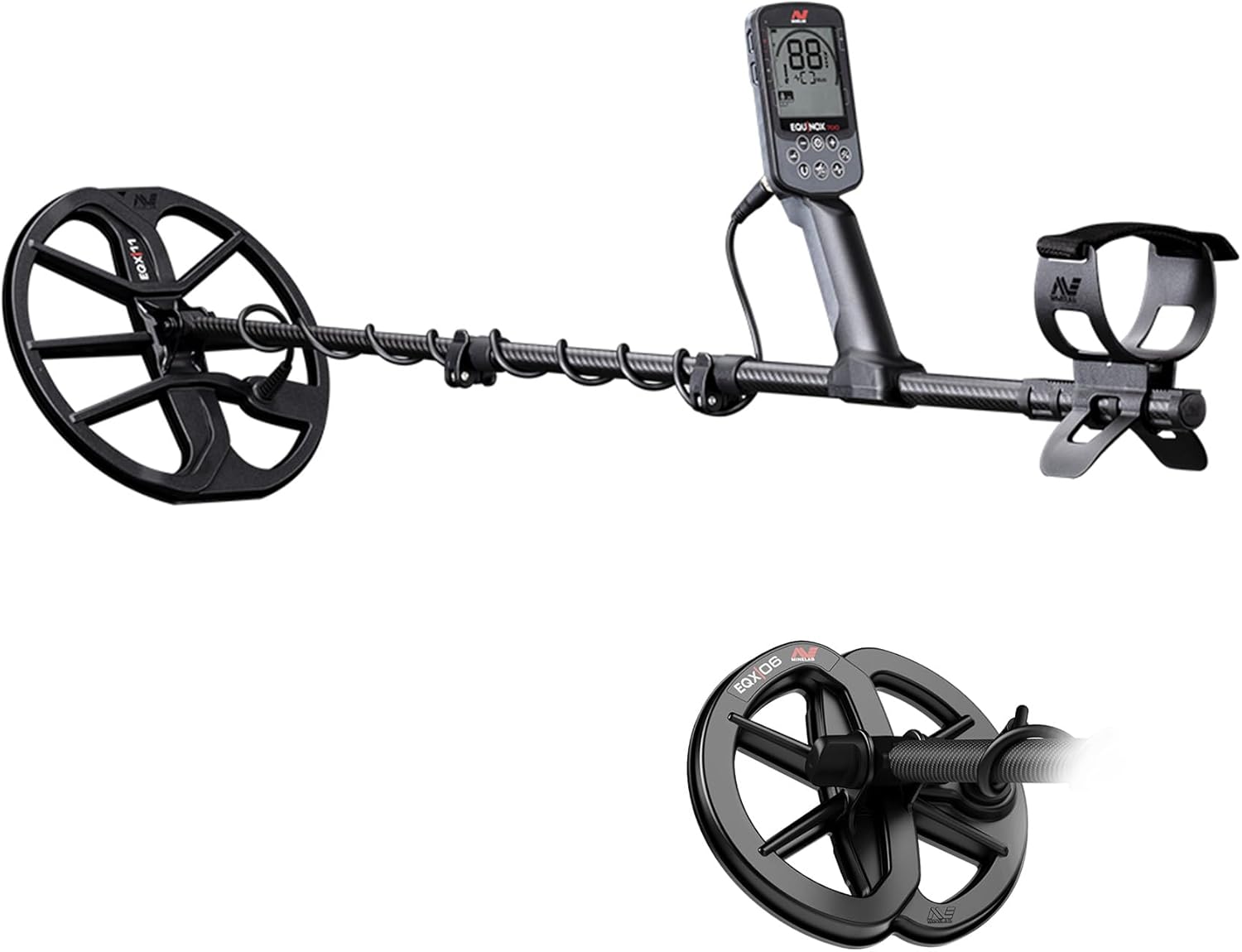
Minelab Equinox 900 provides Park, Field, Beach and Gold detection modes for different hunting conditions. It is fully waterproof and submersible to 16 feet. The detector uses a 119-level Target ID system and weighs 2.8 pounds with its lightweight carbon-fiber shaft design.
Check On AmazonIf you click this link and buy, we earn a commission at no additional cost to you.
Final Thoughts: Buy for the Ground, Trash, and Water
The best detector for gold rings is the one that remains understandable where those rings are likely to be lost. In a trashy park, that usually means useful audio, separation, adjustable rejection, and manageable weight. In wet salt, stable beach operation becomes essential. In shallow water, the entire system has to survive the depth you intend to use.
No detector can make gold stop overlapping foil and pull tabs. A well-matched machine gives you better evidence and more control over the trade-off, but the operator still decides which uncertain targets are worth recovering. Choose the site class first, verify every water claim, and test with real jewelry and real trash before trusting a chart.
FAQs
💍 Can a metal detector tell if a target is a gold ring?
No. It can report conductivity-related Target ID, audio, depth estimation, and response behavior, but foil, tabs, and other aluminum can overlap gold jewelry. Use several clues and expect some uncertain digs.
🧻 Should I reject foil signals when searching for gold jewelry?
Not automatically. Small or thin gold jewelry can respond in regions associated with foil. Test your own targets on the exact detector before rejecting that range.
🏖️ Will an inland detector work on a beach?
It may work well on dry sand, but wet salt is a different ground condition. Confirm that the detector has a suitable saltwater operating method before planning to search the wet line or surf.
🌊 Does a waterproof coil make the whole detector submersible?
No. Check the control unit, connectors, battery or charging port, headphones, and stated depth limit. Each component must support the way you plan to use the system.
⛓️ Why are thin gold chains difficult to detect?
A fine chain may behave like many small links rather than one solid target, and the clasp may produce the strongest response. Test the complete chain in several orientations instead of assuming a ring test represents it.
🎛️ Is maximum sensitivity best for finding gold jewelry?
No. Excessive sensitivity can create unstable audio and false responses that hide useful signals. Use the highest setting that remains interpretable in the current ground and interference.
🪙 Do all gold rings have the same Target ID?
No. Size, alloy, shape, orientation, depth, nearby metal, ground, mode, and detector scale all affect the reading. Any published number must identify the exact machine and test conditions.
Sources and References
- Garrett Metal Detectors, target identification and discrimination manual: supports the documented overlap between gold jewelry of different sizes and aluminum targets on detector identification scales.
- Minelab, guide to discrimination and Target ID: supports the use of Target ID as a decision aid and the overlap between small gold and common trash regions.
- Minelab, metal detecting technical FAQs: supports the principle that target identification changes with target size and conductivity and should not be treated as one universal gold number.
- International Electrotechnical Commission, IEC 60529 IP Code: defines the enclosure-protection classification underlying IP water and dust ratings.
- Nokta Detectors, official manuals library: provides model-specific documentation for modes, discrimination, ground controls, component specifications, and water ratings that must be checked before use.