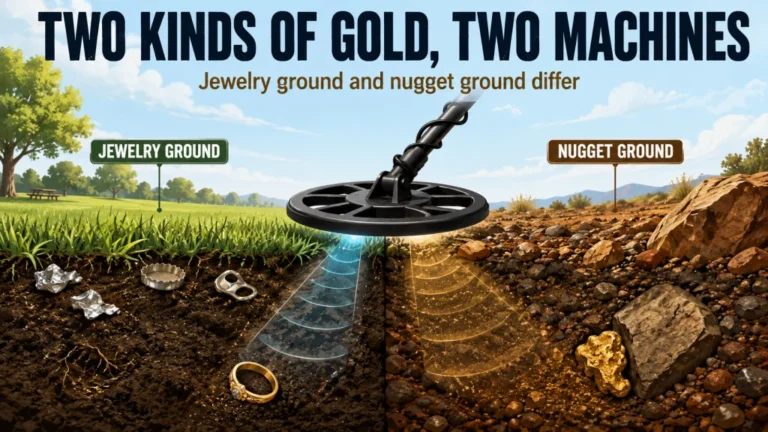
The best metal detectors for gold in mineralized soil are not one universal group because magnetic ground, conductive salt, hot rocks, rapid ground changes, and electromagnetic interference create different problems. Diagnose which condition is masking the target before choosing between a gold-focused pulse induction machine, a newer specialized system, or a capable non-PI detector for moderate ground. Compare stable small-target response, ground handling, target information, weight, controls, coil support, power needs, service, and the amount of trash you will have to dig. The right purchase is the least burdensome detector class that can keep a worthwhile gold signal audible in the ground you will actually hunt.
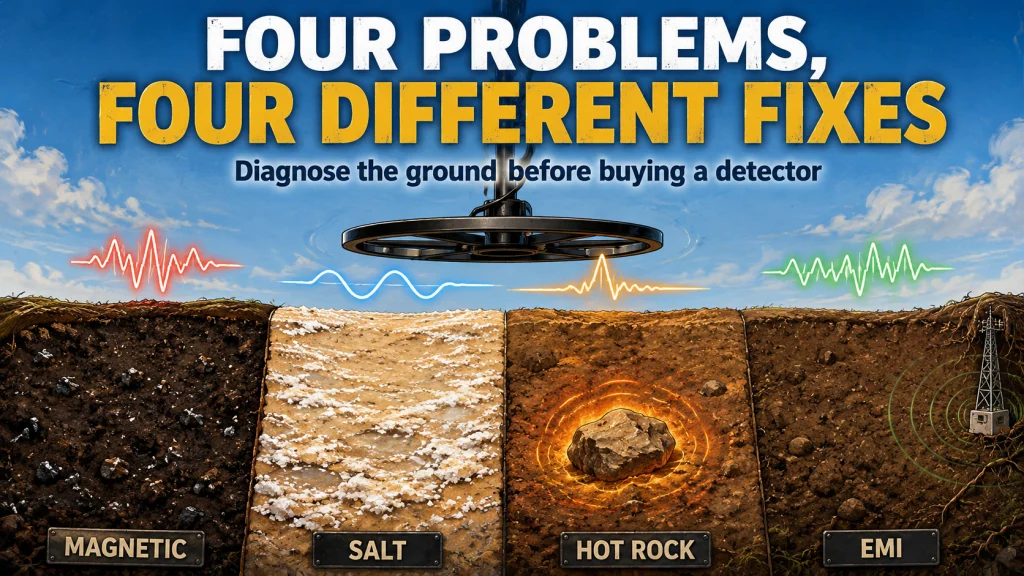
Mineralized Ground Describes Several Different Problems
The phrase best metal detectors for gold in mineralized soil sounds as though one technology should solve every difficult goldfield. It does not. Iron-rich ground produces a strong magnetic response, dissolved salts create a conductive response, hot rocks differ from the surrounding balance point, rapidly changing soil forces the detector to keep readjusting, and electromagnetic interference may create noise without coming from the ground at all.
I have hunted mineralized soil that cut usable depth and made a stable setup chatter across different patches. Not every unstable signal proves the detector lacks power. The cause may be real ground variation, excessive sensitivity, poor balance, or a nearby electrical source.
This article covers the buying decision for difficult US gold ground. It does not rank brands, promise a universal depth, or claim any detector is immune to mineralization, salt, hot rocks, or interference. For the broader decision before difficult ground becomes the main issue, start with choosing a gold detector by hunt conditions.
Diagnose the Ground Before Selecting the Technology
Before replacing a detector, prove what is causing the instability. Move away from power lines, vehicles, generators, fences, phone towers, and other active detectors. Run the detector’s noise-cancel procedure if it has one, then test again with the coil held still and with the coil moving over clean ground. EMI often continues when the coil is raised away from the soil, while a ground response usually changes as the coil approaches or leaves the surface.
Next, ground balance over a clean patch. Sharp changes within a few steps suggest variable ground rather than uniform severity. Individual rocks that signal over manageable soil point to hot rocks, while noise that rises after rain may indicate dissolved salt adding a conductive response.
- Noise follows the location but not the soil: suspect EMI before buying a different ground technology.
- Noise rises as the coil approaches clean soil: check ground balance and magnetic or conductive mineralization.
- Only certain rocks respond: test those rocks separately as hot-rock candidates.
- The balance changes every few yards: prioritize tracking, quick rebalancing, and a stable threshold.
- Wet salty ground changes the response: require an explicit conductive-ground solution, not a generic mineralized-soil claim.
The technical foundation matters here. The explanation of how ground balance separates soil response helps determine whether a setting problem can be corrected before a purchase becomes necessary.
Magnetic Iron-Rich Ground Can Hide Small Gold in the Background
Red clay, black sand, ironstone-rich washes, and decomposed mineralized rock can produce a magnetic response strong enough to compete with a small target. The detector must separate a weak target signal from a much larger ground signal while the coil is moving. When it cannot, the result may be threshold wavering, false responses, reduced depth, unstable identification, or a need to lower sensitivity until small gold becomes harder to hear.
For severe magnetic ground, the buying priority is not the loudest air-test response. It is the smallest target that remains recognizable after the detector has been balanced and adjusted to a stable field setting. A machine that screams on a test nugget above the ground but loses it once mineralized soil enters the detection field has not solved the real problem.
Field Note: The usable signal is always relative to the background. I would rather hear a modest, repeatable target response over stable ground than a dramatic target response buried under constant false signals.
Small coils reduce the volume of reactive soil under the coil and improve control, but cover less area and may lose response on larger, deeper targets. That trade-off prevents one coil size from being universally best.

Minelab GPX 6000 uses GeoSense-PI technology to analyze gold signals while managing competing responses. Its automatic ground balance continuously adapts as soil conditions change. This package includes an 11-inch monoloop coil and a 14-inch Double-D coil.
Check On AmazonIf you click this link and buy, we earn a commission at no additional cost to you.
Conductive Salt Is Not the Same as Magnetic Mineralization
Salt becomes a detector problem when moisture allows it to behave as a conductive ground signal. Dry alkali soil may seem manageable until rain dissolves the salts, or a low area may become noisy while nearby higher ground stays stable. The response can resemble a broad target, produce false signals at changes in coil height, and force settings that reduce sensitivity to small low-conductive gold.
A detector for this condition needs an explicit conductive-ground or salt-handling method. That may involve a dedicated mode, a suitable pulse timing, a different coil configuration, reduced transmit behavior, or processing designed to separate salt response from target response. Do not assume that a machine advertised for iron-rich mineralization will automatically handle conductive salt equally well.
Ask what changes when salt mode is selected and what sensitivity cost follows. If the manual cannot explain whether the adjustment affects pulse timing, transmit power, ground balance range, or coil requirements, the word “salt” is not enough.

Garrett Axiom uses advanced pulse technology for detecting gold in difficult soil conditions. Its Terra-Scan dual-channel ground balance covers mineralized magnetic ground and saltwater. Four pulse settings are provided for targets ranging from larger nuggets to sub-gram gold.
Check On AmazonIf you click this link and buy, we earn a commission at no additional cost to you.
What a Detector for Hot Ground Must Prove
A hot rock is troublesome because its response falls outside the balance established for the surrounding soil. Some produce a positive target-like signal, while others create a negative or null response. One site may contain a consistent hot-rock type that becomes recognizable; another may contain several rock types that respond differently and cannot be removed with one adjustment.
No detector should be purchased on the promise that it eliminates every hot rock. Strong or unusual rocks can overwhelm ground handling, and tuning them out can also reduce response to gold that behaves similarly. The real question is whether the detector makes the common local rocks recognizable without requiring so much sensitivity loss that the target sizes you care about disappear.
Bring representative rocks to a controlled test when possible. Balance to the soil, then test each rock alone, beside a small target, and over it. If the adjacent target disappears, understand that masking before buying.
Rapidly Changing Ground Rewards Tracking and Simple Corrections
Some locations are not uniformly severe. A wash may alternate between mild sand, iron-rich streaks, clay pockets, and weathered bedrock within a short distance. A detector that runs well after one careful balance may become noisy a few yards later because the balance point has changed, not because the target environment suddenly became deeper or more productive.
For variable ground, compare how quickly the detector can update without erasing weak targets. Automatic tracking may reduce workload, but aggressive tracking can follow a faint target if the coil is repeatedly pumped or swept over it. Manual or quick-balance controls preserve more operator control, but they demand attention and repeated adjustment.
The buying decision depends on your tolerance for controls. A machine with excellent manual capability may be the wrong choice if constant tuning interrupts your coverage. A simpler system that stays acceptably stable may produce more useful hunting time, even if it offers fewer expert adjustments.
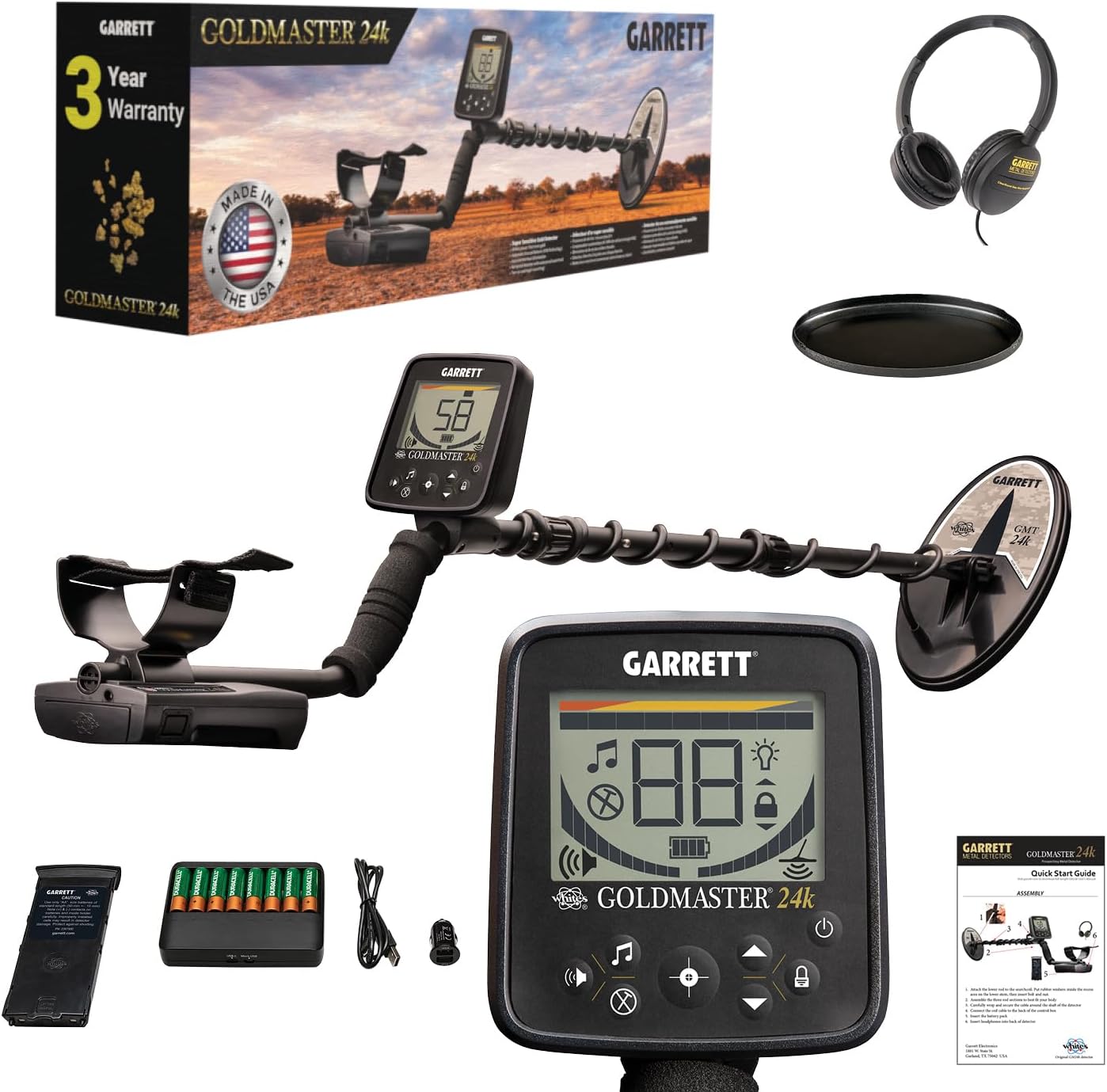
Garrett Goldmaster 24K operates at 48 kHz for sensitivity to small gold nuggets. Its XGB Ground Balance system provides automatic tracking across changing soil conditions. The system is designed to reduce ground noise while maintaining stable prospecting performance.
Check On AmazonIf you click this link and buy, we earn a commission at no additional cost to you.
Do Not Buy a Ground Solution for an EMI Problem
Electromagnetic interference can come from power infrastructure, wireless equipment, vehicles, electric fences, nearby detectors, or electronics carried by the operator. It may sound like random chatter, rhythmic pulsing, or a threshold that refuses to settle. Because it can appear at the same time as mineralized ground, it is easy to blame the soil and buy a more expensive detector that still reacts to the same interference.
Test EMI with the coil raised and stationary, then move to another location before changing the ground balance. Compare noise-cancel channels, operating frequencies, coil sizes, and the machine’s ability to hold a usable threshold at a realistic sensitivity. A smaller coil may reduce EMI exposure, while a different frequency or dedicated cancel process may solve the problem without changing detector technology.
Warning: Stability created by reducing sensitivity is not free. If the setting required to quiet EMI also removes the target size you want, the location, coil, or noise-handling system still needs attention.
When EMI dominates, moving farther from the source may outperform any menu adjustment. Test that possibility before paying for severe-ground capability you do not need.

Minelab Gold Monster 1000 uses a 45 kHz VLF system with a 24-bit signal processor for gold detection. It provides automatic noise canceling to manage unwanted electrical noise. Ground balance and sensitivity adjustment are also handled automatically.
Check On AmazonIf you click this link and buy, we earn a commission at no additional cost to you.
Three Detector Classes Fit Different Levels of Difficult Ground
The right class depends on how much ground response must be suppressed and how much target information you are willing to give up. There is no clean ladder where the most expensive technology wins every site. Severe ground may justify specialist hardware, while moderate ground may reward a lighter machine with better target information and less digging.
Gold-Focused Pulse Induction Specialists
A pulse induction gold detector transmits short pulses, waits for the transmitted field to decay, and measures the returning response during selected timing windows. Ground and targets decay differently enough that the detector can often work through a wider range of mineralized responses than a conventional VLF setup. It does not ignore the ground. Pulse timing, ground balance, coil type, and soil condition still determine what remains audible.
This class is strongest when severe magnetic ground is masking worthwhile targets and a less specialized detector must be detuned too far to stay stable. The trade-offs can include less reliable target classification, more iron and hot-rock digging, higher cost, greater power demand, extra coil expense, and more physical burden. Some systems also need a harness or support arrangement for long sessions.
Newer Specialized or Hybrid Systems
Specialized systems may combine multiple frequencies, advanced ground processing, pulse-based soil handling, or other methods intended to preserve small-target sensitivity while improving stability. Their appeal is a middle path: more information and easier controls than a traditional specialist PI, with better difficult-ground behavior than a general-purpose machine.
The risk is assuming a newer label proves equal performance in every severe condition. Ask for evidence in magnetic ground, conductive salt, hot rocks, and rapidly changing soil separately. A system can be excellent on fine gold in moderate iron mineralization and still require compromises in wet salt or extreme hot-rock fields.
Capable Non-PI Machines for Moderate Conditions
A gold-focused VLF or simultaneous multi-frequency detector can be the better purchase when mineralization is moderate, small shallow gold is the priority, and useful target information reduces unnecessary digging. These machines are often lighter, less expensive, easier to learn, and better at providing some ferrous or visual information than specialist PI systems.
The limit appears when the ground signal forces sensitivity down, destabilizes identification, or overwhelms small-target response. Do not buy this class because an air test looks sharper. Buy it when a controlled ground test shows that the machine remains stable enough to hear the target sizes you expect in the actual soil.

Nokta The Legend uses simultaneous multi-frequency technology for different targets and ground conditions. It includes Park, Field, Beach and Gold Field search modes. Automatic, manual and tracking ground balance provide several ways to adapt the detector as ground conditions change.
Check On AmazonIf you click this link and buy, we earn a commission at no additional cost to you.
Compare the Whole Field Burden, Not One Performance Claim
Difficult-ground buyers often focus on depth and forget the hours spent carrying, balancing, listening, and digging. A detector that reaches farther but supplies little target information may increase the number of holes dramatically. A lighter machine may lose capability in extreme ground but allow steadier coil control and longer coverage in moderate conditions.
| Decision factor | What to verify before buying |
|---|---|
| Small-target response | The smallest relevant target that remains repeatable in the actual ground, not in air alone |
| Ground handling | Performance in magnetic soil, conductive salt, hot rocks, and variable ground as separate tests |
| Target information | Whether audio, visual ID, or iron information remains useful after ground correction |
| Iron handling | How large or irregular iron responds and how much desirable target response may be lost |
| Weight and balance | Whether the complete setup can be controlled for the length of a normal hunt |
| Price | Total cost with the coils, batteries, chargers, headphones, and support equipment actually needed |
| Power | Realistic field runtime and whether spare batteries are practical for remote trips |
| Harness needs | Whether extra support is optional comfort or necessary for safe, level coil control |
| Controls | How quickly ground, salt, EMI, sensitivity, and threshold changes can be corrected |
| Coil system | Availability of small, large, mono, or double-D options that address your ground problem |
| Service | Warranty process, repair access, parts support, and realistic turnaround for the United States |
| Digging burden | How much target information is lost and how many uncertain signals must be recovered |
The general metal detector buying framework helps with budget, fit, and ownership questions. For this decision, add one harder requirement: the machine must prove that it can preserve a target response after the local ground has been allowed into the test.
Demand Controlled, Ground-Specific Evidence
Marketing depth numbers are weak evidence unless the soil, target size, target material, target orientation, coil, settings, and stability standard are stated. Gold response changes with mass, shape, purity, host rock, and orientation. Ground response changes with iron minerals, salt, moisture, and the amount of soil under the coil. A test that omits those conditions cannot predict your field result.
Use the same local soil and representative targets for every candidate. Run each detector at the highest setting that remains stable enough to identify a faint repeatable response, not at the maximum number on the menu. Keep coil size and target placement reasonably comparable, then record both target response and false-signal burden.
- Test away from known EMI before judging ground handling.
- Balance each detector according to its intended procedure.
- Use small natural gold or a representative low-conductive target only when its composition is known.
- Test the target on the surface, shallow in the soil, and beneath representative hot rocks when relevant.
- Repeat from more than one sweep direction and at a controlled coil height.
- Record the stable setting, target clarity, ground noise, hot-rock response, and time needed to retune.
- Compare the number of uncertain signals you would realistically have to dig.
Air tests still have value for checking basic sensitivity and comparing coils, but they do not answer the buying question in difficult ground. The guide to conditions that control detection depth explains why a single depth figure cannot be separated from soil, target, coil, and settings.
Scott’s Field Judgment: Separate Experience from Research
My direct field experience supports the diagnosis order in this guide: prove whether the noise follows the ground, check balance before adding rejection or reducing sensitivity, and judge usable depth by the target response that survives real soil. I have seen promising signals disappear when a machine was forced quiet instead of properly balanced. That experience supports the process, not a claim that I have conducted side-by-side goldfield trials of every current detector class.
The technology comparison here is research-based. Manufacturer documentation supports the differences among magnetic mineralization, conductive salt, tracking ground balance, EMI cancellation, pulse timing, and coil behavior. Prospecting community evidence supports the recurring trade-offs around hot rocks, unstable thresholds, small-target loss, and the digging burden created by limited target information.
Trust boundary: No detector is being presented as immune to difficult ground, and no clean test response is being treated as a guaranteed gold recovery. The recommendation changes with the exact ground problem, target size, operator tolerance, and evidence available from the site.
That boundary is important in a buying guide. It is more useful to state what remains uncertain than to turn one successful test into a universal ranking.
Recommendation Groups by the Exact Ground Problem
Use the ground problem as the first filter and ownership burden as the second. The goal is not to purchase the most specialized technology available. It is to stop the ground from masking a target without accepting more cost, weight, controls, and digging than the site requires.
| Primary condition | Start with this detector class | Confirm before buying |
|---|---|---|
| Severe magnetic iron-rich ground | Gold-focused PI specialist or proven specialized ground-handling system | Small-target response at a stable field setting and acceptable iron digging burden |
| Conductive salt in gold country | System with an explicit conductive-ground mode, suitable timing, or compatible coil solution | What sensitivity is lost when salt response is reduced |
| Dense hot rocks | Detector with flexible ground controls and a demonstrated local hot-rock response | Whether tuning the rocks out also removes representative gold targets |
| Rapidly changing ground | Stable tracking or fast manual rebalancing with clear threshold behavior | Whether tracking follows weak targets and how often manual correction is required |
| Moderate mineralization with shallow small gold | Capable gold-focused non-PI or specialized multi-frequency system | Stable response in soil, useful target information, and manageable learning curve |
| EMI with otherwise manageable soil | Keep the current technology class until noise handling, coil choice, and location changes are tested | Whether instability remains after moving and running noise cancel |
Once the ground class is clear, narrow the target question. The guide to matching a detector to gold nugget size helps separate fine shallow targets from larger, deeper targets. For a deeper technical explanation of specialist machines, read how pulse induction responds after each pulse.

Garrett AT Gold operates at 18 kHz for detecting small gold nuggets and other targets. Its True All Metal mode is intended for prospecting and maximum sensitivity. Ground Balance Window provides both manual and automatic ground balance for varying soil conditions.
Check On AmazonIf you click this link and buy, we earn a commission at no additional cost to you.
Final Thoughts: Buy for the Signal the Ground Is Hiding
Difficult gold ground changes the buying decision only after it has been diagnosed correctly. Magnetic mineralization, conductive salt, hot rocks, rapid variation, and EMI may all sound unstable, but they do not demand the same technology. Prove the source of the noise, identify the target sizes that matter, and compare detectors at stable settings in representative soil.
A specialist PI may be worth its cost and digging burden when severe ground is masking useful targets. A newer specialized system may offer a better balance of sensitivity and information. A capable non-PI detector may be the smartest choice when conditions are moderate and portability matters. Choose the least burdensome class that keeps the target audible after the ground joins the test.
FAQs
These questions focus on the buying decisions that commonly become confused once a detector starts sounding unstable in gold country.
⛏️ Is pulse induction always best for mineralized gold ground?
No. PI becomes compelling when severe ground masks targets or forces another detector to run too weakly. In moderate ground, a lighter non-PI machine may preserve more target information and small-gold sensitivity with less cost and digging.
🧲 Can a detector eliminate every hot rock?
No. Some hot rocks remain outside the detector’s usable balance range, and tuning them out may also reduce response to certain gold targets. Test the local rocks with representative targets before accepting any immunity claim.
📡 How can I tell EMI from mineralized ground?
Raise the coil away from the soil, hold it still, run noise cancel, and move away from electrical sources. Noise that remains away from the ground is more likely to be EMI, while a ground response usually changes with coil height and location.
🧂 Are salty ground and black sand the same problem?
No. Wet salt creates a conductive response, while iron-rich black sand is primarily a magnetic mineralization problem. A detector or coil may handle one better than the other.
🎛️ Do I need manual ground balance?
Manual control is useful when you need to verify or fine-tune the balance, but it also adds workload. Stable automatic or tracking balance may be better when the ground changes rapidly and the operator wants fewer interruptions.
🔍 Should I choose a gold detector by claimed depth?
No. A depth claim matters only with stated soil, target, coil, orientation, settings, and stability conditions. Compare the weakest repeatable response that survives your ground instead.
⚖️ When is a non-PI detector still the better choice?
It can be better in moderate mineralization when shallow small gold, low weight, useful target information, and easier operation matter more than maximum severe-ground handling. Confirm the choice with a local soil test.
The common thread is diagnosis. Do not replace the detector until the test shows which response the current setup cannot manage.
Sources and References
- Minelab, Detecting in Mineralized Soils: distinctions between iron-rich mineralization, salt-based ground response, ground balance, coil choice, instability, and reduced target response.
- Minelab, Frequently Asked Questions: practical troubleshooting for mineralization, electromagnetic interference, noise cancel, sensitivity, and changing ground.
- Minelab, Gold Depth Is Relative to Ground Noise: explanation of target response relative to background ground signal and why depth cannot be separated from soil conditions.
- Detector Prospector, Hot Rocks Discussion: community explanation of hot and cold rocks as responses outside the current ground balance point, plus masking and field trade-offs.
- Detector Prospector, Pulse Timing and Ground Response Discussion: technical community discussion of pulse transmission, receive timing, iron-rich ground, salt, EMI, and energy trade-offs.
These sources support the technical distinctions used in the decision framework. They do not establish a universal product ranking or guaranteed field result.